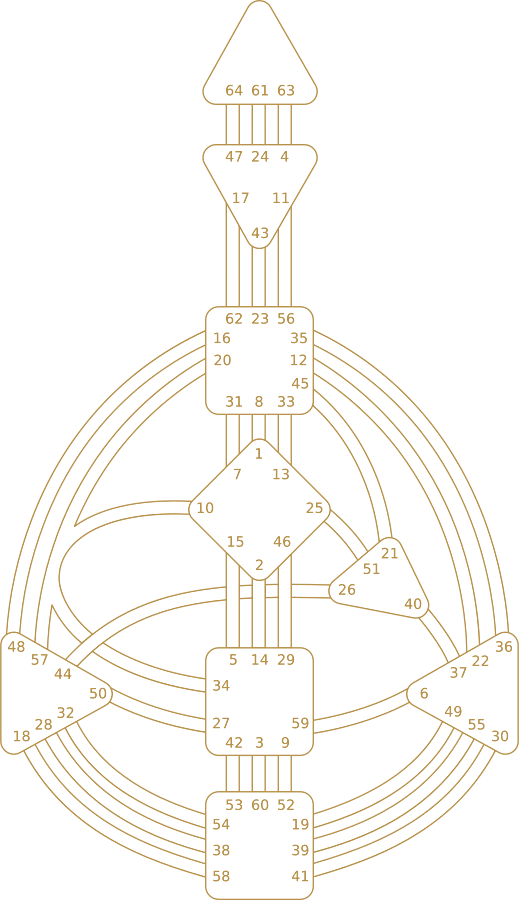

Line 6 in Human Design: The Role Model
Line 6 in Human Design is the Role Model, the top line of every hexagram. Its theme is a life lived in three distinct phases: trial and error until around thirty, a step back to observe until around fifty, then a return as an example of what the first two phases taught. It sits in the 6/2, 6/3, 3/6 and 4/6 Profiles.
Simple way to think about it: The sixth line is the person who climbs the hill, sits at the top for a long while watching the valley, and comes back down knowing which paths actually lead somewhere. Nobody can skip the climb or the sitting; the view is what they bring home.
Find your lines on your free chart
Enter your birth date, time and place to see your Profile and every line in your chart.
Your Profile is two lines: the first number is the line of your Personality Sun, the second the line of your Design Sun. Every planet in your chart also carries a line, written after the dot: 10.6 means Gate 10, Line 6. The chart symbols guide shows where to read them.
Line 6 as your first number
With Line 6 first, it is your Personality Sun line: the part of the Profile you know and experience as yourself. 16.81% of charts have it here, in the 6/2 and 6/3 Profiles.
As the first number, the sixth line is the part of yourself you recognize. You can often feel which phase you are in while it is happening, which gives you a choice about how to use it: treat the first phase's mistakes as material, and treat the quiet of the second phase as watching on purpose rather than hiding.
The risk on this side is being too aware of how far away the third phase still is. A first phase that was never processed can harden into a running commentary that nothing works. The way out is to turn what happened into judgment you can use, which is exactly what the second phase is for.
Line 6 as your second number
With Line 6 second, it is your Design Sun line: it runs below awareness, and other people often meet it before you do. 16.53% of charts have it here, in the 3/6 and 4/6 Profiles.
As the second number, the sixth line runs below awareness. The phases still arrive, but you may only see them in hindsight, and the people around you often notice the shift first: someone who used to be in the middle of everything starts standing at the edge of the room and watching.
Because it is unconscious, others tend to experience this line as a kind of calm authority you did not set out to have. With 3/6, it sits under a Martyr line that is already learning by trial and error; with 4/6, under an Opportunist line that works through its network.
The three phases of the sixth line
Ages are approximate. Standard teaching places the changes at around thirty and around fifty. Treat them as a shape, not as birthdays.
The top line of the hexagram
Every Gate is a hexagram of six lines, read from the bottom up, and the sixth is the last. It closes the upper trigram that Line 4 opens and Line 5 carries, so it sees the whole structure below it at once. That is the source of its overview, and of the distance that comes with it.
The Jovian Archive keyword for the line is Transition, and the three phases are that transition made visible in a life: from being in the middle of experience, to watching it, to embodying what it taught.
The sixth line beyond your Profile
Your Profile uses only the two Sun lines, but every planet in your chart sits in a line too. A Moon in 25.6 or a Mars in 44.6 is a sixth line in that Gate, and the Gate's own Line 6 title says how that planet expresses it.
So a chart with no sixth line in its Profile can still carry several Line 6 activations, and a 6/2 may carry few beyond the Sun. The table further down lists the Line 6 title of every Gate, so you can look yours up from the numbers after the dots.
Line 6 and its harmonic line, Line 3
Lines 1 and 4, 2 and 5, and 3 and 6 sit in the same position of the lower and the upper trigram, so they resonate. Line 6 pairs with Line 3, The Martyr, and the Profiles built from the pair, 3/6 and 6/3, are the harmonic ones for this line.
Both lines learn from experience, but at different heights. Line 3 learns in the middle of things by bumping into what does not work; the sixth line goes through its own third-line years in the first phase and then rises above them to look back. In a 3/6 or a 6/3 the two keep each other honest: one keeps testing, the other keeps watching what the tests mean.
Line 6 in every Gate
Each of the 64 Gates has its own Line 6, with a title Ra Uru Hu gave it in the Rave I Ching. Wherever a planet sits in a Line 6, that title colors the Gate. Open the list to find yours.
All 64 Gates in Line 6
| Gate | Line 6 |
|---|---|
| Gate 1 Self-Expression | 1.6 Objectivity |
| Gate 2 The Direction of the Self | 2.6 Fixation |
| Gate 3 Ordering | 3.6 Surrender |
| Gate 4 Formulization | 4.6 Excess |
| Gate 5 Fixed Rhythms | 5.6 Yielding |
| Gate 6 Friction | 6.6 The Peacemaker |
| Gate 7 The Role of the Self in Interaction | 7.6 The Administrator |
| Gate 8 Contribution | 8.6 Communion |
| Gate 9 Focus | 9.6 Gratitude |
| Gate 10 The Behavior of the Self | 10.6 The Role Model |
| Gate 11 Ideas | 11.6 Adaptability |
| Gate 12 Caution | 12.6 Metamorphosis |
| Gate 13 The Listener | 13.6 The Optimist |
| Gate 14 Power Skills | 14.6 Humility |
| Gate 15 Extremes | 15.6 Self-defense |
| Gate 16 Skills | 16.6 Gullibility |
| Gate 17 Opinions | 17.6 The Bodhisattva |
| Gate 18 Correction | 18.6 Buddhahood |
| Gate 19 Wanting | 19.6 The Recluse |
| Gate 20 The Now | 20.6 Wisdom |
| Gate 21 The Hunter/Huntress | 21.6 Chaos |
| Gate 22 Openness | 22.6 Maturity |
| Gate 23 Assimilation | 23.6 Fusion |
| Gate 24 Rationalization | 24.6 The Gift Horse |
| Gate 25 The Spirit of the Self | 25.6 Ignorance |
| Gate 26 The Egoist | 26.6 Authority |
| Gate 27 Caring | 27.6 Wariness |
| Gate 28 The Game Player | 28.6 Blaze of glory |
| Gate 29 Saying Yes | 29.6 Confusion |
| Gate 30 Recognition of Feelings | 30.6 Enforcement |
| Gate 31 Influence | 31.6 Application |
| Gate 32 Continuity | 32.6 Tranquility |
| Gate 33 Privacy | 33.6 Dissociation |
| Gate 34 Power | 34.6 Common sense |
| Gate 35 Change | 35.6 Rectification |
| Gate 36 Crisis | 36.6 Justice |
| Gate 37 Friendship | 37.6 Purpose |
| Gate 38 The Fighter | 38.6 Misunderstanding |
| Gate 39 Provocation | 39.6 The Troubleshooter |
| Gate 40 Aloneness | 40.6 Decapitation |
| Gate 41 Contraction | 41.6 Contagion |
| Gate 42 Growth | 42.6 Nurturing |
| Gate 43 Insight | 43.6 Breakthrough |
| Gate 44 Alertness | 44.6 Aloofness |
| Gate 45 The Gatherer | 45.6 Reconsideration |
| Gate 46 The Determination of the Self | 46.6 Integrity |
| Gate 47 Realization | 47.6 Futility |
| Gate 48 Depth | 48.6 Self-fulfillment |
| Gate 49 Principles | 49.6 Attraction |
| Gate 50 Values | 50.6 Leadership |
| Gate 51 Shock | 51.6 Separation |
| Gate 52 Stillness | 52.6 Peacefulness |
| Gate 53 Beginnings | 53.6 Phasing |
| Gate 54 Ambition | 54.6 Selectivity |
| Gate 55 Spirit | 55.6 Selfishness |
| Gate 56 Stimulation | 56.6 Caution |
| Gate 57 Intuitive Clarity | 57.6 Utilization |
| Gate 58 Vitality | 58.6 Carried away |
| Gate 59 Sexuality | 59.6 The one night stand |
| Gate 60 Acceptance | 60.6 Rigidity |
| Gate 61 Mystery | 61.6 Appeal |
| Gate 62 Details | 62.6 Self-discipline |
| Gate 63 Doubt | 63.6 Nostalgia |
| Gate 64 Confusion | 64.6 Victory |
Living Line 6
At work
In the first phase work is often a series of attempts that teach more than they pay. In the second, you may be drawn to roles that observe, advise or review rather than lead from the front. In the third, people tend to look to you for judgment because you have visibly lived what you are talking about. Each phase works best when you stop measuring it against the one before.
In relationships
The sixth line looks for a partner and friends it can trust, and the first phase is often where it learns, painfully, what trust is not. In the second phase it may seem distant even to people close to it. Telling them plainly that you are taking a step back to understand, not pulling away from them, saves a lot of misunderstanding.
In decisions
The overview of the sixth line can make it feel like you should already know the answer. The phases describe your timing in life, not how to make the choice in front of you.
Make each decision with your Type and your inner Authority, and let the line describe the arc they add up to. Your Strategy and Authority decide; the line describes how you go about it.
When Line 6 is misread
"Role Model means I have to set a perfect example"
"The second phase means I am stuck"
"The phases start on my 30th and 50th birthdays"
The other lines
FAQ: Line 6 in Human Design: The Role Model
What is Line 6 in Human Design?
Line 6 is the Role Model, the top line of every hexagram. Its theme is living in three phases: trial and error until around thirty, observing from a distance until around fifty, then living as an example of what the first two phases taught.
Which Profiles have a sixth line?
Four of the twelve. It is the first number in the 6/2 and 6/3 Profiles, and the second number in the 3/6 and 4/6 Profiles. As the first number you can often feel the phases happen; as the second you may only see them looking back.
What are the three phases of the 6th line?
The first phase, to around thirty, lives like a third line through trial and error. The second, to around fifty, steps back onto the roof to observe and process. The third comes off the roof as the Role Model. The ages are approximate.
Why does a 6th line pull back around thirty?
The second phase begins around the Saturn return. The line steps back to observe what the first phase taught, so visible output is often lower for those years. It is processing, not a loss of direction.
What is the harmonic line of Line 6?
Line 3, the Martyr. Line 6 closes the upper trigram as Line 3 closes the lower, so the two resonate. The 3/6 and 6/3 Profiles are built from that pair.
How common is a sixth line in a Profile?
Jovian Archive's statistics put Line 6 as the first number in 16.81% of charts and as the second number in 16.53%, so about a third of all charts carry a sixth line in their Profile.