
What is Human Design?
Human Design is a self-awareness system that helps you understand how your energy naturally works, how you are designed to make decisions, and how to move through life in a way that feels more aligned and less forced.
If certain routines, advice, or life paths never seem to fit, Human Design gives you a framework for understanding your natural wiring instead of trying to force yourself into someone else's way of living.
On this page: Human Design at a glance, the five Types, what a BodyGraph chart shows, how your chart is calculated, where the system comes from, how it works, why people use it and what it is not.
Simple way to think about it: Human Design shows you your personal map so you can make decisions with more clarity, use your energy more wisely, and stop forcing what was never meant to fit.
Human Design at a glance
- What it is
- A system for understanding how your energy works and how you are built to make decisions, read from a chart of your own birth.
- Where it comes from
- Originated by Ra Uru Hu in 1987, it brings together the I Ching, astrology, the Kabbalah's Tree of Life and the chakra system with ideas from genetics and physics.
- What goes in
- Your birth date, your birth time and the place you were born.
- What comes out
- Your BodyGraph chart: your Type, Strategy, Authority and Profile, your nine Centers, and the Gates and Channels that make your design specific.
- The five Types
- Generator (about 35% of people), Manifesting Generator (35%), Projector (21%), Manifestor (9%) and Reflector (1%).
- How you use it
- Follow your Strategy, make decisions by your Authority, and notice what changes. It is not something to believe; it is something to test.
See your own chart free in about a minute.
The 5 Human Design Types
Everyone falls into one of five energy Types, and some are far more common than others. Your Type is your starting point in Human Design because it explains how your energy is designed to move, respond, and interact with the world.
Generator
About 35% of people
Sustainable life-force energy when engaged in what feels correct. Strategy: wait to respond.
Explore →
Manifesting Generator
About 35% of people
Fast-moving, multi-passion energy. Strategy: respond, then inform before acting.
Explore →
Projector
About 21% of people
Here to guide and direct energy. Strategy: wait for the invitation.
Explore →
Manifestor
About 9% of people
Initiators. Strategy: inform before acting to reduce resistance.
Explore →
Reflector
About 1% of people
Highly sensitive to environments. Strategy: wait a full lunar cycle before major decisions.
Explore →
What matters most next
Your Type is the doorway. Your Authority is the decision key. That is where real clarity begins.
Explore →
What is a Human Design chart?
Your Human Design chart, also called a BodyGraph, is created from three pieces of information: your birth date, your birth time, and your birth location. For what each part of your own chart tells you, read Human Design chart meaning.
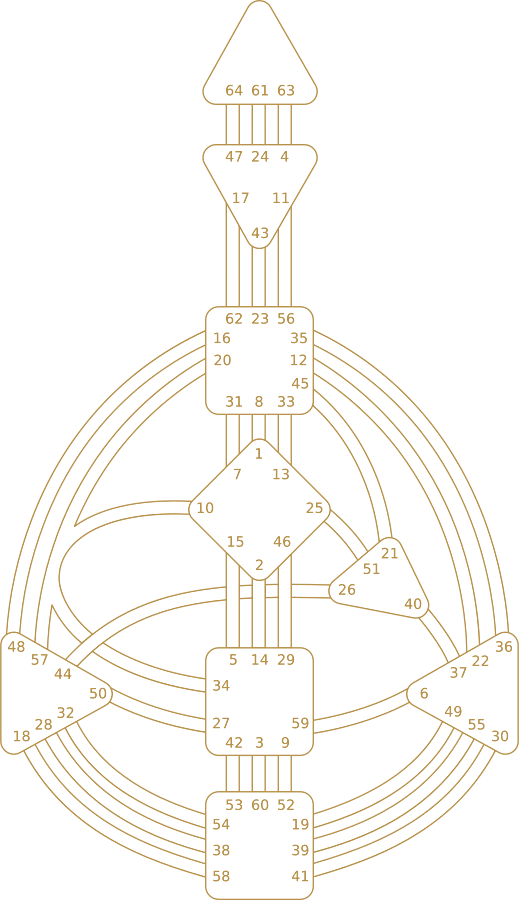
Once your chart is generated, it reveals your Type, Strategy, Authority, Centers, Profile, and deeper layers like Gates, Channels, and your Incarnation Cross. It can look complex at first, but you do not need to understand everything at once.
The simplest approach is to begin with the layers that affect daily life most directly: your Type, your Strategy, and your Authority.

The shape in the middle is the BodyGraph. The nine shapes inside it are your Centers. A gold Center is defined: that energy runs the same way in you every day. An outlined Center is open: you take that energy in from the people around you, and you often feel it more strongly than they do.
That one distinction explains a lot on its own. It shows where your energy is steady, where you absorb pressure that is not yours, and why some rooms drain you while others feel easy.
The cards around the chart name the rest of your design, from your Type and Strategy down to deeper layers like Digestion and Environment. Each one describes a different part of how your energy works, and every one of them comes from the same three birth details.
Generate your Human Design chart
The easiest way to understand Human Design is to look at your own chart. Your free chart shows your core map instantly, including your Type, Strategy, Authority, Profile, and more.
Generate your free chart here: Generate your free chart
How your Human Design chart is calculated
Your chart is calculated twice from the same birth details. Each calculation places the Sun, Earth, Moon, the lunar Nodes and the planets, 13 positions in all, and each position lands in one of the 64 Gates, one for each hexagram of the I Ching.
The same two calculations give you the rest. Your Profile is the line of your Personality Sun over the line of your Design Sun, and the four Sun and Earth Gates make your Incarnation Cross. That is also why birth time matters: a few minutes can move a planet into the next Gate.
Where Human Design comes from
Human Design was originated by Ra Uru Hu, born Alan Robert Krakower, after an eight-day experience on the Spanish island of Ibiza in 1987. He taught it for 25 years, until his death in 2011.
It is a synthesis. It brings together the I Ching, astrology, the Kabbalah's Tree of Life and the Hindu-Brahmin chakra system with ideas from genetics and quantum physics. You can see the threads in the chart itself: the 64 Gates are the I Ching's 64 hexagrams, and, as in astrology, the positions of the Sun, Moon and planets decide which Gates are active.
Jovian Archive publishes Ra Uru Hu's teachings and is the authoritative source for the system. Everything on this site is written in our own words and checked against it.
How Human Design works
Human Design starts from one premise: people are wired differently, so the same advice cannot fit everyone. Instead of a set of rules, it gives you a map of your own wiring and a way to test it in daily life.
At the most practical level, Human Design helps answer a few core questions: How does your energy naturally work? How are you meant to make decisions? Where are you consistent, and where are you more open to outside influence?
Each part of the chart answers one of those questions. Your Type and Strategy describe how your energy meets the world, your Authority how you decide, and your Centers where you are steady and where you take in from others. Human Design Basics takes them one at a time.
It is not something you have to believe in. It is something you can test and experience for yourself.
Why people use Human Design
Most people find Human Design when something in life feels off. They may feel burned out, stuck in overthinking, disconnected from their energy, or tired of following advice that works for other people but not for them.
Human Design offers a different perspective: you are not meant to move through life the same way as everyone else. When you understand your design, you can make decisions with less resistance and create a life that feels more sustainable.
Decision-making clarity
Learn how you are designed to choose so you can stop second-guessing and trust yourself more deeply.
Energy alignment
Notice what energizes you and what drains you so daily life feels more natural and less forced.
Work and direction
Understand how you create value best so your routines, goals, and direction actually fit your nature.
Relationship insight
See your needs and patterns more clearly so communication, boundaries, and connection become easier.
What Human Design is not
Human Design is not a religion, a fixed label, or a rulebook that tells you who you have to be. It is a framework for self-awareness that helps you understand your natural patterns more clearly.
It is also not about putting yourself in a box. The goal is not to limit you. The goal is to help you recognize what feels aligned, what creates resistance, and what helps you work with your own design more consciously.
Learn the basics next
That is what Human Design is. The next step is using it, and that is what Human Design Basics teaches: the seven ideas that make a chart usable, one at a time, with a free calculator to find your own.
The first lessonHuman Design BasicsType, Strategy, Authority, Profile, Centers, Definition, and Signature and Not-SelfLearn the basics →FAQ: What is Human Design
Is Human Design scientific?
Human Design is best approached as a self-awareness framework. Some people view it as symbolic, practical, or experiential. The value comes from applying what you learn and noticing what helps you feel more aligned over time.
Is Human Design a religion?
No. Human Design is not a religion. It is a system people use for self-awareness and decision-making. You can approach it practically or symbolically depending on what feels useful to you.
Do I need to buy a reading to see my Type?
No. Your free chart shows your Type instantly. The Complete Reading is optional and helps you understand your chart in a more detailed, applied way.
What if I do not know my exact birth time?
You can still generate a chart using your best estimate. Exact time helps improve accuracy, especially for finer chart details. If possible, check your birth certificate later and update your chart.
Who created Human Design?
Ra Uru Hu, born Alan Robert Krakower, originated Human Design in 1987 after an experience on the island of Ibiza, and taught it until his death in 2011. Jovian Archive publishes his teachings and is the authoritative source for the system.
How is a Human Design chart calculated?
From your birth date, birth time and birth place, twice: once for the moment of birth (your Personality, shown in black) and once for the moment the Sun was 88 degrees earlier, about 88 days before birth (your Design, shown in red). Each side places 13 positions in the 64 Gates.
How is Human Design different from astrology?
Both use birth data, but Human Design produces a mechanical chart that maps energy flow and decision-making rather than personality predictions. It also draws from the I Ching, Kabbalah, and the Chakra system alongside astrology.
Can Human Design help with relationships?
Yes. Understanding both people's Types, Strategies, and Authorities helps explain attraction, friction, pacing, and communication patterns. You can explore specific pairings through the Compatibility Calculator.