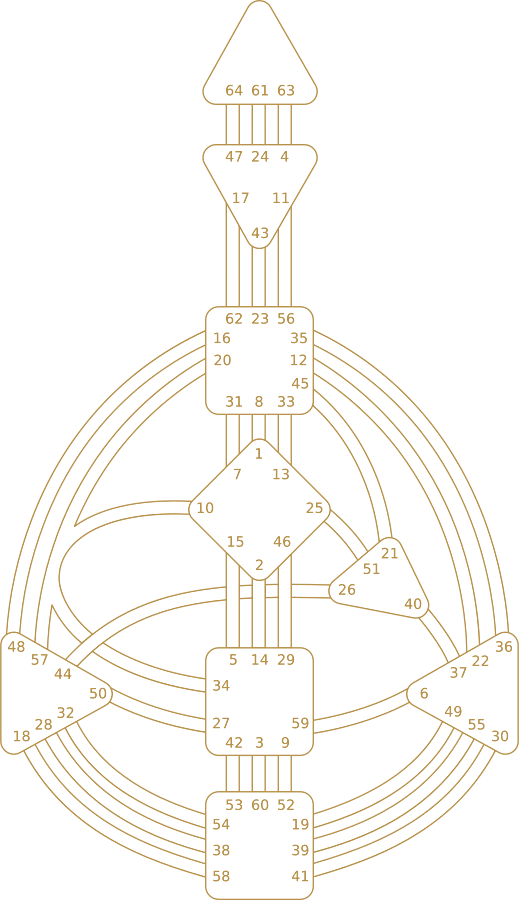

Human Design Astrocartography
Human Design astrocartography is astrocartography read through your Human Design chart: the planet lines on your world map, each named by the gate and line that planet activates in your chart.
Astrocartography itself is a branch of astrology that maps your birth chart onto a world map. For each planet it draws four lines, marking the places where that planet was rising, setting, overhead or underfoot at the moment you were born.
Your own map lives in My Places, inside your private Human Design dashboard. Astrocartography is not part of Human Design, and Ra Uru Hu did not teach it: we offer it as a companion to your chart.
Your astrocartography map, in your private dashboard
My Places opens with your Human Design reading. Here is what it does with your own chart. Start with your free chart.

My Places: search any city and see which of your lines run near it. A companion to your Human Design, not part of it.
All 40 of your lines
Ten planets, four lines each, drawn from the moment you were born and checked against your chart. Each line is named by its Human Design gate and line.
Any city on earth
Where you live, where you might move, where you travel next: type it and see the lines within reach, how far each one is and how loud.
Where you are right now
Press Find me and My Places reads the lines around wherever you are standing: at home, on a trip, on a work visit.
Your energy there
For the lines nearest a place: what each one turns up in you, at its best and when it runs hot, and the part of your chart it belongs to.
Your Environment
The Human Design answer to place: which of the six Environments is yours, its tone, the rooms that suit you, and a week to test it.
Ask Jessica
Jessica, your AI guide, reads your lines with you. Ask which cities sit on your Venus line and she names them from your own map.
See your chart, and where your map lives
Enter your details and your private dashboard opens with your chart, the first section of your reading and the name of your Environment, all free. Your astrocartography map is in My Places there, and opens with your reading, $99 once.
A one-to-one astrocartography reading with an astrologer often costs $100 to $300, and some charge far more. Your map comes with your Human Design reading: $99, once, with 60+ sections written for your exact chart.
New to astrocartography? The rest of this page explains it: what it is, the four lines, all ten planets and what each one means where you live, which line to live on, how far a line reaches, and how it sits beside your Human Design.
What is astrocartography?
Astrocartography (also written astro cartography, and part of what astrologers call locational or relocation astrology) takes the same birth date, time and place a birth chart uses. Then it asks one question of every spot on earth: which planet was rising, setting, overhead or underfoot here when you were born? The American astrologer Jim Lewis developed it and made it popular in the 1970s.
Wherever a planet sat on one of those four angles, the map draws a line. Near a line, astrologers say, that planet's themes turn up in your life: the Sun brings visibility, Venus ease and affection, Jupiter opportunity, and Saturn hard work and structure.
Your map
Your birth chart drawn across the whole world. Think: a map of where each planet's theme is turned up.
A line
Where a planet sat on one of the four angles when you were born. Ten planets, four lines each: 40 lines in all.
Near a line
The closer you are, the louder that theme. Right on a line you tend to get both sides of it, the gift and the pressure.
Why people use it
To choose where to live, travel, study or work, and to understand why some places feel so different from others.
The four lines: rising, setting, overhead and underfoot
Every planet draws four lines, one for each angle of your birth chart. The planet says what turns up. The angle says where in your life it shows.
Rising (AC)
Where the planet was rising on the eastern horizon, also called the Ascendant line. It shows in you: how you come across, and how you feel in your own skin.
Setting (DC)
Where the planet was setting on the western horizon, also called the Descendant line. It shows through other people: partners, clients and the ones you meet.
Overhead (MC)
Where the planet was at its highest, on the meridian, also called the Midheaven line. It shows in public: your work, your reputation, what you are known for.
Underfoot (IC)
Where the planet was directly below the earth, also called the IC line (Imum Coeli). It shows at home: your roots, your family, your private life.
How to tell them apart: overhead and underfoot lines run straight from pole to pole. Rising and setting lines curve, because the horizon tilts as you move north or south. In My Places, overhead and rising lines are solid, and underfoot and setting lines are dashed.
How to read an astrocartography map
Reading a map comes down to two questions for any place you care about: which lines run near it, and how near?
Step 1
Start with an exact birth time. The map is drawn for the minute you were born, so a birth certificate or hospital record beats a guess.
Step 2
Find the places that matter to you: where you live, where you work, where you want to go, and where you grew up or your family lives.
Step 3
Look for the nearest lines. Name the planet and the angle: Venus setting, Saturn overhead. Then read both sides of it below.
Then test it
Stay near a line for a week or more before deciding anything about living there. Notice which side of the planet you are getting.
All ten planets: what each line means
Each planet brings its own theme to a place, with a side at its best and a side when it runs hot. The angle decides where it shows: in you (rising), through other people (setting), in public (overhead) or at home (underfoot).
The same ten planets are in your Human Design chart, where each one activates a gate. In My Places, every line is named by the gate and line of that planet in your chart, so you can see which part of your design a place turns up.
Jump to a planet
Tap a planet to open it
The personal planets
The Sun, the Moon, Mercury, Venus and Mars move fastest and feel the most personal. Their lines tend to be felt day to day.
Sun lines: vitality and visibility
Theme: Near a Sun line you are seen. Recognition comes easier, and so does exposure.
Overhead (MC): recognition for your work. A place to lead, build a name and be known for what you do.
Underfoot (IC): home becomes the center of your life. You feel more like yourself in private, and roots come easier.
Rising (AC): confidence and energy in your own skin. You come across as bright, warm and sure of yourself.
Setting (DC): strong, visible people come into your life. Partners who shine, sometimes brighter than you.
At its best: you are noticed for what you actually do, and leading comes naturally.
When it runs hot: pride and exposure, because every mistake is public too.
In Human Design: the Sun is life force and personality expression, the largest single influence in your chart.
Moon lines: home and belonging
Theme: Somewhere that feels like family, for better and for worse.
Overhead (MC): your feelings go public. Work that cares for people, and a reputation that rises and falls with the mood.
Underfoot (IC): the classic home line: belonging, family and the feeling of roots. Old family patterns come with it.
Rising (AC): your feelings show on your face. You come across as warm and sensitive, and moods sit closer to the surface.
Setting (DC): close, caring relationships. You meet people who look after you, or who need looking after.
At its best: you settle fast, feel at home, and people look after you.
When it runs hot: old family patterns replay, and moods run the day.
In Human Design: the Moon is the driving force: what pushes you.
Mercury lines: talk, study and trade
Theme: Conversation and learning speed up. Good for study and deals, restless for rest.
Overhead (MC): known for your ideas. Writing, teaching, speaking, trade and anything that runs on words.
Underfoot (IC): a home full of books, talk and plans. Good for study at home, harder for switching off.
Rising (AC): quick, curious and talkative. You come across as clever and easy to talk to.
Setting (DC): you meet people through ideas, deals and conversation. Partners you can talk with, and contracts that move.
At its best: ideas, deals and study move quickly, and the right people to talk to appear.
When it runs hot: scattered, over-talked and never switched off.
In Human Design: Mercury is communication and thinking: what you are here to communicate.
Venus lines: ease, beauty and affection
Theme: Things soften. Relationships and taste come to the front.
Overhead (MC): work in beauty, art, design or people. You are liked in public, and money can come through charm.
Underfoot (IC): a beautiful, comfortable home and an easier private life. Family feels softer.
Rising (AC): you feel attractive and at ease, and people find you charming.
Setting (DC): the classic love line: romance, partnership and people who treat you well.
At its best: ease with people, money and taste; life gets prettier.
When it runs hot: comfort over growth, and spending to feel good.
In Human Design: Venus is values and morality: your ideals.
Mars lines: drive and friction
Theme: Energy rises. Good for building, harder for keeping the peace.
Overhead (MC): drive and ambition at work. Things get built, and clashes with bosses and rivals come with it.
Underfoot (IC): energy at home: renovations, projects, and family friction when nothing gives it an outlet.
Rising (AC): strong, bold and physical. You come across as direct, and sometimes as a fighter.
Setting (DC): passion and conflict through other people. Exciting partners, and the arguments that need to be had.
At its best: things get built, and the fights you needed to have get had.
When it runs hot: temper, accidents, and burning out on friction.
In Human Design: Mars is immaturity: raw energy, and what you have to grow into.
The social planets
Jupiter and Saturn, growth and structure. Their lines shape work, money, luck and long-term plans.
Jupiter lines: expansion and luck
Theme: Doors open wider than they should. The classic place to go.
Overhead (MC): the classic career line: opportunity, promotion and recognition that seems to come easily.
Underfoot (IC): a generous home and a growing family or property. Comfort, and sometimes too much of it.
Rising (AC): optimism and confidence. You come across as generous and lucky, and life feels bigger.
Setting (DC): helpful people, good partners and clients who open doors. Watch for promises nobody can keep.
At its best: opportunity, generosity, and luck that looks unearned.
When it runs hot: overreach, excess, and promising more than you can carry.
In Human Design: Jupiter is law and protection: the law you live by, and what rewards you for it.
Saturn lines: work, weight and structure
Theme: Slower, heavier, and where the lasting things get built.
Overhead (MC): serious work and lasting results. Authority and respect come slowly, and responsibility comes with them.
Underfoot (IC): duty at home. A place to build solid foundations, and one where family matters can feel heavy.
Rising (AC): you come across as serious and capable, older than you are. Discipline is easier; lightness is harder.
Setting (DC): committed, serious relationships, sometimes with older partners. Relationships that feel like work, in both senses.
At its best: discipline, serious work, and results that last.
When it runs hot: heaviness, loneliness, and feeling older than you are.
In Human Design: Saturn is discipline: the judge, where restraint and structure are demanded.
The outer planets
Uranus, Neptune and Pluto move slowly and work deep. Their lines are intense, and astrologers treat them with care.
Uranus lines: change and surprise
Theme: Nothing stays as it was. Good for reinvention, hard on routine.
Overhead (MC): sudden turns in your career. Unusual work, technology, and a public image that keeps changing.
Underfoot (IC): a restless home. Frequent moves, and freedom from the family patterns you grew up with.
Rising (AC): you feel free and different. A place to reinvent yourself, and a hard place to keep a routine.
Setting (DC): exciting, unusual people. Relationships that start fast and end fast.
At its best: reinvention, freedom, and the change you have been putting off.
When it runs hot: instability, where nothing sticks, including you.
In Human Design: Uranus is unusualness: science, chaos and order, the unexpected.
Neptune lines: dream and dissolve
Theme: Boundaries blur. Rich for art and retreat, poor for clarity.
Overhead (MC): creative, artistic or healing work. Your public image can blur, and so can what you are known for.
Underfoot (IC): a dreamy, retreat-like home. Good for rest and art, less so for clear boundaries.
Rising (AC): sensitive, intuitive and easy to project onto. People see what they want to see in you.
Setting (DC): romantic, idealized partners. Compassion comes easily, and so does being taken in.
At its best: art, rest, faith and compassion have room to breathe.
When it runs hot: fog, drifting, escaping, and being taken in.
In Human Design: Neptune is illusion: the veil, what stays hidden or dissolves.
Pluto lines: depth and power
Theme: What is buried comes up. Transformative, and not gentle.
Overhead (MC): power and influence at work, and a career that changes you whether you asked for it or not.
Underfoot (IC): deep change at home. What was buried in the family comes to the surface.
Rising (AC): intensity and magnetism. A place of personal transformation, not a gentle one.
Setting (DC): intense, life-changing relationships, and power struggles with the people you meet.
At its best: deep change, real power, and getting to the bottom of things.
When it runs hot: control, obsession, and crises that force the change.
In Human Design: Pluto is truth: transformation, what has to be brought out and made honest.
See your own lines. Your ten planets and 40 lines are drawn in My Places, each named by the gate it activates in your chart. Start with your free chart.
Which line should you live on?
There is no best line for everyone. The right line depends on what you want a place to do for you, and every line has two sides. These are the lines astrologers most often point to for each goal.
Work and recognition
The Sun, Jupiter and Saturn overhead. Jupiter for opportunity, the Sun for visibility, Saturn for slow results that last.
Love and partnership
Venus setting is the classic love line. The Moon setting for closeness, Jupiter setting for generous partners. Mars setting brings heat, and fights with it.
Home and belonging
The Moon or Venus underfoot for a place that feels like home, Jupiter underfoot for a generous one, Saturn underfoot for roots that take work.
Rest, art and healing
Venus and Neptune lines for beauty, art and retreat. Neptune is rich for art and rest, and poor for clear thinking or big decisions.
Study, writing and business
Mercury lines for ideas, talk and trade, with Jupiter for growth.
A fresh start
Uranus for reinvention, hard on routine. Pluto for deep change, and it is not gentle.
The map suggests. Your Authority decides. In Human Design no chart, map or person makes your decisions for you. Your Authority does. Visit, stay a while, and let your Authority tell you whether a place is right for you.
How far does a line reach?
A line is a band, not a wall. The theme is loudest within about 700 miles of a line, and fades from there. In My Places, every line near a place is given a distance and a volume.
Within about 200 miles
Full volume. On the line or close to it, the theme is at its strongest, and you tend to get both sides of it.
200 to 500 miles
Clearly present. The theme is part of daily life without taking it over.
Beyond about 500 miles
A faint note. Still there, fading out at around 700 miles. On its own, a line this far off is not much of a reason to choose a place.
Other maps
Many astrologers work with a band of about 300 to 600 miles, and some with less. Treat any number as a guide, not a border.
Why your birth time matters
The earth turns one degree every four minutes. A birth time ten minutes off slides every line on your map about two and a half degrees east or west, which is roughly 100 to 170 miles on the ground, depending on how far north or south you are. That is why each line is drawn as a band.
If your birth time is a guess, read the lines near a place as a direction rather than an address. The best sources are a birth certificate, a hospital record or a baby book. Your Human Design chart uses the same birth time, so it is worth finding the real one.
Astrocartography, relocation charts and crossings
Astrocartography map
The whole world at once: every place where a planet sat on one of the four angles when you were born. It shows where to look.
Relocation chart
Your birth chart recast for one new place: the same moment, with that place's houses and angles. It looks at one place in depth.
Do your lines move?
No. They are drawn from the moment you were born, so they stay where they are for life. Some astrologers also lay today's planets over the map to time a move.
Crossings and parans
Where two lines cross, both themes meet. Some astrologers also read the latitude of a crossing all the way around the world, and call it a paran.
Human Design astrocartography: how the two fit
Astrocartography is Western astrology. Ra Uru Hu did not teach it, and it is not part of Human Design. We offer it as a companion. Here is how the two fit together.
The same planets, the same moment
The conscious side of your Human Design chart, the Personality in black, uses the planets at the moment you were born. So does your map. That is why each line can be named by the gate its planet activates in your chart.
Only the conscious side
Your map uses the Personality side alone. The unconscious Design side, in red, is calculated about 88 days before birth, when the planets stood somewhere else, so it draws no lines on your map.
Next steps
A map shows where themes turn up. Your Human Design shows how you are built to meet them: Type → Strategy → Authority.
Find your Environment
The kind of place you do best in, out of six. Explore Environments.
Trust your Authority
Your Authority decides what is correct for you, including where to live. Explore Authority.
Meet the planets
What each planet means in a Human Design chart. Explore the Planets.
Then go deeper
Each planet activates a gate, and each gate has six lines. Explore Gates.
Quick recap: astrocartography maps your birth chart onto the world. Each of ten planets draws four lines (rising, setting, overhead and underfoot), and near a line that planet's theme is louder, both sides of it. It is a companion to Human Design, not part of it: your Environment says what kind of place suits you, and your Authority makes the decision.
FAQ: Human Design Astrocartography
What is Human Design astrocartography?
It is astrocartography read through your Human Design chart. Your map uses the planets at the moment you were born, the same planets as the conscious Personality side of your chart, so each line can be named by the gate and line its planet activates. Astrocartography itself is Western astrology: Ra Uru Hu did not teach it, and Human Design's own answer to place is your Environment.
What is astrocartography?
Astrocartography is a branch of astrology that maps your birth chart onto a world map. For each of ten planets it draws four lines, where that planet was rising, setting, overhead or underfoot at the moment you were born. Near a line, that planet's themes are said to be stronger in your life. People use it to choose where to live, travel and work.
How do I find my astrocartography map?
You need your birth date, your birth place and your birth time, as exact as you can find it. A map is calculated from those three. In your private Human Design dashboard the map is in My Places: start with your free chart on this page, and your map opens with your reading. Every line there is named by its Human Design gate, and you can search any city to see which of your lines run near it.
What do the four astrocartography lines mean?
A rising line (AC) shows in you: how you come across and feel in your own skin. A setting line (DC) shows through other people: partners and the people you meet. An overhead line (MC) shows in public: your work and reputation. An underfoot line (IC) shows at home: your roots, family and private life.
Which astrocartography line should I live on?
It depends on what you want a place to do for you. Venus and Jupiter lines are often called the easiest, the Sun and Jupiter overhead are popular for careers, and the Moon underfoot for a place that feels like home. No line is all good or all bad. In Human Design, your Authority makes the decision, not the map.
How far does an astrocartography line reach?
A line is a band, not a wall. In My Places a line is at full volume within about 200 miles, clearly present to about 500 miles, and fades out at around 700. Many astrologers use a band of about 300 to 600 miles. Treat any number as a guide.
Do I need my exact birth time?
Yes, as close as you can get it. The earth turns one degree every four minutes, so a birth time ten minutes off slides every line about two and a half degrees east or west, which can be well over 100 miles on the ground. A birth certificate or hospital record is the best source.
Is astrocartography accurate?
The lines themselves are precise astronomy: they mark where each planet really was when you were born. What a line means comes from astrological tradition, not scientific study. The honest way to use it is as an experiment: spend a week or more near a line, notice what changes, and let your own Authority decide.
Is astrocartography part of Human Design?
No. Astrocartography is Western astrology, made popular by the astrologer Jim Lewis in the 1970s, and Ra Uru Hu did not teach it. Human Design has its own answer to place, your Environment. We offer astrocartography as a companion, with each line named by the Human Design gate its planet activates in your chart.
What is the difference between astrocartography and a relocation chart?
A relocation chart recasts your birth chart for one new place: the same moment, with that place's houses and angles. An astrocartography map shows the whole world at once, marking everywhere a planet sat on one of the four angles. The map shows where to look, and a relocation chart looks at one place in depth.
Can AI read my astrocartography map?
Software draws the map from the planets' real positions, and AI can help you read it. In your Human Design dashboard, Jessica, your AI guide, reads your lines with you, alongside your Environment and your Authority. Ask her which cities sit on your Venus or Jupiter line, and she names them from your own map, with the distance to each.
How much does an astrocartography reading cost?
A one-to-one reading with an astrologer often costs $100 to $300, and some charge far more. Some astrology sites draw a basic map for free, without a reading. Your map in My Places comes with your Human Design reading, $99 once, with 60+ sections written for your exact chart.
What does a Venus line mean in astrocartography?
Venus brings ease, beauty and affection. Setting, it is the classic love line; overhead, it favors work in beauty, art or with people; underfoot, a comfortable home; rising, you feel attractive and at ease. When it runs hot, it is comfort over growth, and spending to feel good.