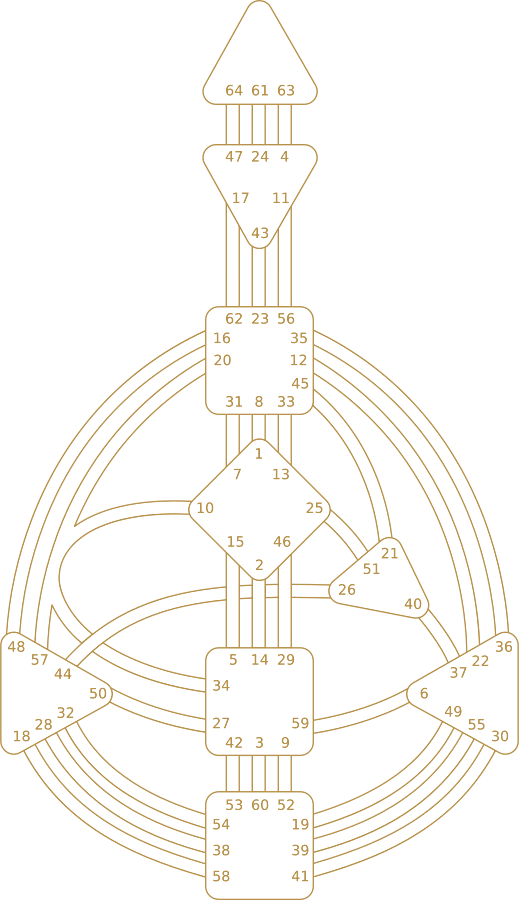

Manifestor Human Design
A Manifestor in Human Design has a motor connected to the Throat and no defined Sacral. About 9% of people are Manifestors. Your Strategy is to inform before you act: tell the people your move affects, then initiate from inner clarity.
Think of a boat moving through still water. Your movement always leaves a wake, and informing is the heads-up that lets the people nearby adjust instead of getting knocked off balance.
Not sure you are a Manifestor? Check with the free chart calculator on this page. It takes your birth date, time and place.
Manifestor at a glance
The facts of the Manifestor Type in one place, from the Human Design canon.
Are you a Manifestor? Find it in your chart
Your Type is calculated from your birth date, birth time and birth place, not from a quiz. Enter your details and your Type shows at the top of your free chart.
Your chart shows a different Type? Every Type has its own guide:
What is a Manifestor in Human Design?
Manifestors are initiators. You start things. You create movement. You set new directions going without waiting for life to hand you a signal first. Generators and Manifesting Generators respond. Projectors wait for the invitation. You do not. You have a motor Center wired straight to the Throat, and that lets you act on your own. The urge comes from inside you.
That motor might be the Solar Plexus, the Heart or the Root. It gives you real power to initiate. It does not give you the steady daily output of a defined Sacral. In practice you work in bursts. When the urge hits and the timing is right, you move with real force and speed. You start the project, launch the idea and create momentum other people can carry forward. Then you rest. That is your cycle, not a fault.
You have likely spent your life in a world built for a different pace. You are not built for steady output. You are built for impact, for starting things that would not exist without you.
Your design is not about control, either. Many Manifestors grow up trying to control their environment because the world keeps trying to slow them down. The design is to initiate from clarity and let the impact unfold.
When it's engaged
Your energy becomes bold, decisive, and impactful. You move quickly and set momentum in motion.
When it's misused
You may overpush, create resistance, or feel blocked when other people do not understand what you are doing.
The Manifestor aura: closed and repelling
Every Type has its own aura. The Manifestor aura is closed and repelling. That sounds harsh. It is not a flaw, it is a feature. Your aura puts a natural boundary between you and everyone else, and that boundary is what lets you move on your own without getting pulled into other people's agendas.
People feel your presence before they understand it. Depending on the room, that reads as magnetic or as intimidating, which is why Manifestors get described as powerful, distant, or hard to read.
A Generator's aura is open and enveloping. A Projector's aura is focused and absorbing. Yours keeps a buffer. It explains why people can seem guarded around you even when you are friendly, and why too much social contact drains you. Your need for solitude is not antisocial. It is how you recharge.
Manifestor strategy: inform before you act
The Manifestor strategy is to inform before you act. When your action affects other people, tell them what you are doing. Informing is not asking permission. It is not seeking approval or waiting for everyone to agree. It is a practical heads-up that cuts the resistance your energy creates when it moves without warning.
Move without informing and people experience it as sudden, sometimes as threatening. They did not see it coming, so they resist, question, or try to control you. People are not against you. Your energy leaves a wake, and it catches them off guard. Inform first and the same action creates space instead. Thirty seconds of "here is what I am about to do" saves hours of conflict.
It does not need to be elaborate. "I am going to work on this for the next few hours." "I have decided to change direction." "I am leaving." People do not need your reasoning. They need the heads-up.
Strategy sits inside a simple cycle: urge, clarity, inform, initiate, rest. The urge comes first, and your only job is to notice it. Your Authority then confirms it or denies it. Once you have clarity, inform the people affected, then move at full power, without needing consensus. After the burst, rest. Rest is not optional: it lets the next urge arrive from a clean place instead of from depletion.
When it works
You feel the urge, check it with Authority, inform clearly, and move with less resistance and more momentum.
When it backfires
You act from pressure, skip informing, and end up feeling blocked, misunderstood, or forced into conflict.
For how strategy works for every Type, see Human Design Strategy. For the Manifestor mechanics in depth, see Manifestor Strategy.
Decision-making for Manifestors
Your Type explains how your energy works. Your Authority explains how you are meant to decide. Being a Manifestor does not mean acting on every urge the moment it arrives. A Manifestor has one of three Authorities, and it tells you whether the urge is correct. If your Solar Plexus is defined, your Authority is Emotional.
Emotional Authority Manifestors
With Emotional Authority, centered in the Solar Plexus, your decisions need time. There is no truth in the now. The urge says go. The Authority says not yet. Sleep on the big ones and come back to them in a different mood. If the urge survives the full wave, it is probably correct. If it faded, that was the wave talking.
Splenic Authority Manifestors
With Splenic Authority, your decisions are meant to be fast. The Spleen speaks once, in the moment, as a quiet hit. Yes or no. You feel the urge, the Spleen confirms it, and you move. That looks impulsive from outside. It is not, when the splenic clarity is real. The Spleen does not repeat itself: if you are now reasoning your way to an answer, the window has closed.
Ego Manifested Authority Manifestors
With Ego Manifested Authority, the defined Heart is the only motor path to your Throat, and your decisions come from willpower. The question is blunt. Do I want this? Is my heart in it? If yes, your will supplies the energy to start and to finish. If no, no amount of reasoning will make it correct.
How Type, Authority, and Centers connect: Your Type (Manifestor) tells you that your energy is built for initiation and impact. Your Authority tells you how to make correct decisions about when to initiate. Your Centers show where your energy is consistent and where you are open to outside influence. Go deeper with Defined vs Undefined Centers.
Anger: the Manifestor not-self theme
Every Type in Human Design has a Not-Self Theme, a signal that you are living out of alignment with your design. For Manifestors, that signal is anger.
Manifestor anger is specific. It is the feeling of being blocked, controlled, or forced into someone else's system when you are built to move on your own. Many Manifestors meet it early, when the adults around them said wait, ask first, fall in line. Over time it can become background noise that shows up as guardedness or pulling away.
Use the anger as information, not as direction. It tells you your freedom is being compromised somewhere. Maybe you held back your urge to keep others comfortable, or stopped informing and the resistance boxed you in.
The opposite of anger is peace, your Signature. Peace does not mean passive. It means the friction is gone. When you initiate correctly, inform clearly, and rest when your energy asks for it, you are moving without fighting for the right to move. That is Manifestor peace.
Manifestor by Profile
Your Profile is the two numbers on your chart, such as 3/5 or 6/2. It shapes how you live your Type. Each Profile guide has a section for Manifestors:
Common Manifestor mistakes
Acting before clarity
Not every urge is correct timing. Moving before your Authority is clear can create conflict, regret, and cleanup.
Skipping informing
When people are affected and do not know what is happening, resistance rises fast even when your move is right for you.
Forcing nonstop output
Manifestors are built for waves of impact, not constant productivity. Overpushing leads to anger, depletion, and burnout.
Using anger as direction
Anger is useful feedback, but it is not always a green light. It often points to blocked freedom, missing boundaries, or a need to pause.
Myths about Manifestors, and what is true
“I need to ask for permission.”
You are here to inform, not to wait for approval.
“If I explain myself, people will control me.”
Clear informing protects your freedom by reducing the resistance that leads to control.
“Anger means I am difficult.”
Anger is your not-self signal, not a personality flaw.
“I work best completely alone.”
You work best with autonomy, and you still benefit from people who carry forward what you start. Independence does not mean isolation.
Manifestors at work and careers that fit
In the right environment your initiating energy becomes the catalyst. Projects, ideas, whole directions exist because you started them. The problem is that most workplaces run on consistent output, steady schedules and group decisions. Ask a Manifestor to get permission for everything and hold a steady pace, and eventually they rebel or shut down.
You do your best work with autonomy over how and when you act, trust that you will deliver, freedom to work in bursts, and enough space that your aura is not pressed up against everyone else's all day. Here is a pattern most Manifestors recognize: you start something, build the momentum, and then lose interest. That is your cycle. You create the opening, and the sustained building is often better handled by Generator or Manifesting Generator energy.
The best careers for Manifestors allow initiation, independence and bold movement. The title matters less than two questions: can you act on your own timing, and can you create impact without asking first? Many Manifestors end up in leadership, entrepreneurship, creative direction or consulting, anywhere they set the direction and trust others with the details. You do not have to be the boss, though, as long as you get real autonomy. If you are angry at work most days, start with the structure, not the tasks or the people.
What helps you thrive
Autonomy, trust, freedom to lead, and room to move on your own timeline.
What drains you
Control, over-collaboration, needing approval for every step, and environments that shrink your independence.
Your full chart adds layers to career fit. Your Profile shapes how you work with colleagues, and your Gates and Channels point to the specific themes and strengths behind the impact you create. To see how being a Manifestor fits with every other layer, read what your Human Design chart means.
Relationships for Manifestors
Relationships are often the hardest area for Manifestors. Not because you cannot connect deeply, but because your closed aura puts space between you and other people, and to someone who wants closeness that space can feel like distance.
Informing is the single most important relationship skill you have. Change plans without telling your partner and they do not just feel surprised. They feel shut out. Informing costs you almost nothing. Skipping it can cost you the relationship. Say out loud when you need space to recharge, rather than just disappearing.
Different pairings create different dynamics. With a Generator, you initiate and they sustain, and the friction is pace. With a Projector, recognize their guidance instead of barreling past it. With another Manifestor, you both have to inform, or it turns into a struggle. With a Reflector, slow down: they decide on a different clock than you do. Read more about each pairing: Generator and Manifestor, Manifesting Generator and Manifestor, Projector and Manifestor, Manifestor and Manifestor, and Manifestor and Reflector.
To see how two specific designs work together, use the Human Design Compatibility Calculator. For Type dynamics in general, see Human Design Relationships.
Rest and avoiding burnout as a Manifestor
Balance is not about splitting time evenly between work and life. It is about honoring your burst-and-rest cycle. In a burst, work may take most of your attention, and that is fine, as long as the initiation is correct and you have informed the people affected. When the burst ends, the rest has to be real.
Manifestor burnout does not look like Generator burnout. It is less about overwork and more about chronic anger, withdrawal, and the sense that every direction is blocked. It usually comes from holding back the urge too long, or pushing without rest too long. Coming back means getting your autonomy back, through firmer boundaries or more room to act on your own timing, and slowing down enough to hear your Authority again.
- Inform before friction builds: it keeps your path cleaner and your relationships healthier.
- Do not overcommit: your power works in waves, not nonstop output.
- Let anger be early information: it often points to blocked autonomy or a missing boundary.
- Follow your Authority: correct initiation starts with correct decisions.
- Protect your rest: the next correct urge cannot arise from a depleted place.
Next steps
Knowing you are a Manifestor is the first layer. The next is learning how your Strategy and Authority work together. Start with Manifestor Strategy, then read the Authority your chart shows: Emotional Authority, Splenic Authority or Ego Authority.
A Human Design reading takes your Manifestor design further in 60+ sections, showing how your Authority, Centers, Gates and Channels shape your initiation, timing and relationships.
FAQ: Manifestor Human Design
What is a Manifestor in Human Design?
A Manifestor is one of the five Human Design Types, defined by a motor connected to the Throat and no defined Sacral. You are built to initiate. You start things, create movement, and open new paths that other people can follow.
How rare is a Manifestor?
In Jovian Archive's statistics, about 9% of people are Manifestors. The Type needs a motor connected to the Throat without a defined Sacral, which is a less common combination than the Sacral Types.
What is the strategy for a Manifestor?
The strategy is to inform before you act. That matters most when your action affects other people. Informing cuts resistance and keeps your relationships clear.
What is the signature and not-self theme for a Manifestor?
Manifestors feel Peace when aligned. The not-self theme is Anger. It shows up when you feel blocked, controlled, or misunderstood.
Do Manifestors need permission?
No. Manifestors are here to inform, not to wait for approval. Informing is a heads-up, not a request.
Why is informing so important for Manifestors?
Your energy can feel sudden to other people. Informing lets them adjust instead of react. It cuts resistance and makes your path smoother.
Do Manifestors have sustainable energy like Generators?
Not in the same way. Manifestors have no defined Sacral, so they tend to work in bursts of action followed by rest. Their rhythm is more wave-like than steady.
How do Manifestors avoid burnout?
Protect your freedom. Rest after a burst instead of forcing the next one. Inform before friction builds, and follow your Authority rather than acting from pressure.
What jobs suit a Manifestor?
Work that lets you initiate and act on your own timing tends to fit best. Many Manifestors are drawn to leadership, entrepreneurship, creative direction or consulting, but the freedom matters more than the title. Inside a larger organization, look for real autonomy and little need to ask permission.
How do I know if I am a Manifestor?
Generate your free chart using your birth date, time, and location. Your Type will appear in your chart results.