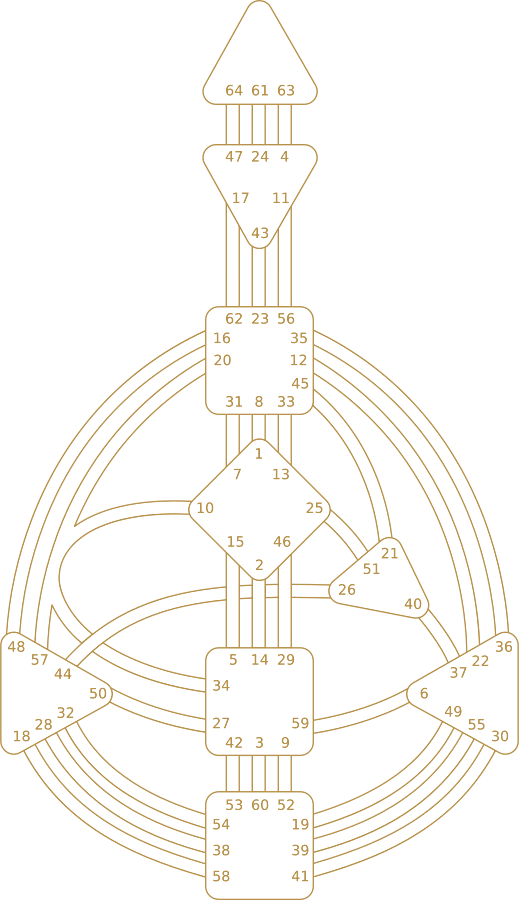

Projector Human Design
A Projector in Human Design has no defined Sacral and no motor connected to the Throat, with at least one Center defined. About 21% of people are Projectors. Your Strategy is to wait for the invitation, so your guidance lands where it is recognized and wanted.
Think of a Projector as a guide: you see how a system works and where its energy is wasted, and your insight lands best when someone has asked for it.
Not sure you are a Projector? Check with the free chart calculator on this page. It takes your birth date, time and place.
Projector at a glance
The facts of the Projector Type in one place, from the Human Design canon.
Are you a Projector? Find it in your chart
Your Type is calculated from your birth date, birth time and birth place, not from a quiz. Enter your details and your Type shows at the top of your free chart.
Your chart shows a different Type? Every Type has its own guide:
What is a Projector in Human Design?
In Human Design, Projectors are the guides, coordinators, and system-readers. Unlike Generators and Manifesting Generators, you are not designed for nonstop sacral output. Unlike Manifestors, you are not designed to initiate independently. Your strength is perception, pattern recognition, and knowing how things can work better.
What makes a Projector a Projector is the absence of a defined Sacral Center combined with no motor-to-Throat connection. You do not have the sustained daily energy of a Generator or the independent initiating power of a Manifestor. What you have instead is an awareness that can read people, systems, and energy patterns in depth. Your design is built for quality of insight, not quantity of output.
Your energy comes in focused bursts of clarity rather than long sustained stretches: three deeply focused hours on the right thing often produce more than eight forced ones. It also matters which energy is yours. Because your Sacral is undefined, you take in and amplify the sacral energy of the Generators and Manifesting Generators around you. That borrowed energy drains away once you leave, which is why many Projectors feel fine at work and crash in the evenings.
The Projector aura: focused and absorbing
The Projector aura is focused and absorbing. Where the Generator's aura is open and enveloping and the Manifestor's is closed and repelling, the Projector's aura locks onto one person at a time and reads them at a level that can feel intense for both of you.
This is the mechanical basis for how a Projector guides. Your aura focuses on another person's system and gives you access to how their energy is being used well and where it is being wasted. It also explains why uninvited guidance fails. When you read someone who did not ask to be seen that deeply, your focus can feel invasive, and their natural response is to resist. When they invite your insight, the same focus is welcomed and the guidance creates value instead of friction.
Projector strategy: wait for the invitation
The Projector strategy is wait for the invitation, especially for the big areas of life: relationships, career, and major direction.
Waiting for the invitation does not mean sitting at home until someone knocks on your door. It means building mastery and letting your competence be seen, so the right people recognize you and invite you in. The waiting is active: you are studying, refining, practicing, and placing yourself where recognition can happen naturally. The strategy filters for correct placement. When you force your way into a job, a relationship, or a leadership role without genuine recognition, you end up working harder to prove a value that was never seen. When the invitation comes from real recognition, your insight is wanted and your energy is received instead of resisted.
The invitation applies to major life decisions. You do not need an invitation to go grocery shopping or decide how to spend your afternoon. Small daily choices run through your Authority.
In practice the Projector rhythm looks like this: study, become skilled, be visible, receive recognition, receive the invitation, check your Authority, engage, guide, rest, repeat. Without mastery there is nothing to recognize, and without rest after an engagement, fatigue compounds.
When it works
You build mastery, are recognized for your insight, receive the right invitation, and your guidance lands cleanly.
When it backfires
You chase, overexplain, push advice, or overwork to be seen, and end up feeling depleted or bitter.
For how strategy works for every Type, see Human Design Strategy. For the Projector mechanics in depth, see Projector Strategy.
What counts as an invitation for a Projector?
A genuine invitation includes recognition. Someone has noticed your insight or competence and is asking you to contribute, participate, or lead. It can be a friend asking for advice, a colleague requesting your input, a company reaching out with a role, or a partner showing genuine interest. The common thread is that the other person recognized something in you and opened the door.
What does not count is manufactured recognition. A generic callback after sending your resume to a hundred companies is not the same as being recruited because someone saw your work. Volunteering for a leadership role no one offered is not an invitation.
None of this means hiding. Visibility is essential. The strategy is not "hide and hope." It is "become excellent, be visible, and let the invitation find you." Writing, teaching, and showing up where the right people gather position you without forcing the outcome.
Decision-making for Projectors
Your Type explains how your energy works. Your Authority explains how you are designed to decide. Waiting for the invitation tells you when the door is open. Authority tells you whether to walk through it. A Projector can have one of five Authorities. If your Solar Plexus is defined, your Authority is Emotional, whatever else your chart shows. To see how being a Projector fits with every other layer, read what your Human Design chart means.
Emotional Authority Projectors
With Emotional Authority, your decisions need time. There is no truth in the now. Your emotional wave moves through highs and lows, and clarity comes once you have ridden it. Even a beautiful invitation is felt into over time rather than accepted at the peak or dismissed at the low. The correct ones still feel right after the wave has passed.
Splenic Authority Projectors
With Splenic Authority, your decisions are made in the moment. The Spleen speaks once, quietly, through an intuitive hit, and it does not repeat. When an invitation arrives, your body knows right away whether it is correct. The skill is catching that signal before the mind starts analyzing.
Ego Projected Authority Projectors
With Ego Projected Authority, a rare configuration where the Heart is defined to the G Center, your decisions come from willpower, spoken through the G to the Throat. Listen to what you say you want. If your will is genuinely engaged, the invitation is likely correct. If you are talking yourself into it while your heart is indifferent, it may not be for you.
Self-Projected Authority Projectors
With Self-Projected Authority, your decisions come from hearing your own voice. Talk your options through, not to get advice but to hear what you sound like describing each path, and listen.
Mental Projectors (no inner Authority)
With Mental Authority, sometimes called no inner Authority, there is no internal signal to follow. You find clarity by talking things through with trusted people in the right environment and hearing what comes out. Your mind is your outer authority for sharing insight, never the decider.
To find out which Authority you have, check your chart or read the Authority guide. Your Centers then show where your energy is consistent and where you absorb and amplify others. Go deeper with Defined vs Undefined Centers.
Bitterness: the Projector not-self theme
Every Type in Human Design has a Not-Self Theme, a signal that you are living out of alignment with your design. For Projectors, that signal is bitterness: the accumulating feeling of being unseen and undervalued for what you bring. It arises when you give insight where it is not wanted, work harder than your energy can sustain to prove your value, accept invitations that are not correct, or stay where your perception is dismissed.
Many Projectors learn early to either suppress their insight or push it harder. Suppressing creates bitterness inside; pushing creates resistance outside that feeds it. The shift comes when you treat bitterness as information, pointing you toward a change that needs to happen.
The opposite of bitterness is success, the Projector's Signature. It means being in the right place, with the right people, offering guidance that is received and valued. When a Projector lives by the invitation, success becomes a natural result of correct placement rather than something earned through exhausting effort.
Projector by Profile
Your Profile is the two numbers on your chart, such as 3/5 or 6/2. It shapes how you live your Type. Each Profile guide has a section for Projectors:
Common Projector mistakes
Forcing recognition
Trying to make people see your value before they are ready often creates exhaustion, resistance, and bitterness.
Giving uninvited guidance
Even when your insight is right, it often does not land well without recognition and invitation first.
Overworking to prove value
Projectors often try to earn recognition by doing more, but your real value comes from insight, direction, and refinement.
Ignoring the need for rest
Trying to keep up with sacral energy usually leads to burnout. Recovery is part of your design, not a weakness.
Myths about Projectors, and what is true
“Waiting for the invitation means doing nothing.”
You are still here to study, refine, practice, and become deeply skillful. The waiting is active.
“Projectors are lazy.”
Projectors have a different energy model: energy that works in focused bursts rather than sustained output.
Projectors at work and careers that fit
Work is where the Projector design creates its most visible tension. Most workplaces are built around sacral energy and eight-hour days. In the right environment the experience is completely different: you are recognized for your insight and strategic thinking, and you contribute through direction, pattern recognition, and optimization rather than volume.
The best careers for Projectors are about work that values perception, strategy, and guidance. Many find natural fits in management, consulting, coaching, teaching, human resources, organizational design, user experience, editing, and advisory roles. The title matters less than whether the role rewards insight over raw output.
Two patterns are worth knowing. First, you will often see what is wrong with a team or process early. If that insight is not invited it rarely lands, so hold it until the right person asks. Second, the career trap is taking roles out of need rather than recognition, which tends to drain slowly toward bitterness. The alternative is mastery: Projectors who become genuinely excellent in a specific domain attract invitations more consistently. Your Profile and your Gates and Channels point to the themes that may guide that mastery.
What helps you thrive
Recognition, strategic roles, clear decision-making authority, and work that values insight over constant output.
What drains you
Proving yourself, overworking to be seen, and saying yes to roles that do not truly value your guidance.
Relationships for Projectors
In relationships, Projectors thrive when they feel recognized, not just liked. The healthiest ones welcome your perception and respect your need for rest. The most common pattern out of alignment is overgiving: because you see so clearly what others need, it is tempting to pour guidance into someone who never asked, and to feel unseen by the person closest to you.
The borrowed energy dynamic matters here too. Around a Generator or Manifesting Generator partner you absorb their sacral energy and can feel more capable than you are on your own. Keeping your own rest practices, even when you feel invincible, protects you if you spend time apart.
Each pairing has its own dynamic. Explore Generator and Projector, Manifesting Generator and Projector, Projector and Manifestor, Projector and Projector, and Projector and Reflector relationships. To see how two specific charts interact, use the Human Design Compatibility Calculator, or read Human Design Relationships.
Rest and avoiding burnout as a Projector
Balance for Projectors is not about managing time. It is about managing energy. Treat your energy like a budget, not a bottomless account: every commitment costs something, and choosing which invitations to accept based on your real capacity makes a Projector feel far more successful.
Projector burnout rarely shows up as sudden collapse. It shows up as a gradual erosion of clarity and of trust in your own insight. The root is almost always energy mismanagement: trying to sustain sacral-level output, accepting invitations that are not correct, or skipping rest between engagements. Recovery takes genuine rest, stepping back from draining environments, and trusting your own Authority again.
- Work in focused bursts: do your most important work in your clearest windows. Quality matters more than long hours.
- Schedule recovery: rest is part of the design, not a reward for productivity.
- Practice boundaries: not every room deserves your energy, and not every invitation is correct.
- Discharge borrowed energy: rest alone in the evenings, and lie down before you are completely exhausted, so you can feel your own energy clearly.
Next steps
Knowing you are a Projector is the first layer. Next, go deeper into Projector Strategy and the Authority in your chart: Emotional, Splenic, Ego, Self-Projected or Mental.
A Human Design reading takes this to your own chart in 60+ sections: your specific Authority, which Centers absorb other people's energy, and the Gates and Channels behind how you guide.
FAQ: Projector Human Design
How do I know if I am a Projector in Human Design?
Generate your free chart using your birth date, time, and location. Your Type will appear instantly. A Projector chart has no defined Sacral and no motor connected to the Throat, and at least one defined Center.
What is a Projector in Human Design?
A Projector is a Human Design Type designed to guide and direct energy efficiently. Projectors do not have consistent sacral stamina. Their strength is perception, strategy, and helping others use energy wisely.
How rare is a Projector?
In Jovian Archive's statistics, about 21% of people are Projectors. That means most of the people around you have a defined Sacral, and much of the world's rhythm is built around their sustained energy rather than yours.
What is the Projector strategy?
The Projector strategy is to wait for the invitation, especially for major decisions in relationships, work, and life direction. Invitations signal recognition and help your guidance land correctly.
What are the Signature and Not-Self Theme of a Projector?
The Projector signature is Success, the feeling of being recognized and valued. The not-self theme is Bitterness, which often shows up when you give too much where you are not recognized or try to force outcomes.
How do Projectors know if an invitation is correct?
A correct invitation usually includes recognition and should still feel right through your Authority. Invitation opens the door. Authority tells you whether to walk through it.
What jobs suit a Projector?
Roles where the main output is insight rather than volume tend to fit: management, consulting, coaching, teaching, human resources, organizational design, user experience, editing, and advisory work. The title matters less than whether the role recognizes and values your perception. Mastery in a specific domain tends to bring invitations more consistently.
Can a Projector be a leader?
Yes. Projectors often make excellent leaders because they see the big picture and guide others. The key is leading through direction and strategy, not through constant output.
Why do Projectors burn out?
Burnout happens when Projectors try to keep up with sacral-paced output, overcommit, or give guidance without invitation. Projectors thrive with focused output and intentional rest.
Do Projectors need more rest than other Types?
Often yes. Because Projectors do not have consistent sacral stamina, regular recovery and quieter space can be essential for clarity and sustainable output.