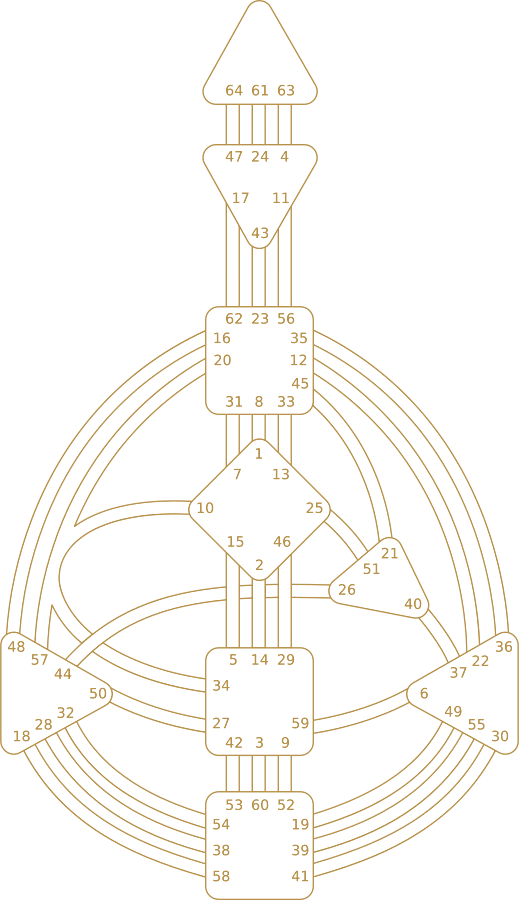

3/6 Human Design Profile: The Martyr Role Model
The 3/6 Human Design Profile is called the Martyr / Role Model. Like every profile with a Line 6, it lives through three distinct life phases. Line 3 learns by trial and error, and Line 6 turns decades of that experience into wisdom others can trust.
Spend the first third of life running every experiment, the middle third processing what they taught you, and the last third as a living example of what works. Your messy years are the curriculum.
Not sure of your Profile? Find it in your free chart on this page. It is the two numbers next to Profile, like 3/6.
3/6 Profile at a glance
The 3/6 Profile from the Human Design canon.
| Profile | 3/6, Martyr / Role Model |
|---|---|
| First number (conscious) | Line 3, the Martyr: learns by trial and error. Your Personality Sun line, the half you experience yourself as. |
| Second number (unconscious) | Line 6, the Role Model: lives in three distinct phases. Your Design Sun line, often the half other people meet first. |
| Angle | Right Angle (Personal Destiny): your life runs through your own experience. Your Incarnation Cross is one of the 64 Right Angle Crosses. |
| Harmonic pair | Yes. Lines 3 and 6 sit in the same position of the lower and upper trigram, so they resonate. |
| Line 6 phases | Experiment until about 30, On the Roof from about 30 to 50, Role Model from about 50. The ages are approximate. |
| Share of charts | About 2.3%, from Jovian Archive's statistics. |
Because lines 3 and 6 are a harmonic pair, the experiments of the early years feed the perspective of the later ones.
Find your Profile in your chart
Enter your birth date, time and place. Your Profile is the two numbers shown next to Profile: the first is your Personality Sun line, the second your Design Sun line.
Each of the 12 Profiles has its own guide:
What is the 3/6 Human Design Profile?
The 3/6 is one of 12 Profiles, and its life arc serves a purpose that often shows only in hindsight. You know your best understanding comes from testing things yourself. What runs below your awareness is the structure around it, three phases that you may not recognize while you are living them.
This is a Right Angle Profile, Personal Destiny, so the three-phase journey runs through your own experience. Compared with the 1/3, which tests from a foundation of research, the 3/6 tests inside a developmental arc, and its wisdom takes decades because that arc cannot be rushed.
Line 3: The Martyr
The full guide: Line 3 in Human Design, as a first and a second number and in all 64 Gates.
Line 3 is the conscious engine of experimentation. What the 1/3 and 3/5 pages say about trial and error and bonds made and broken applies here. In the 3/6 it has a structural job: it produces the raw material Line 6 organizes into wisdom.
What sets the 3/6 apart is the double-3 effect. In Phase 1, a Line 6 profile lives like a third line, so you run a conscious 3 and an unconscious 6 acting as a 3. The first decades are intensely experimental, and designed to be.
Off track, the shame of getting it wrong hits harder, and the weight of experiments that failed can harden into pessimism that follows you into Phase 2. The work is reframing Phase 1 from "everything went wrong" to "everything taught me something."
Line 6: The Role Model
The full guide: Line 6 in Human Design, as a first and a second number and in all 64 Gates.
Where Lines 1 to 5 keep one theme through life, Line 6 changes how you show up at different ages. One lesson its phases often carry is trust. The young 3/6 trusts quickly and gets burned. The middle-aged 3/6 turns selective. The mature 3/6 trusts correctly, having tested enough to know what holds.
In the hexagram house, Line 6 lives on the roof, the highest vantage point. From there you see patterns people on lower floors cannot, and you can watch dynamics without being caught in them. The roof can also be lonely, because Phase 1's intensity has faded and Phase 3's engagement has not arrived.
Unprocessed Phase 1 pain turns Phase 2 cynical: "I have seen everything, and none of it works." Cynicism and discernment can look alike from outside, but only discernment grows into the Role Model.
The three life phases of the 3/6
The ages are approximate, with the changes around thirty and around fifty. Treat them as a shape, not birthdays. The more honestly you live each phase, the more the next one has to work with.
Phase 1: The Experiment (~0-30)
You live like a third line: intense, often chaotic trial and error. Relationships form and dissolve, careers shift, beliefs get tested. This phase gathers raw material, so the more fully you engage, the richer what you carry forward.
Phase 2: On the Roof (~30-50)
Around the Saturn return, experimenting slows and you step back to observe. It can feel like a lull, but it is integration. The trap is coming off the roof early because you feel pressure to be productive.
Phase 3: The Role Model (~50+)
Around the Chiron return, you come off the roof with what the first two phases produced. People trust you because the wisdom shows in how you live. You keep learning, now in service of modeling correct engagement.
The 3/6 Profile by Type
Your Type shapes how you move through each phase. Here is the 3/6 in each.
3/6 Generator
Your Sacral response filters experiments in Phase 1, tells you which reflections deserve engagement in Phase 2, and confirms which role model work fits in Phase 3. Your Strategy is to respond. The trap at every phase is initiating out of Frustration instead of responding, and Satisfaction is the signature when you respond.
3/6 Manifesting Generator
Phase 1 runs at Manifesting Generator speed: start, pivot, adjust. Phase 2 can feel frustrating because your energy wants to engage, not observe. Phase 2 is processing, not stagnation. Respond, then inform before acting, and Phase 3 brings that speed to mature wisdom for rapid, grounded impact.
3/6 Projector
Phase 1 is hard because you lack consistent energy for a double-3 pace, so wait for the invitation and choose experiments carefully. Phase 2 often fits: the roof suits your seeing. Phase 3 gives a steady guide with system-seeing clarity and decades of tested experience. Success follows, and Bitterness is the warning.
3/6 Manifestor
Initiating in Phase 1 with double-3 intensity makes a turbulent first chapter. Phase 2 asks you to step back, which does not come naturally, and informing matters most there because people may not understand why you went quiet. Inform before you act and Peace follows. Anger is the Not-Self signal.
3/6 Reflector
You absorb every environment you test, so Phase 1 data is rich and sometimes overwhelming. The roof gives you needed distance from what you absorbed. Phase 3 produces a role model who can tell healthy from conditioned. Wait a lunar cycle, about 28 days, at every phase. Surprise is the signature, Disappointment the warning.
Conditioning and deconditioning
In a culture that rewards early success and straight lines, the three-phase arc feels like falling behind. Deconditioning takes about seven years.
"You should have figured this out by now."
This calls Phase 1 a failure to settle and Phase 2 procrastination. Your timeline is the design, and skipping phases yields a shallow wisdom that was never integrated.
"Everyone else has it together."
Comparison treats cleaner-looking paths as the standard and yours as a deviation. How a path looks from outside says little about how well it was tested. Yours looks messy because you examined everything, and what survives is reliable.
"Just commit to something."
Locking in a career or relationship before your system has processed the experiments creates commitments that break later. Let Phase 2 finish, and what you commit to in Phase 3 holds.
"Your best years are behind you."
This inverts the design. Your 20s are the chaotic Phase 1, and the Role Model period starts around fifty. Absorb the message and you grieve a decline that is not happening.
Relationships
Relationships follow the phase you are in, and honesty about which one matters most.
Phase 1 and 2
Phase 1 bonds are intense, formative, and often short, because you are testing everything. They are data, not mistakes. In Phase 2 you grow selective, and partners need to know your distance is earned discernment, not coldness.
Phase 3
By now you know what works in connection. You engage as a complete person, and trust runs deeper because the foundation took decades to build.
What helps
Do not expect Phase 3 stability in Phase 1. Partners who understand the arc and do not pressure you for stability you have not reached support the design.
To see how your design meets someone else's, use the Human Design Compatibility Calculator.
Work and career
Test, learn, refine, share: the rhythm holds, and only the scale changes. Phase 1 tests broadly, Phase 2 refines, and Phase 3 delivers with earned authority.
Phase 1 and 2 career
Job changes and varied paths look unstable but are correct for Phase 1. A "forever career" there feels like a trap. In Phase 2 you consolidate around what fits, and the trap is staying on the roof without applying it.
Phase 3 career
Teaching, mentoring, advising, and leading from experience, wherever "I have been through this" creates value. People follow because the lived experience is clear.
Daily practice
Know which phase you are in and use its practice: experiment honestly, observe without forcing, or share what is tested. Review what the "failures" taught you, and let Authority confirm timing rather than committing early.
Next steps
Your Profile describes your role and phases. Your Type, Strategy, and Authority show how your energy runs and how you decide. Start there, then compare the other Profiles, learn how to read your chart, or run your free chart.
A Human Design reading shows how your 3/6 meets your own Type, Authority, and Centers across 60+ sections.
FAQ: 3/6 Human Design Profile
What does 3/6 mean in Human Design?
The 3/6 combines Line 3 (the Martyr) with Line 6 (the Role Model). Line 3 is your conscious side and learns by trial and error. Line 6 is your unconscious side and moves through three phases: experimentation, observation, and role model embodiment.
What are the three phases of the 3/6?
Phase 1 (to about thirty) is intense experimentation. Phase 2 (about thirty to fifty) is the roof, where you step back and process. Phase 3 (about fifty on) is the role model phase, where you re-engage as a living example.
What does "double Line 3" mean in Phase 1?
Until the Saturn return, Line 6 lives like a third line. Your conscious and unconscious sides both run experiments, which makes the first decades intense and often chaotic. That is by design.
Why does the 3/6 feel like a late bloomer?
The Role Model phase begins around fifty. You are not behind: this slow arc produces wisdom that is deep and trustworthy.
Is the 3/6 a harmonious profile?
Yes. Lines 3 and 6 are a harmonic pair, sitting in the same position of the lower and upper trigram, so they resonate. Line 3's experiments feed the wisdom Line 6 develops, which is why nothing from the messy early years is wasted.
What careers suit a 3/6 profile?
Career changes with the phase: exploration in Phase 1, expertise in Phase 2, and teaching, mentoring, or advising in Phase 3. Throughout, look for roles that value real-world testing over credentials.
How does the 3/6 work in relationships?
Relationships match the phase: intense and formative in Phase 1, selective in Phase 2, and deeply authentic in Phase 3, built on decades of learning what works in connection.
How is the 3/6 different from the 6/3?
Both contain Lines 3 and 6. In the 3/6, experimentation is conscious and the three phases run unconsciously. The 6/3 reverses this, so the inner experience of each phase differs.
Can my profile change?
No. It is calculated from your birth data. What changes is which phase of Line 6's arc you are in, which shifts how the profile shows up.
How does the 3/6 profile relate to Type and Authority?
Your Profile is your role and phases, your Type is your energy mechanics, and your Authority is how you decide. Authority filters which experiments to run in Phase 1, which observations to act on in Phase 2, and which engagements to accept in Phase 3.