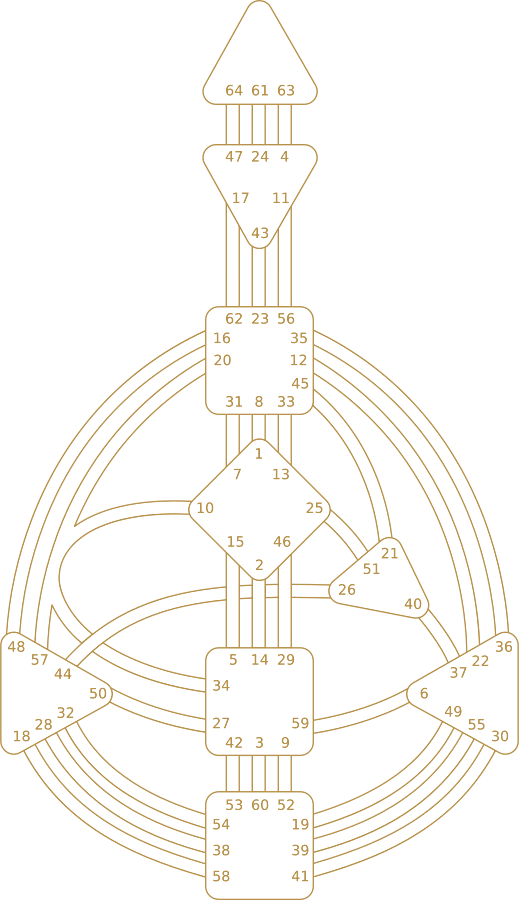

Human Design Connections
Human Design connections are the four ways two people meet in a Channel when their charts are read together: electromagnetic, companionship, dominance and compromise. Each comes from which Gates each person has, so it is fixed by the two charts, and together they describe where a relationship pulls, settles, pushes and clashes.
Simple way to think about it: Picture two maps laid one on top of the other. Where both show the same road, you walk it together; where each shows half a bridge, the bridge appears only when the maps meet; and where one map has a road the other lacks, one of you leads the way there.
Find the connections between two charts
Enter both birth details to see every Channel the two of you make together.
Put both charts into the Compatibility Calculator. For each Channel, look at who has which Gate: both of you have the whole Channel, one of you has it and the other has one Gate, one of you has it and the other has neither Gate, or each of you has one Gate. Those four cases are the four connections.
The Partnership Composite
Partnership Analysis reads both people's activations in one BodyGraph (the Partnership Composite). It looks at two things: the Center formula (how many Centers are defined in the composite) and the Channel formula (the four ways two people meet in a Channel).
Reading the two charts as one picture changes what you look for. Instead of comparing two separate lists of Gates, you see which Channels and Centers are defined when the two charts are combined, and who brings what to each.
The Channel formula, the four connections below, says how you meet in each Channel. The Center formula, further down, says how much of the BodyGraph the two of you define together.
The four connections
| Connection | How it forms in a Channel |
|---|---|
| Companionship | Both people have the same Channel defined. |
| Compromise | One person has the Channel defined and the other has only one of its Gates. |
| Dominance | One person has the Channel defined and the other has no Gate of it at all. |
| Electromagnetic | Each person has one Gate of the Channel and neither has the whole Channel; together they complete it. |
Companionship
You both have the same Channel defined. It is shared ground that tends to feel easy and safe, and the canon calls it uncommon, because people tend to be drawn to what they do not carry.
Compromise
One of you has the whole Channel and the other has only one of its Gates. It is the hardest of the four and fixed by the mechanics: in that Channel the person with one Gate either follows the other's lead or the two keep clashing.
Dominance
One of you has the Channel and the other has neither Gate. It is a steady, one-way conditioning neither person can change, usually irritating rather than serious, and going along with it teaches both of you about your differences.
Electromagnetic
Each of you has one Gate and neither has the whole Channel, so together you complete it. It brings a strong pull with charge in both directions: each wants what the other brings and also rubs against it.
The order of checks
Each Channel between two charts is read once, in this order: companionship, then compromise, then dominance, then electromagnetic. The first rule that fits names the connection, so a Channel never counts twice.
The order matters because the cases overlap at the edges. If you both have a Channel, it is companionship even though each of you also has its Gates. Reading companionship first, then compromise, then dominance, then electromagnetic gives every Channel exactly one name.
The Center count
The composite is also read as a count: how many of the nine Centers the two of you define together, against how many stay open. BodyGraph names each count with a theme; the ones confirmed so far are 9 - 0 (Nowhere To Go), 8 - 1 (Have Some Fun), 7 - 2 (Work To Do).
The count is a second, simpler lens than the Channels: it shows how much of the BodyGraph is defined between you and how much stays open. Only the counts confirmed in BodyGraph's own output are named here; the rest are left unnamed rather than guessed.
How to read a pair
One way to start is with the Channels that join a motor to the Throat, and with the ones that define the Sacral or the Solar Plexus, because those shape a lot of daily life. Note which of the four each one is, then look for patterns: where the pull is, where the shared ground is, and where one person sets the tone.
Then come back to each person on their own. The connections describe the field between two people; each person's Type, Strategy and Authority still decide how they move in it.
Connections are not a compatibility score
No connection is a verdict on a relationship, and no count makes a pair right or wrong for each other. Electromagnetic Channels carry charge, companionship is shared ground, and compromise and dominance show where one person's design shapes the other's.
That makes connections most useful as a way to name what is already happening. Once a recurring argument or an easy afternoon has a Channel attached to it, it becomes something two people can talk about instead of something they blame each other for.
Read each connection
FAQ: Human Design Connections
What are the four connections in Human Design?
Electromagnetic, companionship, dominance and compromise. They are the four ways two people can meet in a Channel when their charts are read together in the Partnership Composite.
What is the Partnership Composite?
Both people's activations read in one BodyGraph. It looks at two things: the Channel formula, which is the four connections, and the Center formula, which counts how many Centers the two define together.
Which connection is the hardest?
Compromise. One person has the whole Channel and the other has only one of its Gates, so in that Channel the person with one Gate either follows the other's lead or the two keep clashing.
Can two people have all four connections?
Yes. Each Channel is read on its own, so one pair can have companionship in one Channel, dominance in another, compromise in a third and electromagnetic in a fourth.
Do connections apply to friends and family?
Yes. The mechanics are the same for any two charts: partners, parent and child, siblings, friends or coworkers. Only the way you live with them changes.
Which planets count for connections?
The Gates of the 13 planets in each chart: the Sun, Earth, the Nodes, the Moon and the planets from Mercury to Pluto. Chiron and Lilith never count.