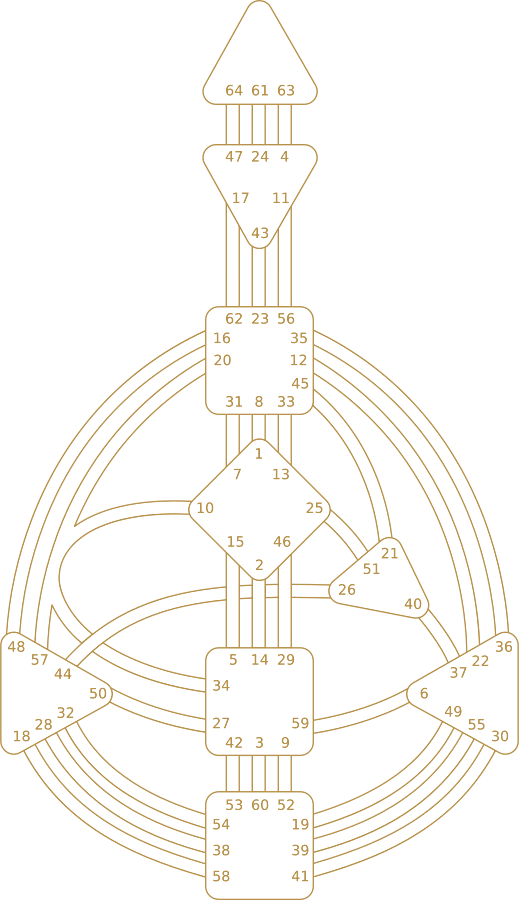
HUMAN DESIGN HD • PROFILE GUIDE

6/2 Human Design Profile: The Role Model Hermit

The 6/2 Human Design Profile is called the Role Model / Hermit. It's the only profile where the three-phase maturity arc is conscious. In the 3/6 and 4/6, Line 6 operates unconsciously and you may not recognize the phases until looking back. In the 6/2, you can feel them shifting. You know when you're in the messy experiential phase. You know when you've stepped back to observe. You can sense when the role model energy is beginning to arrive. This conscious awareness gives you a form of agency over your developmental arc that no other Line 6 profile has.

This is one of the six inharmonious profiles in Human Design. Line 6 moves through phases that change your perspective, standards, and engagement with the world. Line 2 needs consistent private space to maintain natural talent that develops below your awareness. The tension: Phase 2's observation combined with Line 2's retreat can create a double withdrawal that crosses from healthy integration into isolation. When you learn to balance the phase process with adequate (but not excessive) solitude, the combination produces a role model whose authority is both deeply earned and naturally expressed.

This is a Left Angle profile (transpersonal karma), meaning your influence extends beyond personal development. On this page, you'll learn how the conscious three-phase arc differs from unconscious Line 6 profiles, how Line 2's natural talent operates across all three phases, how the 6/2 expresses differently across all five Types, what conditioning patterns to watch for, and how this profile operates in relationships, work, and the long arc of growth.

Simple way to think about it: the 6/2 is the conscious observer who carries natural gifts they don't fully see. You can feel your life moving through chapters. You know your perspective is deepening. And somewhere in the background, you carry talent that others notice before you do. The role model you're becoming will express that talent naturally, once you've given both the phases and the gifts enough time and space to mature.

What is the 6/2 Human Design Profile?

In Human Design, the 6/2 profile is one of 12 Profiles that describes your role, your learning style, and the way you naturally interact with the world. It combines Line 6 (the Role Model) with Line 2 (the Hermit), creating someone who consciously experiences a three-phase maturity process while unconsciously carrying natural talent that needs private space to stay effective.

The first number (6) is your conscious line, the Personality side. You can feel the three-phase arc operating in your life. You're aware that your perspective deepens over time, that your standards evolve, and that you're developing toward something that takes decades to fully emerge. This conscious awareness is both a gift (you can trust the process because you can see it happening) and a source of impatience (you can see how far you still have to go, which can make the timeline feel frustratingly slow).

The second number (2) is your unconscious line, the Design side. Line 2 operates below your awareness as natural talent that develops through private process rather than formal study. Your gifts feel ordinary to you because they came without effort. Others see them more clearly than you do. Across all three phases, Line 2's need for retreat remains constant, providing the private space each phase requires for proper integration.

The inharmonious tension between Lines 6 and 2 shows up most clearly in Phase 2. Line 6 goes on the roof to observe. Line 2 pulls toward retreat. Together, they can create a double withdrawal: you step back from life's intensity (Line 6) AND retreat into solitude (Line 2), which can cross from productive integration into disconnection. The practice is knowing when solitude serves the process and when it's become avoidance.

Compare the 6/2 to the 3/6 profile. Both carry Line 6's three-phase arc. The critical difference: in the 3/6, Line 6 is unconscious and Line 3 is conscious (you identify with experimentation). In the 6/2, Line 6 is conscious (you can feel the phases) and Line 2 is unconscious (natural talent operates in the background). The 3/6 gathers wisdom through conscious trial and error. The 6/2 gathers wisdom through conscious phase observation plus unconscious natural development. The 3/6 is Right Angle. The 6/2 is Left Angle.

The Left Angle geometry means your role model influence extends beyond your personal circle. Your mature expression in Phase 3 doesn't just affect the people immediately around you. It ripples outward into communities, audiences, and groups that may not know you personally. This transpersonal reach is why the 6/2's maturity process matters beyond personal growth: what you become affects more people than just you.

Your Profile describes your role and learning style, while your Type, Strategy, and Authority show how your energy operates and how you're designed to make decisions.

Line 6: The Role Model (Conscious)

Line 6 in the 6/2 is conscious, which fundamentally changes the experience of the three-phase arc. In the 3/6, you might look back at age 35 and realize "Oh, my life had a distinct chapter that ended around 30." In the 6/2, you can often feel the transition happening in real time. You know when Phase 1's intensity is winding down. You can sense when the observation phase is beginning. You may even consciously anticipate Phase 3's arrival.

This conscious awareness gives you agency. You can participate in your developmental process deliberately rather than being carried through it unconsciously. In Phase 1, you can frame difficult experiences as learning rather than only seeing them as chaos. In Phase 2, you can observe with intention rather than withdrawing reactively. In Phase 3, you can step into role model expression with awareness rather than stumbling into it by default.

Line 6 carries the theme of trust. The entire arc is a trust curriculum: Phase 1 teaches you what can't be trusted through direct experience. Phase 2 develops the discernment to distinguish genuine trust from naive hope. Phase 3 embodies earned trust, both in yourself and in the specific people and situations that have proven themselves over decades. The 6/2's conscious awareness of this trust theme means you can actively engage with the learning rather than just absorbing it passively.

The not-self expression of conscious Line 6 is pessimism with awareness. Because you can see the phases, you can also see how far you are from Phase 3. If Phase 1 experiences were painful and haven't been reframed, the conscious mind can generate a running commentary of cynicism: "I've seen everything and none of it works." This is more sophisticated than the unconscious pessimism of the 3/6 or 4/6 because you're aware of the pattern while still being caught in it. The exit is the same: processing Phase 1 experiences into discernment rather than holding them as evidence of a broken world.

Line 2: The Hermit (Unconscious)

Line 2 in the 6/2 operates the same way it does in the 2/4, 2/5, and 5/2: natural talent that develops through private process, an inability to fully see your own gifts, and a structural need for solitude.

What makes Line 2 significant in the 6/2 is that it provides a constant across all three phases. Phase 1 changes. Phase 2 changes. Phase 3 changes. But Line 2's need for retreat and the quiet development of natural talent remain consistent throughout. This constancy gives the 6/2 an anchor: no matter which phase you're in, the practice of protecting private space applies. The content of the solitude changes (Phase 1 solitude processes raw experience, Phase 2 solitude integrates observation, Phase 3 solitude restores role model energy), but the need for it never does.

The challenge is that Line 2 is unconscious. You may not realize how much your effectiveness depends on retreat until you've been overexposed. Because Line 6 is conscious and often focused on the developmental process, you may over-prioritize phase-related engagement and under-prioritize the solitude that Line 2 needs to keep your natural talent accessible. The 6/2 who deliberately schedules retreat across all phases maintains the natural quality that makes their eventual role model expression genuine rather than performed.

The three life phases of the 6/2

Phase 1: Conscious Learning (~0-30)

The 6/2 experiences Phase 1 with more awareness than the 3/6 or 4/6. You can feel that what you're going through is formative, even when it's painful. Relationships, careers, and directions shift as you discover what's real versus what's projected. Line 2's natural gifts are present during this phase but may not be fully recognized because Phase 1's intensity dominates your attention. The conscious Line 6 advantage: you can reframe experiences as learning in real time rather than only seeing the pattern in hindsight.

Phase 2: Conscious Observation (~30-50)

Around the Saturn Return, the 6/2 goes on the roof with awareness. You know you're stepping back. You can feel the shift from engagement to observation. This is when the double-withdrawal risk is highest: Line 6 observes from the roof AND Line 2 retreats into solitude. The practice is maintaining enough connection to stay alive as a social being while protecting enough space for both the observation process and the talent development. Phase 2's conscious observation gives you exceptional clarity about patterns, people, and systems, but only if you're observing life rather than avoiding it.

Phase 3: Conscious Role Model (~50+)

Around the Chiron Return, the 6/2 comes off the roof and re-engages with life as a conscious example. You know you're stepping into role model expression. You can feel the shift from observer to participant. For the 6/2, Phase 3 has a distinctive quality: your role model energy is expressed through natural gifts (Line 2) that have been developing privately across two full prior phases. The result is a form of authority that feels both earned (because the phases are conscious and genuine) and effortless (because Line 2's talent flows without force). The Left Angle transpersonal reach means this Phase 3 expression affects communities beyond your personal circle.

The 6/2 Profile by Type

Your Profile describes your developmental arc and learning style. Your Type describes your energy mechanics. The combination shapes how you move through each phase.

6/2 Generator

The 6/2 Generator uses Sacral response to navigate each phase. In Phase 1, the Sacral helps you feel which experiences are genuinely formative versus which are just chaotic. In Phase 2, it confirms which observations deserve engagement. In Phase 3, it signals which role model expressions are correct. The Generator's sustained energy supports Line 2's natural talent across all phases. The trap is staying in Phase 2 observation too long because the Sacral isn't being given anything to respond to.

6/2 Manifesting Generator

The 6/2 MG may find Phase 2's observation period especially challenging. The MG energy wants to engage, create, and move, but Phase 2 asks you to step back and watch. The key is recognizing that Phase 2 isn't stagnation for the MG. It's selective engagement: you're not stopping, you're choosing more carefully. Phase 3 re-engagement happens with the full force of MG speed applied to mature wisdom and natural talent, producing rapid, grounded impact.

6/2 Projector

The 6/2 Projector's Phase 2 aligns naturally with the Projector's design: both involve observation, system-seeing, and waiting for recognition. This period is where the 6/2 Projector often produces their deepest insights. Phase 3 produces one of the most powerful guide expressions in the system: a Projector with decades of conscious observation, natural talent, and the ability to see systems clearly, all flowing through an invitation-based engagement model.

6/2 Manifestor

The 6/2 Manifestor initiates differently at each phase. Phase 1 initiations are intense and formative. Phase 2 initiations become more selective and strategic. Phase 3 initiations carry the authority of decades of observation plus natural talent. Inform the people affected by your actions at every phase. The 6/2 Manifestor who informs consistently builds the trust that makes their Phase 3 role model expression land with community support rather than resistance.

6/2 Reflector

The 6/2 Reflector mirrors the phase process through their open design. Phase 1's intensity is absorbed and reflected. Phase 2's observation is amplified by the Reflector's natural mirroring ability. Phase 3 produces a role model who can reflect genuine community health versus conditioned dysfunction with unusual accuracy. The 29-day lunar cycle gives natural pacing at every phase, preventing premature transitions and ensuring each phase completes fully.

Conditioning and deconditioning

The 6/2's conditioning patterns target both the conscious phase process and the unconscious natural talent. Conditioning either rushes the phases or blocks the retreat.

"You should be further along by now."

This attacks the three-phase timeline. Because Line 6 is conscious, you can feel how far Phase 3 still is, which makes this conditioning message especially effective. The 6/2 who absorbs it either forces premature role model authority (performing wisdom before it's genuine) or despairs at the timeline (giving up on the process because it seems too slow). The truth: your phases can't be rushed. The depth they produce is proportional to the time they take.

"Stop hiding and get out there."

This attacks both Line 2's retreat AND Phase 2's observation. It tells you that your withdrawal is avoidance, that privacy is laziness, and that you should be constantly visible. The 6/2 who absorbs this forces engagement during periods when their design needs integration. The truth: retreat serves a different purpose at each phase, but it's never optional. Phase 2 especially requires significant private processing time.

"What's so special about what you do? Anyone could do that."

This attacks Line 2's natural talent at the root. Because your gifts feel ordinary to you (they came without effort), you're vulnerable to this dismissal. The truth: the ease is the signal. What feels unremarkable to you looks genuinely remarkable to others. Trusting the evidence rather than your self-assessment is the practice.

"You've become too detached from reality."

This can be accurate or conditioning, depending on whether your Phase 2 observation has crossed into disconnection. The practice is checking Authority: is your distance serving the integration process, or has it become a way to avoid the vulnerability of re-engagement? Healthy Phase 2 observation maintains enough connection to stay relevant. Unhealthy withdrawal creates a gap between your perspective and the reality you'll need to engage with in Phase 3.

Deconditioning for the 6/2 means trusting the phase timeline, protecting retreat without guilt, recognizing your natural talent as genuinely valuable, and maintaining enough connection during Phase 2 to prevent isolation from replacing observation.

Relationships

Phase 1 relationships

Intense and formative. Because Line 6 is conscious, you may be aware during Phase 1 that these relationships are teaching you about trust, even when the lessons are painful. Line 2's retreat need can create friction with partners who expect constant availability. The 6/2 in Phase 1 is learning what genuine connection looks like through direct experience, and the conscious awareness of the learning process can make you seem more mature than your years suggest.

Phase 2 relationships

More selective, more observant, and potentially more distant. The double withdrawal (Line 6 on the roof + Line 2 in retreat) can create genuine isolation if you're not careful. Phase 2 relationships work best with partners who understand that your distance isn't rejection. It's integration. You need someone who can respect your observation period without taking your selectivity personally and who can hold the relationship steady while you process decades of experience.

Phase 3 relationships

The most authentic expression. By Phase 3, you know from decades of conscious observation and lived experience what genuine connection looks like. Your relationships carry the quality of earned trust: you've tested it, observed it, and now you embody it. Line 2's natural gifts flow into your partnerships without force, creating a quality of presence that partners experience as both easy and deeply trustworthy.

What helps at every phase

Partners who respect retreat without interpreting it as rejection. People who can hold space for your evolving perspective without trying to fix your process. Relationships where honesty about which phase you're in creates shared understanding rather than conflict. The 6/2 needs someone who can grow with them across phases, which requires both patience and genuine appreciation for the depth the process produces.

To see how your design interacts with someone else's, use the Human Design Compatibility Calculator.

Work and career

Phase 1 career

Exploration and formative experience. Jobs may shift as you discover what aligns with your natural talent and evolving values. The conscious awareness of the phase process can create a paradox: you know this period is formative, which may make you more deliberate about choosing experiences, but you also know it will end, which can create impatience. Let Phase 1 run its course. The experiences you gather here become the foundation for Phase 3 authority.

Phase 2 career

More autonomous, more selective, more focused. This is often when the 6/2 develops their deepest expertise because the observation period allows concentrated growth within a refined professional context. Line 2's natural talent may become more visible during Phase 2 because you've stepped back from the intensity that obscured it in Phase 1. The work that emerges during this period tends to carry a natural quality that colleagues notice even when you don't.

Phase 3 career

Role model expression through natural talent. Teaching, mentoring, advising, leading by example, and any role where decades of conscious development plus effortless natural ability create genuine authority. The Left Angle transpersonal reach means your Phase 3 career influence extends beyond your immediate organization into wider professional communities. People follow the Phase 3 6/2 because the combination of earned wisdom and natural talent is genuinely rare.

Leadership style

Example-based authority expressed through natural talent. People follow the 6/2 not because you demand it but because they can see that you live what you teach with a quality that feels both genuine and effortless. Your leadership deepens with each phase: Phase 1 builds credibility through experience, Phase 2 refines perspective through observation, Phase 3 embodies everything through natural expression.

Growth arc

The 6/2 growth arc is the three phases experienced consciously. You can feel the transitions, which means you can participate in your own development rather than being carried through it. Phase 1 builds the experiential foundation while Line 2 develops talent quietly in the background. Phase 2 integrates those experiences through conscious observation while Line 2's retreat provides the private space for deep processing. Phase 3 expresses the resulting wisdom naturally through Line 2's gifts, creating a role model whose authority is both earned through conscious living and expressed through effortless natural ability.

The breakthrough is trusting both the phases and the talent. Your conscious awareness of the developmental process can create impatience. Your unconscious talent can feel unremarkable. But the combination of conscious development plus natural ability, expressed across a transpersonal Left Angle reach, produces one of the most trustworthy and impactful role model expressions in the system. Trust the timeline. Trust the gifts. Both are real.

Daily practice

Protect retreat across all phases

Line 2's need for solitude doesn't change between phases. What changes is what the solitude serves. Phase 1: processing experience. Phase 2: integrating observation. Phase 3: restoring role model energy. Build private time into your schedule at every phase. This isn't luxury. It's the infrastructure that keeps your natural talent accessible and your phase development on track.

Stay connected during Phase 2

The double withdrawal (Line 6 observation + Line 2 retreat) can create genuine isolation. Maintain enough connection to stay relevant: a few genuine relationships, periodic engagement, enough contact with reality to keep your observations grounded. The roof is for observing life, not for disappearing from it.

Trust what others see in you

Line 2's natural talent feels ordinary to you. When people tell you you're good at something, when your abilities produce results others find remarkable, notice the evidence rather than dismissing it. The talent is real. Your inability to see it clearly is the design (Line 2 is unconscious). Let the external evidence inform your self-assessment.

Use Authority for phase-level decisions

Major decisions at each phase (who to commit to, what career to pursue, where to live, when to re-engage) need Authority confirmation. Your conscious awareness of the phases can generate pressure to make phase-appropriate decisions from the mind rather than from Authority. The mind can see which phase you're in. Authority can tell you what's correct within that phase. Both are needed. Authority takes priority.

Quick recap: The 6/2 Profile is the Role Model / Hermit. It's one of six inharmonious profiles and a Left Angle (transpersonal karma) profile. Line 6 (conscious) carries a three-phase maturity arc you can feel shifting. Line 2 (unconscious) carries natural talent that needs retreat across all phases. The 6/2 is the only profile where the three-phase process is conscious, giving you agency over your developmental arc. The double-withdrawal risk in Phase 2 (Line 6 observation + Line 2 retreat) requires active management. Phase 3 produces a role model whose authority is both consciously earned and naturally expressed, with transpersonal influence that reaches beyond your personal circle.

Your personalized reading explains how your 6/2 Profile interacts with your Type, Strategy, Authority, Centers, Gates, and Channels to shape your specific phase experience, natural talent expression, and role model path. Learn what a reading includes.

Want to go deeper? Get your personalized Human Design reading — 50+ sections written for your exact chart, a free Self-Discovery Notebook, a personalized MP3 letter, and your personal AI guide Jessica. Yours forever.

FAQ: 6/2 Human Design Profile

What does 6/2 mean in Human Design?

The 6/2 profile combines Line 6 (the Role Model) with Line 2 (the Hermit). Line 6 is your conscious personality that moves through three life phases you can feel. Line 2 is your unconscious design that carries natural talent and needs retreat across all three phases.

What are the three phases of the 6/2?

Phase 1 (birth to approximately age 30) is conscious experiential learning. Phase 2 (approximately 30-50) is conscious observation from the roof. Phase 3 (50+) is conscious re-engagement as a role model whose natural talent flows through decades of lived perspective.

Why is the 6/2's three-phase arc different?

In the 3/6 and 4/6, Line 6 is unconscious: you may not recognize the phases until looking back. In the 6/2, Line 6 is conscious: you can feel the phases shifting in real time. This gives you agency over your developmental process that other Line 6 profiles don't have.

What is the double-withdrawal risk?

In Phase 2, Line 6 goes on the roof to observe AND Line 2 retreats into solitude. Together, they can create isolation that crosses from productive integration into disconnection. The practice is maintaining enough connection to stay grounded while protecting enough space for both the observation and the talent development.

Is the 6/2 an inharmonious profile?

Yes. Line 6 evolves through phases that change your perspective. Line 2 needs consistent retreat that doesn't change between phases. The tension is between evolving engagement (Line 6) and constant withdrawal need (Line 2). Managing both simultaneously is the practice.

What careers suit a 6/2 profile?

Autonomous roles where depth and long-term growth matter. Career expression evolves across phases: exploration in Phase 1, focused expertise in Phase 2, and role model leadership through natural talent in Phase 3. Teaching, mentoring, advising, creative work, and any environment that allows retreat and values example-based authority.

How is the 6/2 different from the 3/6?

Both carry Line 6's three-phase arc. In the 6/2, Line 6 is conscious (you feel the phases) and Line 2 is unconscious (natural talent). In the 3/6, Line 3 is conscious (experimentation) and Line 6 is unconscious (phases operate below awareness). The 6/2 is Left Angle. The 3/6 is Right Angle.

How does the 6/2 work in relationships?

Relationships evolve with each phase. Phase 1 connections are formative. Phase 2 connections are more selective. Phase 3 connections carry the deepest authenticity. The double-withdrawal risk in Phase 2 requires partners who don't interpret retreat as rejection. Honest communication about which phase you're in creates shared understanding.

Can my profile change?

No. Your profile is calculated from your birth data and doesn't change. What changes is which phase of the conscious three-phase arc you're currently in, which fundamentally shifts how the profile expresses across your lifetime.

How does the 6/2 profile relate to Type and Authority?

Your Profile describes your role and developmental phases. Your Type describes your energy mechanics. Your Authority shows how you make decisions. The conscious mind can see which phase you're in. Authority tells you what's correct within that phase. Both are needed. Authority takes priority for decisions.