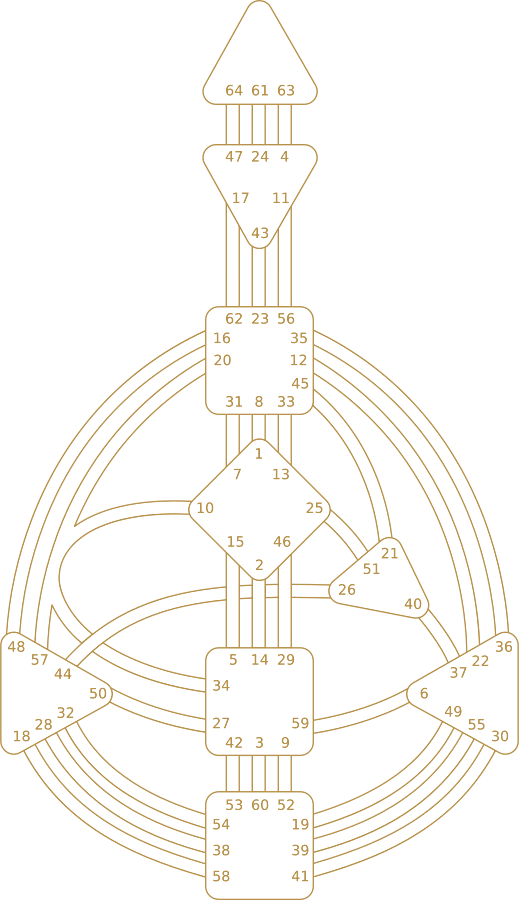

Gate 19 Human Design: The Gate of Wanting
Gate 19 in Human Design is the Gate of Wanting, and its I Ching hexagram is Approach. It lives in the Root Center, the center of adrenaline, pressure, and the drive to act. When Gate 19 is active, you feel the needs around you: the energy in a room, the tension in a voice.
Think of Gate 19 as your tribal antenna. It keeps scanning whether your people have enough food, safety, and connection, and the pressure eases only when the need is met.
Is Gate 19 active in your chart? Check with the free chart calculator on this page. It takes your birth date, time and place.
Gate 19 at a glance
The Gate of Wanting in one place, from the Human Design canon.
Is Gate 19 active in your chart? Find it
Your Gates are calculated from your birth date, birth time and birth place. Enter your details and your free chart shows every active Gate, with the planet that activates it.
The 9 Gates of the Root Center, side by side:
What is Gate 19 in Human Design?
Gate 19 is the Gate of Wanting. Its I Ching hexagram, number 19, is Approach, and its other names include Need and Sensitivity. It carries the pressure to connect with others so that fundamental needs are met. Approach here means moving outward, reaching toward people, seeking connection and resources. It is a deeply tribal energy.
Gate 19 lives in the Root Center. The Root's pressure drives Gate 19 to seek what is needed: food, shelter, emotional connection, belonging, and a sense of something larger than yourself. This is not casual wanting. It is a survival-level awareness that your tribe's basic needs must be met for anyone to thrive.
The approach is sensitive and attentive, not aggressive. Gate 19 belongs to the Tribal Circuit, in its Ego sub-circuit.
What does an active Gate 19 look like?
When Gate 19 is active in your chart, you carry a consistent pressure to know that your needs and your tribe's needs are met: enough food, safety, connection, and belonging.
Constant sensitivity
You feel what people need, often before they express it, and you pick up on subtle shifts in mood, energy, or tension. This is not a flaw. It is a design feature.
Need for security
You need to know your basic needs are met before you can relax. A full fridge, a safe home, people who care about you: when these are in place, you settle and your sensitivity becomes a strength. When they feel threatened, it becomes overwhelming.
Potential challenge
Neediness, or sacrificing your own needs so that others' are met. The pressure to approach and connect can feel relentless. Without Gate 49's principles, you may not know who truly belongs in your circle.
What if Gate 19 is not active in your chart?
If Gate 19 is not active in your chart, you do not carry this pressure to meet needs consistently, and you may meet it in other people: the friend who notices the empty cupboard, the colleague who senses who feels left out. If you carry Gate 49, a person with Gate 19 completes Channel 19-49, the Channel of Synthesis, with you.
The 6 lines of Gate 19
Each of the six lines also has its own guide: Line 1, Investigator · Line 2, Hermit · Line 3, Martyr · Line 4, Opportunist · Line 5, Heretic · Line 6, Role Model.
Every Gate has six lines, and your line changes how Gate 19 expresses through you. It appears as a decimal after the Gate number: 19.1 means Gate 19, Line 1.
Line 1: Interdependence
Sensitivity built on mutual exchange. You need common ground before approaching, and you know giving and receiving must balance for any connection to last.
Line 2: Service
A natural sensitivity that serves others without fanfare. You may not realize how deeply you attune to people's needs until they point it out. Your approach works best when it emerges naturally rather than under outside pressure.
Line 3: Dedication
Once a need matters to you, you commit to it, and through lived experience you learn which needs truly deserve that commitment. Each relationship teaches you what real support looks like.
Line 4: The Team Player
Your sensitivity works as part of a team. Within established networks, you sense the needs of your immediate community and play your part in meeting them.
Line 5: Sacrifice
Others project the role of need-meeter onto you and expect your sensitivity to solve their problems. The challenge is knowing when sacrifice serves growth and when it keeps others dependent.
Line 6: The Recluse
With time and experience, you become selective about who you approach and why. You may avoid general contact but remain deeply available for specific, meaningful connections.
Channel 19-49: The Channel of Synthesis
Gate 19 reaches toward Gate 49, Principles in the Solar Plexus Center. When both Gates are active, they form Channel 19-49, the Channel of Synthesis, linking the Root and the Solar Plexus in the Tribal Circuit (Ego sub-circuit). Both Centers are then defined.
This channel joins the Root's pressure to meet needs (Gate 19) with the Solar Plexus's emotional principles about who belongs and who does not (Gate 49). Together they create someone who senses what people need and also holds the principles that decide whether those needs will be met or refused.
The tribal bond
Channel 19-49 carries the frequency that unites families and communities. Sensitivity to needs combined with principles of belonging is the glue that holds a tribe together, and the force that breaks it apart when agreements are violated.
Gate 19 without Gate 49
This is a hanging Gate. You feel the needs around you but may lack the principles to decide which to meet and which to release. Without that discernment, you may try to meet everyone's needs until you reach exhaustion.
Gate 49 without Gate 19
Gate 49 holds the principles about who belongs, but without Gate 19 the sensitivity that detects what people actually need is not consistently available. Someone with Gate 19 completes it.
Gate 19 by Type
Your Type changes how Gate 19's sensitivity to needs enters your life and how it is best used.
Generator with Gate 19
Your Strategy is to respond. Life presents needs and your Sacral responds to which ones are yours to address. When your body says yes, your sensitivity goes to the right needs.
Manifesting Generator with Gate 19
You may sense several people's needs at once. Your Strategy is to respond, then inform before acting, and to take one need at a time.
Projector with Gate 19
You can accurately sense what a person or group needs and guide others with it. Wait for the invitation. When invited, your attunement can change the quality of support within a family or team.
Manifestor with Gate 19
You may feel sudden impulses to approach others and address their needs. Inform before you act: approaching without warning may meet resistance.
Reflector with Gate 19
You reflect the need-state of your environment and may feel more wanting where needs are unmet. Wait a lunar cycle, about 28 days, before major decisions about who and how to support.
Conscious vs unconscious Gate 19
Conscious (Personality) Gate 19
You are aware of your sensitivity and your pressure to ensure needs are met. You may describe yourself as someone who always notices what people need before they ask.
Unconscious (Design) Gate 19
Others notice your sensitivity before you do. People around you see how naturally you sense what is missing and move to provide it. You may be absorbing others' needs without realizing the toll.
Both sides active
The sensitivity is both consciously felt and unconsciously expressed, a steady attunement to needs that others can feel immediately. Either way, your Authority decides which needs are yours to address.
Which planet activates your Gate 19?
Your chart has 26 activations: 13 planetary positions on the Personality side (black, conscious) and 13 on the Design side (red, unconscious). Gate 19, Wanting, brings the same theme wherever it appears. The planet beside it says where in your life that theme works. These are Ra Uru Hu's thirteen, in his order.
Sun
Life force. Personality expression. With Gate 19 on your Sun, your Earth is in Gate 33.
Earth
Grounding and balance. Always the Gate opposite the Sun. With Gate 19 on your Earth, your Sun is in Gate 33.
North Node
Future direction. The environment and theme of the second half of life, after the Uranus opposition (around 40).
South Node
The past. The environment and theme of the first half of life.
Moon
The driving force. What pushes you.
Mercury
Communication and thinking. What you are here to communicate.
Venus
Values and morality. Ideals.
Mars
Immaturity. Raw energy dynamics; what you have to grow into.
Jupiter
Law and protection. The law you live by, and what rewards you for it.
Saturn
Discipline. The judge; where restraint and structure are demanded.
Uranus
Unusualness. Science, chaos and order; the unexpected.
Neptune
Illusion. The veil; what stays hidden or dissolves.
Pluto
Truth. Transformation; what has to be brought out and made honest.
Chiron and Lilith
Some charts show them too. They are modern additions, not among Ra's thirteen.
Gate 19 on the wheel
The 64 Gates sit in a fixed order around a wheel, one for each hexagram of the I Ching, each spanning 5 degrees 37 minutes 30 seconds. The wheel starts at Gate 41, which the Sun enters around 22 January. Gate 19 is the 2nd Gate from there.
Opposite: Gate 33
Gate 33, Privacy, in the Throat Center, sits directly across the wheel. A Sun in Gate 19 means an Earth in Gate 33, and the other way around.
The Quarter of Mutation
Purpose fulfilled through Transformation. Gate 19 is one of the 16 Gates in this quarter of the wheel, from Gate 1 to Gate 19.
If your Personality Sun is in Gate 19
Your Incarnation Cross is one of three: the Right Angle Cross of The Four Ways (19/33 | 44/24), the Juxtaposition Cross of Need (19/33 | 1/2) or the Left Angle Cross of Refinement (19/33 | 1/2). Your Profile decides which: 4/1 gives the Juxtaposition; 5/1, 5/2, 6/2 and 6/3 the Left Angle; every other Profile the Right Angle.
Every Incarnation Cross with Gate 19
- The Four Waysall four places, one in each version
- AlignmentDesign Sun or Earth, by version
- RefinementPersonality Sun or Earth, by version
Gate 19 in relationships
In relationships, Gate 19 senses when your partner wants something even when nothing has been said. The work is making sure the attunement goes both ways, rather than one person always giving.
Where friction can show up
Meeting your partner's needs at the expense of your own. Resenting that they do not sense YOUR needs with the same accuracy. Over-giving out of fear of being left. Sensitivity turning into surveillance.
What helps
A partner who asks about your needs rather than expecting you to voice them. Shared understanding that your sensitivity is a design feature, not a demand for reciprocation. Space to tend to your own needs without guilt.
Compatibility insight
If your partner has Gate 49, you form Channel 19-49 together: one senses the needs, the other holds the principles for who belongs and what is accepted or refused. Explore it with the compatibility calculator.
Gate 19 at work and in purpose
At work, Gate 19 senses what people need before they put it into words, an insight that data and surveys can miss.
Aligned work
Caregiving, social work, community organizing, animal care, hospitality, food service, advocacy, humanitarian work, and any role where your sensitivity to needs creates tangible value for people or animals.
Misaligned work
Environments that ignore or punish sensitivity, or roles where you must suppress your attunement to look "professional."
Secure your own needs first
You cannot keep serving others' needs if your own are unmet. Financial security, physical safety, and belonging need to be in place before your professional sensitivity can work at its best.
Working with Gate 19 in daily life
Distinguish your needs from theirs
Check in with yourself and ask: "What do I need right now, separate from everyone else?"
Let approach be reciprocal
You are designed to approach others, and also to be approached. Let people come to you and let your needs be met by others. Receiving is as important as giving in Gate 19's tribal exchange.
Let your Authority choose
Gate 19 works best when your own needs are secure. Your Authority tells you which needs are yours to meet and which belong to someone else.
Next steps
See where Gate 19 sits among all 64 in the Human Design Gates guide, read the full Channel of Synthesis page, meet its partner Gate 49, Principles, explore the Root Center, and learn what an active Gate without its partner means on the Hanging Gates page.
A Human Design reading shows Gate 19 in your own chart: its line, the planet activating it, and how it connects to the rest of your design across 60+ sections.
FAQ: Gate 19 Human Design
What is Gate 19 in Human Design?
Gate 19 is the Gate of Wanting, and its I Ching hexagram is Approach. It lives in the Root Center and carries the tribal pressure to ensure that basic needs are met: food, shelter, connection, belonging. One of its other names is Sensitivity.
What center is Gate 19 in?
Gate 19 is in the Root Center, the center of adrenaline, pressure, and the fuel to act. The Root's pressure drives Gate 19 to approach others and seek the resources and connection needed for survival and belonging.
What channel does Gate 19 form?
Gate 19 connects to Gate 49 in the Solar Plexus Center to form Channel 19-49, the Channel of Synthesis. It belongs to the Tribal Circuit, Ego sub-circuit, linking the pressure to meet needs with the emotional principles of who belongs.
What does an active Gate 19 mean?
An active Gate 19 means a consistent sensitivity to the needs of your environment. You are always attuned to whether your people have what they need. When your own needs are secure, this sensitivity becomes a real strength.
What are the 6 lines of Gate 19?
Line 1 (Interdependence) is sensitivity through mutual exchange. Line 2 (Service) is natural service to others' needs. Line 3 (Dedication) is commitment refined through experience. Line 4 (The Team Player) is sensitivity within established networks. Line 5 (Sacrifice) is meeting needs under others' projection. Line 6 (The Recluse) is a selective approach that comes with maturity.
Does my Type change how Gate 19 works?
Yes. A Generator with Gate 19 attunes to needs through response. A Projector with Gate 19 guides support when invited. A Manifestor with Gate 19 informs before approaching. Your Type determines how the sensitivity is best used.
What Gate is opposite Gate 19?
Gate 33, Privacy, sits directly across the wheel from Gate 19. The Earth is always the Gate opposite the Sun, so when your Sun is in Gate 19, your Earth is in Gate 33, and the other way around.
Why am I so sensitive to everything with Gate 19?
Gate 19's sensitivity is built into the Root Center's pressure and the Tribal Circuit's concern with survival and belonging. It is not a flaw. It is how the Gate is designed, and it works best when your own needs are secure.
Is Gate 19 the same as being codependent?
No. Gate 19 is pressure from the Root to meet needs. When your own needs are met, that sensitivity serves others without losing you. When they are not, you may give too much of yourself to meet everyone else's.
What is the Channel of Synthesis?
Channel 19-49 is the Channel of Synthesis. It connects Gate 19 in the Root to Gate 49 in the Solar Plexus, in the Tribal Circuit, Ego sub-circuit. It joins a deep sensitivity to needs with the emotional principles that decide who belongs in the tribe and who does not.