
Line 1 in Human Design: The Investigator
Line 1 in Human Design is the Investigator, the bottom line of every hexagram and the base of the lower trigram. Its theme is needing a foundation before it can act, so it digs and checks. It sits in the 1/3 and 1/4 Profiles as the first number and in the 4/1 and 5/1 Profiles as the second.
Simple way to think about it: The first line is the person who walks the whole foundation of a house before agreeing to live in it. They tap the walls, look in the basement and ask who built it. Once they know the ground is solid, they can relax and enjoy everything above it.
Find your lines on your free chart
Enter your birth date, time and place to see your Profile and every line in your chart.
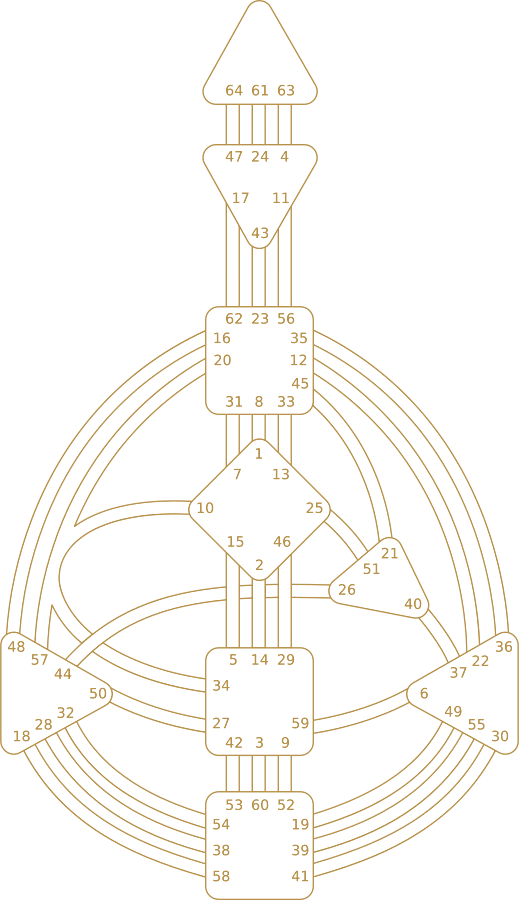
Your Profile is two lines: the first number is the line of your Personality Sun, the second the line of your Design Sun. Every planet in your chart also carries a line, written after the dot: 10.1 means Gate 10, Line 1. The chart symbols guide shows where to read them.
Line 1 as your first number
With Line 1 first, it is your Personality Sun line: the part of the Profile you know and experience as yourself. 16.81% of charts have it here, in the 1/3 and 1/4 Profiles.
As the first number, the first line is the part of yourself you recognize. You probably know that you feel better once you understand something properly, and that a half answer leaves you uneasy. You may be the one who reads the manual, checks the source or asks one more question before saying yes, and in this position that is usually not nervousness. It is how you build the footing you act from.
The challenge on this side is mistaking the preparing for the doing. Because the line is built on knowing, it can keep collecting information long after you have enough. The useful question is not whether you know everything but whether you have a foundation solid enough to take the next step. When the answer is yes, the line is asking you to move, and your Strategy and Authority tell you when.
Line 1 as your second number
With Line 1 second, it is your Design Sun line: it runs below awareness, and other people often meet it before you do. 16.76% of charts have it here, in the 4/1 and 5/1 Profiles.
As the second number, the first line runs below awareness. You may not describe yourself as someone who needs to investigate, yet the need shows up in your behavior: a pull to look underneath things, to understand why before agreeing, to be quietly sure of your ground. Others often meet this side first. They may see someone thorough and serious, even when you feel casual about it.
Because it is unconscious, a first line in the second position can feel like an odd flatness when you are asked to act without preparation, or like a private discomfort you cannot explain. With 4/1, it sits under an Opportunist line that moves through its network; with 5/1, under a Heretic line that others project onto. In both cases the quiet need for a foundation is working under the surface, and giving it a little time usually helps.
The foundation of the hexagram
Every Gate is a hexagram of six lines, read from the bottom up, and the first line is where the structure begins. It opens the lower trigram, which Line 2 and Line 3 then build on, so everything else in the Gate stands on it. That is the source of the first line's theme: a base has to be there before anything above it can hold.
The Jovian Archive keyword for the line is Introspection. It points inward, toward the question of what you actually know and what you only assume. This is why the first line is often described as the line that wants to be sure, and why it does its best work when it is allowed to get properly sure.
How the first line differs from its neighbors
The three lines of the lower trigram each meet life in their own way. Line 2 is called out by others, and Line 3 learns by trial and error. Line 1 is the one that wants to understand before it does either. Where the third line finds out by trying, the first line would like to have found out already, and it will often go and look first.
In practice this makes the first line the slowest to commit and the steadiest once it has. When it has done its homework it holds its position well, and others notice. When it has not, it tends to feel unsteady without knowing why. Reading up, asking questions and taking time are not obstacles to the line. They are how it works.
Line 1 and its harmonic line, Line 4
Lines 1 and 4, 2 and 5, and 3 and 6 sit in the same position of the lower and the upper trigram, so they resonate. Line 1 pairs with Line 4, The Opportunist, and the Profiles built from the pair, 1/4 and 4/1, are the harmonic ones for this line.
Line 1 and Line 4 sit in the same position of the lower and upper trigram, which is why the pair resonate. The first line builds a foundation in private through study and checking. The fourth line takes what it knows into the people around it and works through its network. In a 1/4 or a 4/1 the two complete each other: one makes sure the ground is solid, the other brings that ground to the people who can use it.
Line 1 in every Gate
Each of the 64 Gates has its own Line 1, with a title Ra Uru Hu gave it in the Rave I Ching. Wherever a planet sits in a Line 1, that title colors the Gate. Open the list to find yours.
All 64 Gates in Line 1
| Gate | Line 1 |
|---|---|
| Gate 1 Self-Expression | 1.1 Creation is independent of will |
| Gate 2 The Direction of the Self | 2.1 Intuition |
| Gate 3 Ordering | 3.1 Synthesis |
| Gate 4 Formulization | 4.1 Pleasure |
| Gate 5 Fixed Rhythms | 5.1 Perseverance |
| Gate 6 Friction | 6.1 Retreat |
| Gate 7 The Role of the Self in Interaction | 7.1 Authoritarian |
| Gate 8 Contribution | 8.1 Honesty |
| Gate 9 Focus | 9.1 Sensibility |
| Gate 10 The Behavior of the Self | 10.1 Modesty |
| Gate 11 Ideas | 11.1 Attunement |
| Gate 12 Caution | 12.1 The Monk |
| Gate 13 The Listener | 13.1 Empathy |
| Gate 14 Power Skills | 14.1 Money isn't everything |
| Gate 15 Extremes | 15.1 Duty |
| Gate 16 Skills | 16.1 Delusion |
| Gate 17 Opinions | 17.1 Openness |
| Gate 18 Correction | 18.1 Conservatism |
| Gate 19 Wanting | 19.1 Interdependence |
| Gate 20 The Now | 20.1 Superficiality |
| Gate 21 The Hunter/Huntress | 21.1 Warning |
| Gate 22 Openness | 22.1 Second class ticket |
| Gate 23 Assimilation | 23.1 Proselytization |
| Gate 24 Rationalization | 24.1 The sin of omission |
| Gate 25 The Spirit of the Self | 25.1 Selflessness |
| Gate 26 The Egoist | 26.1 A bird in the hand |
| Gate 27 Caring | 27.1 Selfishness |
| Gate 28 The Game Player | 28.1 Preparation |
| Gate 29 Saying Yes | 29.1 The Draftee |
| Gate 30 Recognition of Feelings | 30.1 Composure |
| Gate 31 Influence | 31.1 Manifestation |
| Gate 32 Continuity | 32.1 Conservation |
| Gate 33 Privacy | 33.1 Avoidance |
| Gate 34 Power | 34.1 The Bully |
| Gate 35 Change | 35.1 Humility |
| Gate 36 Crisis | 36.1 Resistance |
| Gate 37 Friendship | 37.1 The Mother/Father |
| Gate 38 The Fighter | 38.1 Qualification |
| Gate 39 Provocation | 39.1 Disengagement |
| Gate 40 Aloneness | 40.1 Recuperation |
| Gate 41 Contraction | 41.1 Reasonableness |
| Gate 42 Growth | 42.1 Diversification |
| Gate 43 Insight | 43.1 Patience |
| Gate 44 Alertness | 44.1 Conditions |
| Gate 45 The Gatherer | 45.1 Canvassing |
| Gate 46 The Determination of the Self | 46.1 Being discovered |
| Gate 47 Realization | 47.1 Taking stock |
| Gate 48 Depth | 48.1 Insignificance |
| Gate 49 Principles | 49.1 The law of necessity |
| Gate 50 Values | 50.1 The Immigrant |
| Gate 51 Shock | 51.1 Reference |
| Gate 52 Stillness | 52.1 Think before you speak |
| Gate 53 Beginnings | 53.1 Accumulation |
| Gate 54 Ambition | 54.1 Influence |
| Gate 55 Spirit | 55.1 Cooperation |
| Gate 56 Stimulation | 56.1 Quality |
| Gate 57 Intuitive Clarity | 57.1 Confusion |
| Gate 58 Vitality | 58.1 Love of life |
| Gate 59 Sexuality | 59.1 The pre-emptive strike |
| Gate 60 Acceptance | 60.1 Acceptance |
| Gate 61 Mystery | 61.1 Occult knowledge |
| Gate 62 Details | 62.1 Routine |
| Gate 63 Doubt | 63.1 Composure |
| Gate 64 Confusion | 64.1 Conditions |
Living Line 1
At work
The first line tends to do well where depth is rewarded: research, analysis, specialist craft, anything that rewards someone who has really checked. It may be uncomfortable being asked to improvise in an area you have not had time to study. If you can, build in a short stretch of preparation before you commit to a new role or project, and tell others you work better with it. That is a statement about how you work, not an excuse.
In relationships
In relationships the first line wants to feel that the footing is real. Trust may come slowly, because you would like to see how someone is over time before you rely on them. That can look like distance to a partner who moves faster, so it helps to say that you are getting to know the ground, not pulling back. Once you are sure of someone, you tend to be steady.
In decisions
The first line can ask for more certainty than a decision needs. Waiting until you know everything can quietly turn into never moving at all.
Let the line tell you what kind of groundwork you need, and let your Type and inner Authority tell you when the decision is ready. Your Strategy and Authority decide; the line describes how you go about it.
When Line 1 is misread
"The Investigator has to research everything before doing anything"
"A first line is insecure"
"Line 1 means I should be an expert at something"
The other lines
FAQ: Line 1 in Human Design: The Investigator
What is Line 1 in Human Design?
Line 1 is the Investigator, the bottom line of every hexagram. Its theme is needing a foundation before it can act, so it investigates, reads and checks until the ground feels solid. The Jovian Archive keyword is Introspection.
Which Profiles have Line 1?
Four of the twelve. It is the first number in the 1/3 and 1/4 Profiles, and the second number in the 4/1 and 5/1 Profiles. Its own position is conscious when it comes first and below awareness when it comes second.
What is the harmonic line of Line 1?
Line 4, the Opportunist. Both are the first line of a trigram, the base of the lower and of the upper three. The 1/4 and 4/1 Profiles are built from that pair.
Why does the first line keep asking questions?
The line's theme is needing a foundation before it can act. Questions, reading and checking are how it builds that foundation, so they are part of how the line works and not a sign that something is wrong.
Can the first line research too much?
It can, because the line is comfortable gathering information. The signal to watch is whether you have a foundation solid enough for the next step. When you do, your Strategy and Authority are the guide for moving.
How common is Line 1 in a Profile?
Jovian Archive's statistics put Line 1 as the first number in 16.81% of charts and as the second number in 16.76%, so about a third of all charts carry a first line in their Profile.