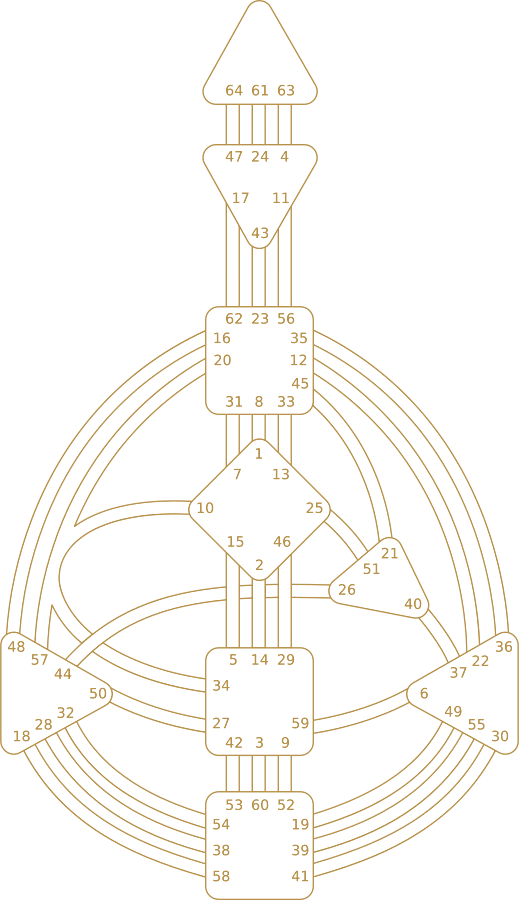

Human Design Channels
Human Design Channels are the energetic pathways that connect two Gates across two Centers. They show the consistent patterns, strengths, and themes that make your chart feel personal and specific.
If your Type is your energy engine and your Authority is your decision-making compass, your Channels are the wiring. They help explain why two people with the same Type can still feel very different in daily life.
On this page, you'll learn what Channels mean, how to find them in your chart, how they group into circuits, and how to use them in a grounded way without losing sight of your Strategy and Authority.
Simple way to use this page: Generate your free chart first, then use the directory below to find your defined Channels and understand how they show up in your life. Each channel links to a full dedicated guide.
Quick overview
Before you get into the full Channel directory, it helps to understand the basics. A Channel is a complete energetic connection. A hanging Gate is only one side of that connection.
Channel
Two connected Gates activated across two Centers. Think: a consistent energy pathway.
Defined Channel
Stable, repeating pattern. Often feels like: "I can rely on this."
Hanging Gate
One Gate active without the full Channel. Can feel amplified with certain people or transits.
Why it matters
Channels explain why two people with the same Type can still have very different strengths, rhythms, and patterns.
How to find your Channels on your chart
After you generate your chart, you'll see a full BodyGraph with Centers and colored lines connecting them. Those connected, colored pathways are your defined Channels. Channels are those lines; for every other mark, see Human Design chart symbols.
Found yours? Look each one up in all 36 Channels below. Your Type, Strategy and Authority come first; Channels add the detail.
Quick check: A full Channel is two Gates connected between two Centers. If you see only one side without the full connection, that's a hanging Gate.
Defined Channels vs Hanging Gates
A defined Channel is like a reliable route your energy runs through consistently. A hanging Gate is one side of a Channel. It can still feel important, but it does not create the same stable energetic pathway unless the other Gate is also active.
Most activations are hanging. 60 of the 64 Gates have exactly one possible partner, which is why complete Channels are less common than single Gates. Read the full guide to hanging Gates.
Foundation rule: Your mind can study Channels, but your Authority is what decides what is correct for you. Use Channels to understand yourself, not to make your decisions for you.
The 3 circuits (and where each channel belongs)
Every Channel belongs to one of three major circuit groups. The circuit tells you the PURPOSE of the channel's energy: whether it serves the individual, the collective, or the tribe. Each one has its own guide: the Individual circuit, Tribal circuit and Collective circuit.
Individual Circuit
15 channels across the Knowing, Centering, and Integration sub-circuits. Individual energy is about empowerment, mutation, and knowing. It is not here to share or be understood. It is here to be different. These channels pulse on and off and often feel deeply personal.
Collective Circuit
14 channels across the Understanding (Logic) and Sensing (Abstract) sub-circuits. Collective energy is about sharing. Logic channels test, prove, and create reliable patterns for everyone. Abstract channels collect experience, reflect on it, and share the wisdom. All collective energy is designed to benefit the group.
Tribal Circuit
7 channels across the Ego and Defense sub-circuits. Tribal energy is about support, loyalty, and material survival. Ego channels deal with resources, willpower, and material provision. Defense channels deal with intimacy, caring, and preserving what the tribe has created. All tribal energy operates through bargains and bonds.
Understanding which circuit your channels belong to explains a lot about how your energy moves. Individual channels feel personal and may confuse others. Collective channels feel shareable and seek an audience. Tribal channels feel bonded and need fair exchange.
Why Channels matter
Channels often describe your most consistent patterns. Once your Type, Strategy, and Authority are clear, Channels help explain the specific way your energy repeatedly shows up in work, relationships, communication, and growth.
How you work
Pace, consistency, and output style. Some channels produce steady output. Others pulse. The channel tells you which rhythm is correct for you.
How you relate
Chemistry, bonding, agreements, and needs. Hanging gates explain magnetism. Defined channels explain what you reliably bring to every relationship.
How you communicate
Voice themes, clarity, and expression timing. Throat-connected channels speak. Non-Throat channels influence without speaking. The distinction matters.
Where you're naturally gifted
The strengths that can feel like "this is just me." Channels explain the things you do consistently that others may find remarkable but you consider ordinary.
How Channels show up in real life
Work and contribution
Defined Channels can feel like reliable strengths you build a life around, especially when your Strategy is honored.
Relationships and chemistry
Hanging Gates can help explain magnetism, completion dynamics, and why certain connections feel unusually intense or important.
Consistency and pressure
Channels can create steady output or steady pressure depending on how aligned you are with your Authority.
Clarity beyond stereotypes
Type tells you the engine. Channels show the wiring that makes your design feel more nuanced and personal.
All 36 Channels
Use this directory to find the Channels that are defined in your chart. Each channel links to a full dedicated guide with circuit context, by-Type breakdowns, and 10 FAQs.
Most people do not resonate with all Channels, only the ones defined in their chart. Pull up your chart first, then explore what's defined in you.
Jump to a Channel
Tap a pair to jump
Individual Circuit: Centering
The smallest Individual sub-circuit: two channels, both from the G Center, one to the Sacral and one to the Heart.
Channel 10-34: Exploration
Theme: Following what's correct for the self, power moves best when it's aligned.
Centers: G Center → Sacral
In real life: You may feel strongest when your actions come from genuine self-alignment rather than external pressure.
Full Channel 10-34 guide →
Channel 25-51: Initiation
Theme: Courage and awakening, initiating self and others through brave leaps and shock.
Centers: G Center → Heart/Will
In real life: Life may move through turning points, challenges, or bold moments that awaken a new level of truth in you.
Full Channel 25-51 guide →
Individual Circuit: Knowing
Mutation, emotional depth, and unique knowing. These channels carry the individual's creative and acoustic frequency.
Channel 1-8: Inspiration
Theme: Creative contribution, expressing your unique style in a way that inspires others.
Centers: G Center → Throat
In real life: You may feel driven to create or express something original rather than simply repeat what already exists.
Full Channel 1-8 guide →
Channel 2-14: The Beat
Theme: Direction and resources, moving energy toward the right path and the right work.
Centers: G Center → Sacral
In real life: You may feel strongest when your effort is aligned with a path that feels natural, sustainable, and truly yours.
Full Channel 2-14 guide →
Channel 3-60: Mutation
Theme: Pulsing change, breakthroughs happen in waves, not in a straight line.
Centers: Root → Sacral
In real life: Your growth may feel nonlinear, with bursts of change followed by pauses that are part of the process.
Full Channel 3-60 guide →
Channel 12-22: Openness
Theme: Emotional expression, when the mood is right, your voice carries real impact.
Centers: Solar Plexus → Throat
In real life: There may be moments when what you say lands deeply, and other times when silence feels more correct than speaking.
Full Channel 12-22 guide →
Channel 20-57: The Brainwave
Theme: Instant intuition, splenic knowing that reaches the Throat directly.
Centers: Spleen → Throat
In real life: Insight may come as a fast inner knowing that is difficult to explain but often highly accurate in the moment.
Full Channel 20-57 guide →
Channel 23-43: Structuring
Theme: Genius to words, sharing unique insights in a way people can understand, with the right timing.
Centers: Ajna → Throat
In real life: Your ideas may seem unusual at first, but when expressed at the right moment, they can change how others see things.
Full Channel 23-43 guide →
Channel 24-61: Awareness
Theme: Mystery to knowing, inner truth that arrives after contemplation and repetition.
Centers: Head → Ajna
In real life: You may revisit the same question again and again until an inner knowing forms from within.
Full Channel 24-61 guide →
Channel 28-38: Struggle
Theme: Fighting for meaning and purpose.
Centers: Root → Spleen
In real life: You may feel most alive when your effort is tied to purpose, truth, and something genuinely worth standing for.
Full Channel 28-38 guide →
Channel 39-55: Emoting
Theme: Spirit and feelings, abundance is a question of spirit, not money.
Centers: Root → Solar Plexus
In real life: Emotional intensity may open the door to creative truth or deeper self-understanding.
Full Channel 39-55 guide →
Individual Circuit: Integration
Pure self-empowerment. These four channels, among Gates 10, 20, 34 and 57, connect the G Center, Throat, Sacral and Spleen for individual survival.
Channel 10-20: Awakening
Theme: Authentic presence, being yourself in the now, without performance.
Centers: G Center → Throat
In real life: Your power often comes through when you stop trying to be someone else and let your truth speak for itself.
Full Channel 10-20 guide →
Channel 10-57: Perfected Form
Theme: Instinctive correctness, an intuitive sense for what's healthy and right in the moment.
Centers: Spleen → G Center
In real life: Your body may sense what is safe, healthy, or off long before your mind can explain it.
Full Channel 10-57 guide →
Channel 20-34: Charisma
Theme: Power in the now, the only manifesting channel in Integration and the classic Manifesting Generator channel.
Centers: Sacral → Throat
In real life: When aligned, your energy can move fast, decisively, and with a strong sense of immediate capability.
Full Channel 20-34 guide →
Channel 34-57: Power
Theme: Instinct-powered action. Silent power with no Throat.
Centers: Sacral → Spleen
In real life: Your energy may move quickly and powerfully when your instinct knows the moment is right.
Full Channel 34-57 guide →
Collective Circuit: Understanding (Logic)
Testing, proving, and creating reliable patterns for the group. Logic channels move from doubt to answer through evidence and repetition.
Channel 4-63: Logic
Theme: Doubt to answers, testing patterns until something is logically sound.
Centers: Head → Ajna
In real life: You may naturally question what does not make sense and keep turning it over until clarity arrives.
Full Channel 4-63 guide →
Channel 5-15: Rhythm
Theme: Natural flow, finding the right routine, timing, and pace for life.
Centers: Sacral → G Center
In real life: You may function best when allowed to move at your own pace rather than being forced into someone else's timing.
Full Channel 5-15 guide →
Channel 7-31: The Alpha
Theme: Leadership by recognition, the kind people choose to follow.
Centers: G Center → Throat
In real life: Your influence tends to work best when people genuinely want your direction, not when leadership is forced.
Full Channel 7-31 guide →
Channel 9-52: Concentration
Theme: Still focus, a format energy that sets the rhythm for the entire Logic Circuit.
Centers: Root → Sacral
In real life: You may have a natural gift for sustained focus when something truly deserves your energy.
Full Channel 9-52 guide →
Channel 16-48: The Wavelength
Theme: Talent through practice, depth meets enthusiasm for mastery.
Centers: Spleen → Throat
In real life: Mastery may come through repetition, experimentation, and staying with what you care enough to improve.
Full Channel 16-48 guide →
Channel 17-62: Acceptance
Theme: Opinions to details, organizing patterns into clear language and plans.
Centers: Ajna → Throat
In real life: You may naturally want to explain things clearly, structure ideas, and turn complexity into something practical.
Full Channel 17-62 guide →
Channel 18-58: Judgment
Theme: Improvement drive, spotting what's off and upgrading it with joy.
Centers: Root → Spleen
In real life: You may constantly notice what could work better, especially when your energy is invested in making things healthier or stronger.
Full Channel 18-58 guide →
Collective Circuit: Sensing (Abstract)
Experience, reflection, and shared wisdom. Abstract channels collect life experience, process it through feelings and memory, then share the insight with the group.
Channel 11-56: Curiosity
Theme: Ideas to stories, sharing experiences to stimulate learning and meaning.
Centers: Ajna → Throat
In real life: You may naturally process life through ideas, examples, and stories that help others reflect and learn.
Full Channel 11-56 guide →
Channel 13-33: The Prodigal
Theme: Remembering and sharing, collecting secrets, then reflecting and revealing the lesson.
Centers: G Center → Throat
In real life: You may hold the memory of people, experiences, and patterns until the right time to share the wisdom appears.
Full Channel 13-33 guide →
Channel 29-46: Discovery
Theme: Commitment to experience, Succeeding Where Others Fail.
Centers: Sacral → G Center
In real life: Your path may unfold through committed experiences that teach you through direct participation, not theory alone.
Full Channel 29-46 guide →
Channel 30-41: Recognition
Theme: Desire to experience. The Human Design year starts at Gate 41.
Centers: Root → Solar Plexus
In real life: You may feel pulled toward new experiences through longing, imagination, and emotional anticipation.
Full Channel 30-41 guide →
Channel 35-36: Transitoriness
Theme: Change through experience, the Jack of All Trades and the only manifesting Sensing channel.
Centers: Solar Plexus → Throat
In real life: Growth may come through change, emotional depth, and learning what experience is here to teach you. Nothing lasts, and that IS the point.
Full Channel 35-36 guide →
Channel 42-53: Maturation
Theme: Cycles of growth, a format energy that colors the rhythm of the whole circuit with beginning, middle, and end.
Centers: Root → Sacral
In real life: You may learn through full cycles, where beginnings matter but completion is what brings wisdom.
Full Channel 42-53 guide →
Channel 47-64: Abstraction
Theme: Confusion to meaning, Gate 64 is the raw film clips. Gate 47 is the editor.
Centers: Head → Ajna
In real life: You may process life by reflecting on what happened until the pattern, lesson, or meaning finally clicks.
Full Channel 47-64 guide →
Tribal Circuit: Ego
Material resources, willpower, and community prosperity. Ego channels handle the tribe's money, ambition, salesmanship, and social agreements.
Channel 19-49: Synthesis
Theme: Needs and principles, the marriage contract. Three tribal needs: resources, shelter, beliefs.
Centers: Root → Solar Plexus
In real life: You may feel highly tuned in to needs, boundaries, values, and whether a relationship or agreement still feels right.
Full Channel 19-49 guide →
Channel 21-45: Money Line
Theme: Managing resources, the ONLY voice of the entire Tribal Circuit. "I have, or I don't have."
Centers: Heart/Will → Throat
In real life: You may naturally feel called to organize, oversee, or manage what supports the wellbeing of a group or structure.
Full Channel 21-45 guide →
Channel 26-44: Surrender
Theme: Influence and memory, the only Spleen-Heart link in the chart.
Centers: Spleen → Heart/Will
In real life: You may have a sharp instinct for patterns, value, and how to influence others when something truly matters.
Full Channel 26-44 guide →
Channel 32-54: Transformation
Theme: Ambition with instinct, the tribe's venture capital arm. Lasting success only.
Centers: Root → Spleen
In real life: You may naturally sense which opportunities have real long-term value and which do not.
Full Channel 32-54 guide →
Channel 37-40: Community
Theme: Support through agreements, "the bargain" that underlies ALL tribal life.
Centers: Solar Plexus → Heart/Will
In real life: Relationships often feel healthiest when expectations, support, and commitment are clear and mutual.
Full Channel 37-40 guide →
Tribal Circuit: Defense
Intimacy, caring, and preserving what the tribe creates. Defense channels handle bonding, caring for what the tribe creates, and nurturing the next generation.
Channel 6-59: Mating
Theme: Bonding energy, the drive to make intimate bonds.
Centers: Sacral → Solar Plexus
In real life: Relationships may quickly move beneath the surface with you, creating strong emotional or energetic bonds.
Full Channel 6-59 guide →
Channel 27-50: Preservation
Theme: Caring and values, Gate 50 is Values. Caring without values wastes resources.
Centers: Sacral → Spleen
In real life: You may feel a strong pull to protect, provide, or care in ways tied to responsibility and values.
Full Channel 27-50 guide →
Next steps
Channels add detail, but the biggest real-life shift comes from pairing them with the foundation: Type → Strategy → Authority.
Start with Strategy
Use your Strategy to reduce resistance and stop forcing outcomes. Explore Strategy.
Trust Authority
Your Authority decides what's correct, not your mind. Explore Authority.
Understand Centers
Centers show where you're consistent versus influenced. Explore Centers.
Then go deeper
Gates add nuance inside Channels. Explore Gates.
Quick recap: Channels are the wiring that connects your Gates and Centers into consistent patterns. All 36 Channels are listed above, grouped by circuit. Start with your defined Channels, then pair what you learn with your Strategy and Authority for the strongest real-life application.
FAQ: Human Design Channels
What is a Channel in Human Design?
A Channel is a full energetic connection between two activated Gates across two Centers in your Human Design chart. It represents a consistent pattern of energy that you can rely on throughout your life.
What is the difference between a Gate and a Channel?
A Gate is a single activation point in the chart. A Channel is formed when two corresponding Gates connect, creating a full pathway of defined energy between two Centers.
How many Channels are there in Human Design?
There are 36 Channels in the Human Design system. They are grouped into three major circuits: Individual (15 channels), Collective (14 channels), and Tribal (7 channels).
What are the three circuits in Human Design?
The Individual Circuit is about empowerment and mutation. The Collective Circuit is about sharing through logic or experience. The Tribal Circuit is about support, loyalty, and material survival through bargains and bonds.
Do Channels matter more than Type or Authority?
No. Type, Strategy, and Authority remain the foundation of Human Design. Channels add depth by showing how your energy operates consistently, but they never replace your Strategy and Authority.
What is a hanging Gate?
A hanging Gate is an activated Gate that does not connect to the matching Gate on the other end to form a full Channel. It can still be important, especially in relationships where another person completes the connection.
How do I find my Channels?
Generate your Human Design chart using your birth date, time, and location. Your chart will show which Gates and Channels are defined as colored lines connecting your Centers.
How do Channels affect my relationships?
Hanging Gates explain magnetism: when someone else completes your hanging Gate, it can create a strong sense of chemistry or completion. Your defined Channels show the energy you consistently bring to every relationship.