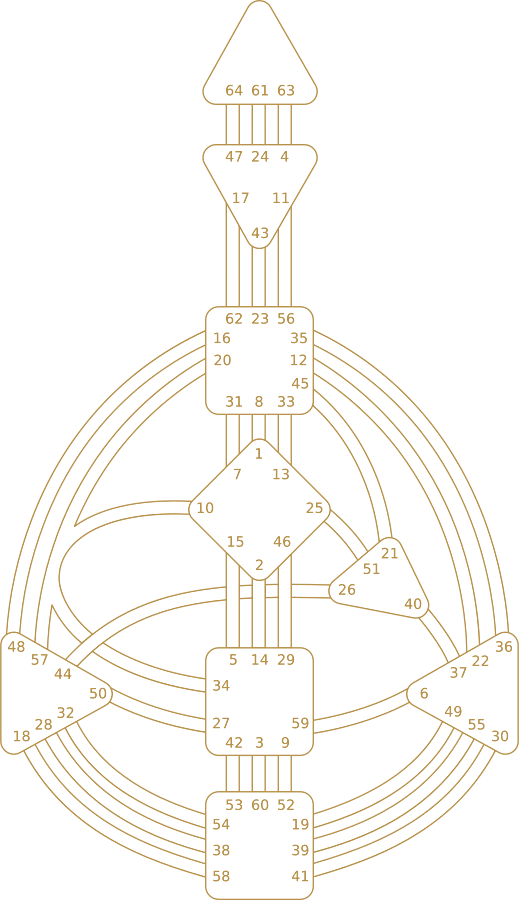

Human Design Gates
Gates are the specific traits and "themes" inside your Human Design chart. There are 64, one for each hexagram of the I Ching, and each sits in one of the nine Centers.
If Centers are where energy operates, and Channels are the pathways, Gates are the individual points that activate your unique map.
On this page: the Gates at a glance, a free calculator to find yours, active and hanging Gates, the 64 Gates by Center and on the wheel, and every Gate with its meaning. Live them through your Strategy and Authority, not around them.
Don't know your Gates yet? Find them with the free calculator on this page, then look each one up in the directory.
Human Design Gates at a glance
Every number on the BodyGraph is a Gate, written at the edge of the Center it belongs to.
How to find your Gates on your Human Design chart
Your Gates are calculated from your birth date, birth time and birth place. Enter yours below and your chart lists every Gate that is active in it.
Found yours? The numbers down both sides are your active Gates: the red Design column on the left (about 88 days before birth) and the black Personality column on the right (the moment of birth). In 63.2, the Gate is 63 and the line is 2. Look each one up in the directory.
Defined vs hanging Gates
An activated Gate can feel like a strong, repeating theme. It becomes even more consistent when it completes a Channel. Hanging Gates can feel "turned up" with certain people (who carry the other side), or during transits.
Most of your Gates are hanging. 60 of the 64 Gates have exactly one possible partner, so completed Channels are the exception rather than the rule. Read the full guide to Human Design hanging Gates.
How Gates show up in real life
Strengths you repeat
Some traits show up everywhere, how you work, relate, and communicate. Gates often name those patterns.
Triggers + lessons
Gates can also describe what pushes you to grow, especially when you override your Authority.
Chemistry + completion
Hanging Gates can explain why certain people feel magnetic, activating, or intense.
Make it usable
Read your Gate meanings, then apply them with Strategy + Authority so it stays practical.
Ground rule: Gates are for self-understanding, your Authority is still how you decide. Learn the themes, then live them through Strategy + Authority.
The 64 Gates by Center
Every Gate belongs to one of the nine Centers, and a Gate's Center is part of what it is about. Tap a number for that Gate's guide, or a Center for what it does. The numbers on your chart are the Gates; Human Design chart symbols explains every other mark around them.
The Gates on the wheel. The 64 Gates also sit in a fixed order around the zodiac wheel, each spanning 5 degrees 37 minutes 30 seconds. The order starts with Gate 41, where the Sun arrives around 22 January, and falls into four quarters of 16 Gates: Initiation (purpose through mind), Civilization (purpose through form), Duality (purpose through bonding) and Mutation (purpose through transformation). Where the Sun stood on that wheel when you were born gives your Sun Gate, the root of your Incarnation Cross.
All 64 Gates (quick directory)
Tap any Gate to expand its overview, then follow the link for the complete guide with all 6 lines, Type breakdowns, the planets and its place on the wheel.
Gate 1, Self-Expression
Unique creativity and self-expression from the G Center. The gift is originality. The challenge is feeling blocked or pressured to create inauthentically.
Gate 2, The Direction of the Self
Inner compass and receptive guidance from the G Center. The gift is natural orientation. The challenge is forcing direction instead of allowing it.
Gate 3, Ordering
Turning chaos into workable form through the Sacral. Format channel of mutation. The gift is adaptation. The challenge is frustration with messy beginnings.
Gate 4, Formulization
Mental solutions and logical formulization in the Ajna. The gift is clear reasoning. The challenge is rushing to solve everything mentally.
Gate 5, Fixed Rhythms
Natural timing and routines from the Sacral. The gift is consistency. The challenge is rigidity when life moves outside your rhythm.
Gate 6, Friction
Emotional boundaries and intimacy timing from the Solar Plexus. The gift is discernment. The challenge is confusion around when to open or protect.
Gate 7, The Role of the Self in Interaction
Democratic leadership through direction from the G Center. The gift is guidance. The challenge is leading without recognition.
Gate 8, Contribution
Sharing your unique gift to inspire others through the Throat. The gift is individual contribution. The challenge is trying too hard to prove uniqueness.
Gate 9, Focus
Concentration and detail energy from the Sacral. Format channel energy. The gift is persistence. The challenge is over-fixating on the wrong details.
Gate 10, The Behavior of the Self
Authenticity and self-love in action from the G Center. The gift is natural self-respect. The challenge is people-pleasing or performing.
Gate 11, Ideas
A stream of abstract ideas and images from the Ajna. The gift is imagination. The challenge is mistaking ideas for certainty or acting on every concept.
Gate 12, Caution
Speaking with the right mood and timing through the Throat. The gift is refined expression. The challenge is saying too much at the wrong moment.
Gate 13, The Listener
Holding stories and secrets from the G Center. The gift is deep listening. The challenge is carrying too much that is not yours to hold.
Gate 14, Power Skills
Resources and energy for the right work from the Sacral. The gift is capability. The challenge is pouring resources into the wrong direction.
Gate 15, Extremes
Love of humanity and wide-ranging rhythms from the G Center. The gift is acceptance. The challenge is feeling out of sync or misunderstood.
Gate 16, Skills
Talent developed through practice at the Throat. The gift is mastery through enthusiasm. The challenge is wanting recognition before the skill is ready.
Gate 17, Opinions
Pattern recognition and structured viewpoints in the Ajna. The gift is logic. The challenge is rigid attachment to being right.
Gate 18, Correction
Seeing what needs improving through the Spleen. The gift is refinement. The challenge is perfectionism or always noticing flaws first.
Gate 19, Wanting
Sensitivity to needs and belonging from the Root. The gift is emotional attunement. The challenge is neediness or over-attachment.
Gate 20, The Now
Presence and truth in the moment at the Throat. Connects to three centers. The gift is immediacy. The challenge is impulsiveness.
Gate 21, The Hunter/Huntress
Managing resources and authority from the Heart Center. The gift is stewardship. The challenge is controlling others or over-managing.
Gate 22, Openness
Emotional openness and social charm from the Solar Plexus. The gift is grace. The challenge is moodiness or inconsistency in connection.
Gate 23, Assimilation
Simplifying insights into clear words at the Throat. The gift is clarity. The challenge is being misunderstood or speaking before others are ready.
Gate 24, Rationalization
Returning to ideas until they make sense in the Ajna. The gift is contemplation. The challenge is repetitive thinking or mental looping.
Gate 25, The Spirit of the Self
Universal love and pure intent from the G Center. The gift is openness. The challenge is emotional hardening or losing touch with innocence.
Gate 26, The Egoist
Influence, persuasion, and tribal marketing from the Heart Center. The gift is impact. The challenge is manipulation or exaggeration.
Gate 27, Caring
Nurturing and tribal responsibility from the Sacral. The gift is care. The challenge is over-giving or rescuing others at your own expense.
Gate 28, The Game Player
Fighting for meaning and purpose through the Spleen. The gift is courage. The challenge is struggle without meaning or burnout.
Gate 29, Saying Yes
The power of saying yes from the Sacral. The gift is perseverance. The challenge is overcommitting or saying yes too quickly.
Gate 30, Recognition of Feelings
Emotional longing that fuels experience from the Solar Plexus. The gift is passion. The challenge is attachment or suffering from unmet expectations.
Gate 31, Influence
Leading through voice when chosen at the Throat. The gift is leadership. The challenge is forcing authority you haven't been given.
Gate 32, Continuity
Instinct for what will last and succeed through the Spleen. The gift is endurance. The challenge is fear of failure or excessive caution.
Gate 33, Privacy
Retreat, reflection, and sharing the lesson later through the Throat. The gift is wisdom. The challenge is withdrawing too much or hiding.
Gate 34, Power
Pure Sacral life-force and powerful action, from the largest motor. The gift is vitality. The challenge is busyness without direction.
Gate 35, Change
Growth through new experiences at the Throat. The gift is adaptability. The challenge is restlessness or chasing novelty endlessly.
Gate 36, Crisis
Emotional depth through crisis from the Solar Plexus. The gift is resilience. The challenge is chaos or emotional reactivity before clarity arrives.
Gate 37, Friendship
Family bonds and tribal agreements from the Solar Plexus. The gift is loyalty. The challenge is over-sacrificing or clinging to bonds out of obligation.
Gate 38, The Fighter
Resilience and fighting for what matters from the Root. The gift is strength. The challenge is fighting everything or struggling without purpose.
Gate 39, Provocation
Stirring emotion to reveal truth from the Root. The gift is catalytic energy. The challenge is provoking without purpose or creating unnecessary friction.
Gate 40, Aloneness
Will to serve the tribe and the need for rest from the Heart Center. The gift is reliability. The challenge is overworking or isolation.
Gate 41, Contraction
The pressure to begin a new experience, from the Root. The Human Design year starts at Gate 41. The gift is desire and imagination. The challenge is escapism or longing without grounding.
Gate 42, Growth
Finishing cycles and maturing through completion in the Sacral. Format channel energy. The gift is completion. The challenge is quitting too early.
Gate 43, Insight
Breakthrough knowing from the Ajna. The gift is original insight. The challenge is isolation or being misunderstood when sharing what you know.
Gate 44, Alertness
Pattern memory and recognition through the Spleen. The gift is instinct. The challenge is distrust or being trapped by old patterns.
Gate 45, The Gatherer
King/queen energy and tribal resource leadership at the Throat. The gift is stewardship. The challenge is control or hoarding.
Gate 46, The Determination of the Self
Being in the right place at the right time from the G Center. The gift is embodiment. The challenge is disconnection from the body.
Gate 47, Realization
Turning confusion into meaning in the Ajna. The gift is perspective. The challenge is mental overwhelm or forcing clarity too early.
Gate 48, Depth
Deep solutions from The Well in the Spleen. The gift is mastery. The challenge is fear of inadequacy or underestimating your depth.
Gate 49, Principles
Values and boundaries in tribal bonds from the Solar Plexus. The gift is integrity. The challenge is emotional ultimatums or cutting off too fast.
Gate 50, Values
The values gate of the Spleen, and the tribal lawmaker. The gift is ethics. The challenge is carrying too much responsibility.
Gate 51, Shock
Initiation through shock in the Heart Center. Only Individual gate in a Tribal center. The gift is bravery. The challenge is recklessness.
Gate 52, Stillness
Focused stillness as a format channel in the Root. The gift is concentration. The challenge is restlessness or feeling stuck.
Gate 53, Beginnings
Pressure to start new cycles from the Root. Format channel energy. The gift is momentum. The challenge is starting too much without finishing.
Gate 54, Ambition
Drive for material rise from the Root. Fuels the Ego Stream pathway. The gift is aspiration. The challenge is climbing for status alone.
Gate 55, Spirit
Spirit in the Solar Plexus, in the Individual circuit. Acoustic gate. The gift is emotional depth. The challenge is mood swings or scarcity thinking.
Gate 56, Stimulation
The Storyteller at the Throat. Voice of "I believe." The gift is communication. The challenge is restlessness or talking without depth.
Gate 57, Intuitive Clarity
Intuitive clarity in the Spleen. Speaks only once. The gift is instant knowing. The challenge is fear or mistrusting instinct.
Gate 58, Vitality
Joyous vitality and pressure to improve from the Root. The gift is joy. The challenge is chronic dissatisfaction.
Gate 59, Sexuality
Aura-breaker in the Sacral. Six bonding strategies, one per line. The gift is intimacy. The challenge is boundary confusion or breaking walls without discernment.
Gate 60, Acceptance
Format channel of mutation in the Root. On/off pulse. The gift is realism. The challenge is fighting limitations or forcing creativity during the off-pulse.
Gate 61, Mystery
Pressure to know the unknowable from the Head Center. Acoustic mind. The gift is inspiration. The challenge is obsessive thinking or mental overwhelm.
Gate 62, Details
Creation of language at the Throat. Voice of "I think." The gift is precision. The challenge is over-explaining or getting lost in facts.
Gate 63, Doubt
Ignition switch of all logic from the Head Center. The gift is inquiry. The challenge is suspicion, self-doubt, or chronic mental pressure.
Gate 64, Confusion
Abstract imagination that thinks in pictures from the Head Center. The gift is imagination. The challenge is mental overwhelm or forcing clarity too soon.
Want yours read for you? A Human Design reading writes a section for every Gate active in your chart, Personality and Design, each by number, among 60+ sections written from your chart.
FAQ: Human Design Gates
How many Gates are in Human Design?
There are 64 Gates. Your chart shows which ones are activated by your birth data.
Where do the 64 Gates come from?
Each of the 64 Gates corresponds to one of the 64 hexagrams of the I Ching, the Chinese Book of Changes, and carries a keynote of its own: Gate 1 is the hexagram The Creative, and its keynote is Self-Expression. Ra Uru Hu set out the Human Design system in 1987, and Jovian Archive is its authoritative source.
Where do I see my Gates on the chart?
After generating your chart, look at the side columns labeled Design and Personality. Those numbers are your activated Gates. For example, 63.2 means Gate 63, line 2.
What is the difference between a Gate and a Channel?
A Gate is one theme. A Channel is created when two Gates connect across Centers, forming a full energy pathway.
What is a hanging Gate?
A hanging Gate is an activated Gate that does not complete a full Channel. It can feel amplified through certain relationships or transits.
Do I need to memorize all 64 Gates?
No. Start with Type, Strategy, and Authority. Use Gates as a personalization layer once the foundation is clear.
How many Gates does a person usually have?
Your chart has 26 activations, 13 for the moment you were born and 13 for about 88 days before it. When two of them land in the same Gate it counts once, so a chart usually shows fewer than 26 different Gates. Your personalized reading explains every one of them in the context of your design.
What do the numbers after the Gate mean?
Every Gate has six lines, and the number after the decimal tells you which one is active. In 63.2, the 2 is the line. The Gate gives you the theme and the line tells you how that theme expresses. The six carry consistent characters: 1 the Investigator who needs a foundation, 2 the Hermit who is naturally gifted, 3 the Martyr who learns by trial and error, 4 the Opportunist who works through their network, 5 the Heretic who gets projected onto, and 6 the Role Model. The two lines of your Sun positions are what form your Profile.
How are the 64 Gates ordered on the wheel?
In a fixed order around the zodiac wheel, each Gate spanning 5 degrees 37 minutes 30 seconds. The order starts with Gate 41, where the Sun arrives around 22 January, and falls into four quarters of 16 Gates: Initiation, Civilization, Duality and Mutation. The Gate the Sun was in when you were born is your Sun Gate.
Which of my Gates is most important?
The Sun Gate in your Personality column, at the top of the right hand side, is generally treated as the most significant single activation in the chart. Together with the Earth Gate opposite it, and the matching pair on the Design side, it forms your Incarnation Cross, which describes the broad theme your life tends to organize around.
Why do some Gates appear twice in my chart?
Your chart has 26 activations in total, 13 on the Design side and 13 on the Personality side, but they do not all land on different Gates. When two planets occupy the same Gate it is activated more than once, usually at different lines. That is why a chart usually shows fewer than 26 different Gates, and it is normal rather than an error in the chart.
Do Gates affect relationships?
Yes. Hanging Gates can create strong chemistry when another person carries the completing Gate. This is one reason certain people feel magnetic or activating.
Should I make decisions based on my Gates?
Gates add self-understanding, but decisions are still best guided by your Authority. Gates show themes and patterns. Authority shows how to choose correctly.