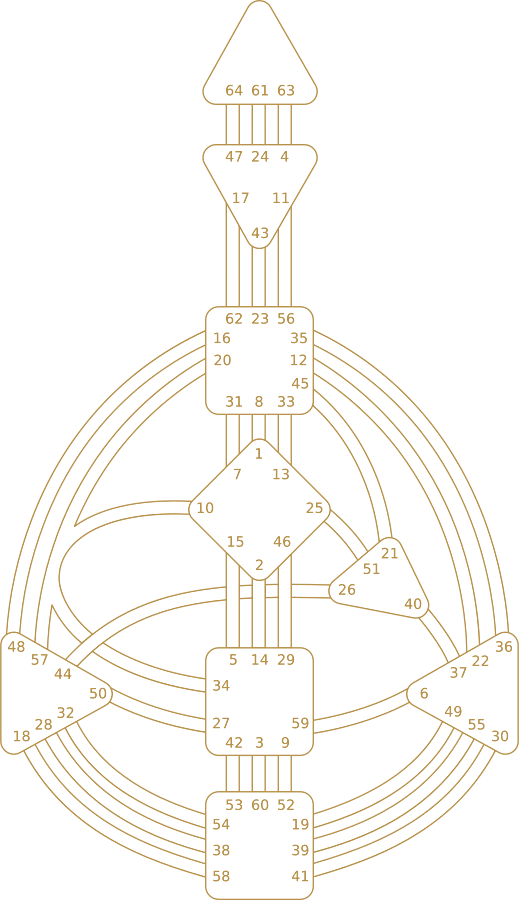

Human Design Gates and Channels
Human Design Gates and Channels explain how your chart moves from raw potential into consistent expression. Gates represent specific traits and themes, while Channels show what happens when those traits connect and become part of your defined energy.
There are 64 Gates and 36 Channels. Think of music: the Gates are the individual notes, the Channels are the melodies they make together, and the three circuits are the genres, telling you who the energy serves.
On this page: the Gates and Channels at a glance, a free calculator to find yours, what each one is, how they work together, and the three circuits.
Don't know your Gates and Channels yet? Find them with the free calculator on this page. Your Type, Strategy, Authority and Centers come first. Gates and Channels add the detail.
Gates and Channels at a glance
Every chart has the same 64 Gates and 36 Channels in the same places. What changes from one person to the next is which of them are active. Here they are on the BodyGraph, with one Channel shown.
How to read Gates and Channels in your chart
Your Gates and Channels are calculated from your birth date, birth time and birth place. Enter yours below. In your chart, a Gate number that is colored in is active, and a line colored in all the way between two Centers is a defined Channel.
Found yours? Read them in order: your Type, Strategy and Authority, then your Centers, then your Channels, then the Gates inside them.
A Gate colored in at one end of a Channel, with nothing at the other end, is a hanging Gate. Your birth time matters: a few minutes can move a planet into the next Gate.
What are Human Design Gates and Channels?
Human Design Gates and Channels are part of the deeper structure of your chart. After you understand your Type, Strategy, Authority, and Centers, Gates and Channels help you see the more specific ways your energy is expressed.
A Gate is a single point of potential. It represents a theme, trait, lesson, or way of processing life. There are 64 Gates in total, drawn from the 64 hexagrams of the I Ching, mapped onto the nine Centers of the BodyGraph. A Channel is created when two activated Gates connect across two Centers. That connection forms a stable energetic pathway. There are 36 Channels in total.
This is why Gates and Channels should not be studied as completely separate ideas. Gates show the building blocks. Channels show the wiring. Together, they reveal how specific qualities in your design become part of your real, lived pattern.
Human Design Gates
In Human Design, there are 64 Gates. Each Gate carries a different theme and reflects a specific kind of intelligence, pressure, awareness, expression, direction, emotion, instinct, or life lesson. The Gates are drawn from the 64 hexagrams of the I Ching and are mapped onto the nine Centers of the BodyGraph.
When a Gate is activated in your chart, it becomes part of your design. That Gate may show up as a repeating strength, a natural perspective, a pattern you are here to work through, or a way you interact with other people and the world around you.
Gates matter because they add detail to your chart. Two people may share the same Type and Authority, but their Gates can make them feel and operate very differently. Gates help explain the specific flavor of your design.
Gates by Center
Each of the 64 Gates lives in one of the nine Centers. Knowing which Center a Gate belongs to tells you what kind of energy it operates through.
Head Center (3 gates)
Gates 61, 63, 64. Pressure to think, question, and wonder. Mental inspiration and doubt.
Ajna Center (6 gates)
Gates 4, 11, 17, 24, 43, 47. Processing, conceptualizing, and forming opinions.
Throat Center (11 gates)
Gates 8, 12, 16, 20, 23, 31, 33, 35, 45, 56, 62. Expression, communication, and manifestation.
G Center (8 gates)
Gates 1, 2, 7, 10, 13, 15, 25, 46. Identity, direction, and love.
Heart Center (4 gates)
Gates 21, 26, 40, 51. Willpower, ego, material resources, and courage.
Solar Plexus (7 gates)
Gates 6, 22, 30, 36, 37, 49, 55. Emotions, feelings, desire, and mood.
Sacral Center (9 gates)
Gates 3, 5, 9, 14, 27, 29, 34, 42, 59. Life force, work, sexuality, and response.
Spleen Center (7 gates)
Gates 18, 28, 32, 44, 48, 50, 57. Instinct, intuition, health, time, and survival.
Root Center (9 gates)
Gates 19, 38, 39, 41, 52, 53, 54, 58, 60. Pressure, drive, adrenaline, and fuel.
Hanging Gates and partial expression
A Gate does not always create a full Channel on its own. Sometimes you will have one activated Gate without the Gate on the other end. This is often called a hanging Gate. A hanging Gate can still be important, but its expression may feel more situational, relational, or amplified when you are around the right people. This is one reason your environment and the people around you can sometimes activate parts of your chart in powerful ways.
Go deeper: Every gate has a full dedicated page. Explore the complete Human Design Gates directory to find yours, or read the full guide to Human Design hanging Gates.
Human Design Channels
Human Design Channels are formed when two activated Gates connect across two Centers. A Channel is what turns potential into a stable energetic pathway. When a Channel is defined, that pattern becomes a more reliable part of how you operate.
If Gates are the individual themes in your chart, Channels are the way those themes come alive. They create continuity. They show where energy moves in a defined way, and they often explain why certain behaviors, gifts, communication styles, emotional patterns, or work rhythms feel natural to you.
Channels matter because they show your wiring, not just your ingredients. A single Gate may suggest a quality you carry. A full Channel shows that the quality has a built-in route of expression. There are 36 Channels in total, and each one connects two specific Centers.
What Channels reveal
Channels can reveal how you process life, how you create, how you relate, how you work, how you communicate, and where your energy has continuity. They often point to enduring strengths and recognizable life themes. Channels also help explain why certain Centers are defined: a Center becomes defined when it is connected through a full Channel. This means Channels are one of the keys to understanding why your chart has stable energy in some places and openness in others.
Go deeper: Every channel has a full dedicated page with circuit context, by-Type breakdowns, and 10 FAQs. Browse the complete Human Design Channels directory to find yours.
How Gates and Channels work together
The most important thing to understand is that Gates and Channels are part of the same system. Gates show potential. Channels show connection. A Gate by itself can still matter, but when two Gates connect and form a Channel, that energy becomes more stable and embodied.
When you read both together, your chart becomes much more coherent. You stop seeing isolated traits and start seeing patterns. The circuit adds another layer: it tells you whether those patterns serve your individual empowerment, the collective's understanding, or your tribe's survival.
The 3 circuits: where Gates and Channels belong
Every Gate and Channel belongs to one of three major circuit groups. The circuit tells you the purpose of the energy: who it serves and how it moves. Understanding circuits helps explain why some parts of your chart feel deeply personal while others feel shared or relational.
Individual Circuit (15 channels)
Energy for empowerment, mutation, and unique knowing. Individual channels pulse on and off, feel deeply personal, and are not designed to be understood by others. Sub-circuits: Knowing (acoustic, emotional depth), Centering (creative expression and direction), and Integration (pure self-empowerment). If your chart is heavy in Individual channels, you may feel different from most people around you. That's by design.
Collective Circuit (14 channels)
Energy for sharing with the group. Collective channels process information and experience for the benefit of others. Sub-circuits: Understanding/Logic (testing, proving, creating reliable patterns through evidence) and Sensing/Abstract (collecting experience, reflecting, sharing wisdom through story). If your chart is heavy in Collective channels, you are wired to share what you learn with others.
Tribal Circuit (7 channels)
Energy for support, loyalty, and material survival. Tribal channels operate through bargains, bonds, and direct personal contact. Sub-circuits: Ego (resources, willpower, ambition, community agreements) and Defense (intimacy, caring, preserving what the tribe creates). If your chart is heavy in Tribal channels, loyalty and fair exchange are central to everything.
Most people have channels from more than one circuit. The mix of circuits in your chart creates your unique relationship to individuality, sharing, and belonging. When you read your gates and channels, always notice which circuit they belong to. It will change how you understand the energy.
Your next step with Gates and Channels
Your own Gates and Channels: the free chart shows which of yours are active. To have what they mean written out for your own chart, that is what a Human Design reading does.
FAQ: Human Design Gates and Channels
What is the difference between a Gate and a Channel in Human Design?
A Gate represents a specific trait, theme, or point of potential in your chart. There are 64 Gates. A Channel is created when two activated Gates connect across two Centers, forming a stable energetic pathway. There are 36 Channels.
How many Gates and Channels are there in Human Design?
There are 64 Gates and 36 Channels in the Human Design system. Each Gate carries a unique theme drawn from the I Ching, and each Channel represents a specific energetic pathway connecting two Centers.
What are the 64 Gates in Human Design?
The 64 Gates are the 64 hexagrams of the I Ching, placed on the nine Centers of the BodyGraph. Each Gate is one theme. The Gates the planets were in at your birth, and at your Design date before it, are active in your chart. The Gates directory has a guide to each one.
Which Center does each Gate belong to?
Every one of the 64 Gates sits in exactly one of the nine Centers, and that Center tells you what kind of energy the Gate operates through. The distribution is uneven: the Throat holds 11 Gates, the Sacral and Root hold 9 each, the G Center 8, the Solar Plexus and Spleen 7 each, the Ajna 6, the Heart 4, and the Head only 3. The full breakdown by Center is listed above on this page.
What is a hanging Gate?
A Gate that is active in your chart while the Gate at the other end of its Channel is not. On its own it does not define a Center. With someone who has the other Gate, the Channel completes between you, and the theme can feel strongly switched on.
Do Gates belong to circuits, or only Channels?
Both, but Channels are where circuit membership actually lives. A Gate inherits its circuit from the Channel or Channels it can form. Because no Gate forms Channels in two different circuits, every Gate belongs to exactly one: 22 Gates are Individual, 28 are Collective, and 14 are Tribal. Even Gates 10, 20, 34, and 57, which each form three different Channels, are Individual in all of them.
Should I learn Gates or Channels first?
Start with Channels, then study the Gates within each Channel. Channels show the stable patterns in your chart. The Gates inside each Channel show the specific flavor and nuance of that pattern.
Do Gates and Channels matter if I already know my Type and Authority?
Yes. Type and Authority give you the foundation, while Gates and Channels add precision. They help explain the specific patterns, strengths, and traits that make your design unique beyond your Type.
Why do two people with the same Type feel completely different?
Because Type is a summary and Gates and Channels are the detail underneath it. Your Type comes from which Centers are defined and whether a motor connects to your Throat. Two people can match on both of those and still share almost no Gates or Channels, which is where the real differences in how they work, relate, and communicate come from. It is the single best reason to read past your Type.
How do Gates and Channels affect Centers?
Channels connect Gates across Centers. When a full Channel is present, it defines both Centers it connects. This is the primary mechanism by which Centers become defined (colored) in your chart, creating consistent energy in those areas.