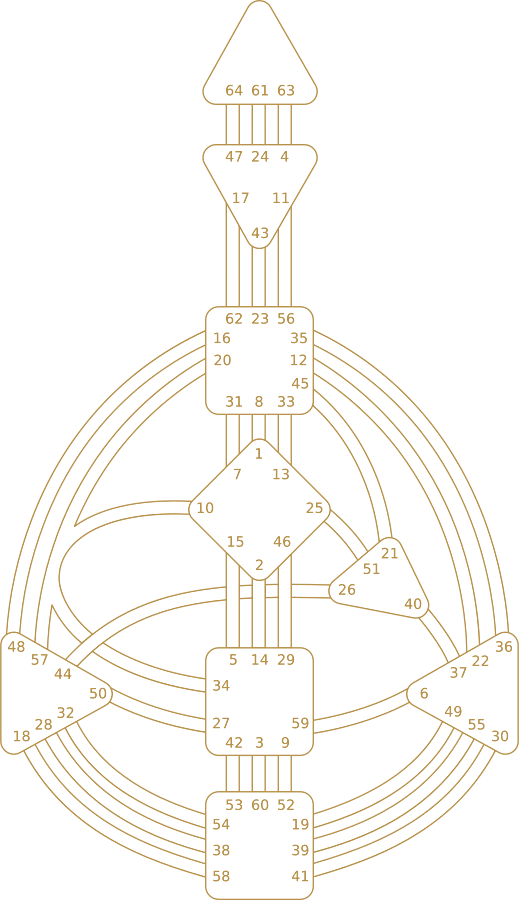

Human Design Basics
Human Design basics are the seven ideas that make your chart usable: your Type, Strategy, Authority, Profile, Centers, Definition, and your Signature and Not-Self. Learn them in that order and the rest of the chart has somewhere to land.
Think of it like learning a language. The basics are the grammar. Gates and Channels are the vocabulary, and they make far more sense once the grammar is in place.
On this page: a free calculator to find your own basics, the seven basics one at a time, what changes when you use them, and where to go after the basics.
Simple goal of this page: find your Type, Strategy, and Authority with the free calculator below, then read the seven basics in order. Everything else becomes easier once those click.
Find your Type, Strategy and Authority
Your chart, also called a BodyGraph, is calculated from your birth date, birth time and birth place. Enter yours below. The free chart shows your Type, Strategy, Authority, Profile and more, in about a minute.
Found yours? Read the seven basics below in order, starting with your Type.
If your birth time is not exact, your chart is still a useful starting point. Exact time matters more as you go deeper, because a few minutes can move a planet into the next Gate.
What matters first in Human Design
If you are brand new, the goal is not to learn everything. The goal is to learn the few pieces that make your chart immediately useful. Human Design becomes practical when you understand how your energy works, how life tends to open for you, and how you are designed to make decisions. Once your chart is in front of you, what your Human Design chart means walks through it layer by layer.
For most people, that means learning Type, Strategy, and Authority first. Once those are clear, the rest of the chart stops feeling random and starts feeling like extra detail built on a foundation that already makes sense.
New to the system itself? Start with What Is Human Design: where it comes from and how your chart is calculated.
The 7 Human Design basics
Learn them in this order. The first three, Type, Strategy and Authority, change how your days feel and how your decisions land. The other four explain why. Each one has its own page when you want more, and How to Read Your Chart shows where each one sits on the BodyGraph.
1Type: how your energy works
There are five Types, set by which Centers in your chart are defined and how they connect. Your Type describes how your energy meets the world, and everything else in the chart builds on it.
- Generator, about 35% of people: steady, renewable energy for work you respond to.
- Manifesting Generator, about 35% of people: the same energy, faster, and often across more than one thing.
- Projector, about 21% of people: here to see others clearly and guide them.
- Manifestor, about 9% of people: here to start things and set them moving.
- Reflector, about 1% of people: no defined Centers at all, a mirror for the people around them.
2Strategy: how life opens for you
Your Strategy is the way your Type is built to engage with life, so that the right things come to you with less resistance. Each Type has one.
3Authority: how you decide
Your Authority is how you are built to make decisions: where in you a clear yes or no comes from, instead of your mind. Your chart sets it in a fixed order. A defined Solar Plexus always comes first, then the Sacral, then the Spleen, and so on.
- Emotional (Solar Plexus): over time, across your emotional wave. There is no truth in the now.
- Sacral (Sacral Center): in the moment, as a gut response before words.
- Splenic (Spleen): in the moment, once and quietly. It does not repeat.
- Ego (Heart): from willpower: what you genuinely have the will and heart for. It comes in two forms, Ego Manifested and Ego Projected.
- Self-Projected (G Center): by hearing your own voice. Talk it out and listen.
- Mental (no inner authority): by talking it through with people you trust, in the right environment.
- Lunar (Reflectors): across a full 28-day lunar cycle.
4Profile: the role you play
Your Profile is two numbers, like 1/3 or 4/6. The first is the line of your Personality Sun, the side of you that you know. The second is the line of your Design Sun, the side that runs below awareness and that other people often meet first. Together they describe the role you play and how you learn.
There are six lines (1 Investigator, 2 Hermit, 3 Martyr, 4 Opportunist, 5 Heretic, 6 Role Model) and 12 Profiles in all.
5Centers: where you are steady and where you are open
The BodyGraph has nine Centers: Head, Ajna, Throat, G Center, Heart, Solar Plexus, Sacral, Spleen and Root. A colored-in Center is defined: that energy works the same way in you every day. A white Center is open: you take that energy in from the people around you, often more strongly than they feel it themselves. That is where you are most open to other people's influence.
6Definition: how your energy connects
Definition is how your defined Centers join up. When they all connect into one group, you have Single Definition. Two groups with no Channel between them are a Split, then come Triple Split and Quadruple Split. A Reflector has No Definition. With a Split, the people whose Gates bridge your two groups can make you feel more complete.
7Signature and Not-Self: how you know it is working
Every Type has a Signature, the feeling that tells you that you are living your design, and a Not-Self theme, the feeling that tells you that you are not. It is the simplest test in Human Design: you do not have to believe anything, only notice which one you feel more often.
Signatures and the Not-Self Theme →
Why the basics matter more than most beginners think
Learning the basics of Human Design can change more than your vocabulary. It can change how you use your energy, how much you force life, how you handle pressure, and how often you trust yourself instead of overriding what your body already knows.
The basics matter because they create a foundation for self-trust. You stop needing to figure everything out at once. Instead, you start noticing what supports your energy, what reduces resistance, and what helps life feel more honest and less forced.
Real life examples: overwhelmed versus aligned with the basics
Human Design basics become powerful when you can feel the difference between living without them and living with them. This is where the system becomes less theoretical and more personal.
Energy
Overwhelmed: You keep pushing, overcommitting, and wondering why everything feels heavy.
Aligned: You begin noticing what is actually correct for your energy and stop spending yourself the wrong way.
Decision-making
Overwhelmed: You overthink everything and keep looking outside yourself for certainty.
Aligned: You begin trusting your Authority and feel more settled in the choices you make.
Timing
Overwhelmed: Life feels like pressure, wrong timing, and forcing outcomes.
Aligned: Strategy helps you move with less resistance and better timing.
Inner experience
Overwhelmed: You feel confused, reactive, or disconnected without knowing why.
Aligned: You feel more honest, more grounded, and more connected to how you actually work.
After the basics: Gates, Channels and the rest of your chart
Once the seven basics feel familiar, the rest of the chart adds detail without changing the foundation: the 36 Channels and 64 Gates, your Incarnation Cross, the Variables, and the planets behind them.
The Human Design Guide maps all of it in one place, with every Type, Authority, Center, Profile, Channel and Gate linked to its own page. Use it when you want to look something up in your own chart.
A simple 10-minute path
If you want a clear starting path without spiraling into research, do this:
- Generate your free chart → the calculator on this page
- Find your Type → Types
- Learn your Strategy → Strategy
- Learn your Authority → Authority
- Skim Centers → Centers
- For one week, notice your Signature and Not-Self → lesson 7 above
Quick recap: Human Design Basics comes down to seven ideas, and the first three do most of the work. Your Type shows how your energy works. Your Strategy shows how life opens for you. Your Authority shows how you make decisions. Profile, Centers, Definition, and Signature and Not-Self explain the rest. Start there. Everything else builds on that foundation.
FAQ: Human Design Basics
What are the basics of Human Design?
Seven ideas: your Type, Strategy, Authority, Profile, Centers, Definition, and Signature and Not-Self. Learn Type, Strategy and Authority first, because they change how you use your energy and make decisions. Your free chart shows all of them.
Do I need to buy a report to use Human Design?
No. Your free chart gives you your Type and key basics. Reports are optional depth for when you want more context and practical guidance.
What should I learn first: Type or Authority?
Start with Type to understand your energy style, then learn Strategy, then Authority for decision-making. If you only master one thing deeply after Type, make it Authority.
How do I start learning Human Design without getting overwhelmed?
Start with your Type, Strategy, and Authority. You do not need to understand Gates, Channels, or deeper layers immediately. Those first layers alone can create meaningful shifts in clarity and decision-making.
Is Human Design woo?
It does not have to be. We keep it beginner-first and practical: how your energy works, how you decide, and what helps life feel less forced.
What if I don't know my exact birth time?
You can still generate a chart with your best estimate, and it can be helpful for learning. Exact birth time matters for accuracy, especially for finer details, so if you are unsure, treat the results as a starting point.
What is the difference between a free chart and a paid report?
Your free chart shows the pattern. Your report helps you understand it. Paid reports explain what your design means in real life, with deeper interpretation, context, and guidance you can actually apply.
How is Human Design different from astrology?
Both use your birth data, but astrology focuses on personality and timing. Human Design focuses on how your energy works and how you are designed to make decisions. They answer different questions and can be used together.
How long does it take to learn the basics of Human Design?
You can learn the core basics in under 10 minutes. Understanding your Type, Strategy, and Authority is enough to start experimenting right away. The deeper layers unfold over time as you apply them in real life.