
Chiron in Human Design: Your Core Growth Pattern
Chiron in Human Design is a modern addition: a small body between Saturn and Uranus whose gate and line, on both sides of your chart, name one growth pattern you meet again and again across your life.
This page shows where Chiron sits on your free chart, what its gate means by center and by Type, and why the Chiron Return around age 50 matters, especially for 6th line Profiles. Find your Chiron gate first.
Where Chiron sits in Human Design: Chiron is not one of the 13 positions Ra Uru Hu used to calculate the BodyGraph, so it never changes your Type, Authority, Profile or defined Centers. Ra did teach the Chiron Return, around age 50, as the start of the third phase of a 6th line life. Reading the Gate your own Chiron sits in is a modern addition, and this page teaches it as one.
Simple way to think about it: Chiron is like a callus on your hand. It formed because that spot kept getting pressure. At first it was only friction. Over time it became the toughest part of your hand, the part that grips hardest. Chiron marks the gate where repeated pressure builds real strength, once you stop avoiding the friction.
How to Find Your Chiron Gate
Enter your birth date, time and place. Your free chart shows Chiron on both sides of the chart.
Chiron is row 14 of both planet columns, just under Pluto, with the ⚷ symbol. The Personality column on the right is your conscious Chiron, where it stood at your birth. The Design column on the left is your unconscious Chiron, about 88 days before. A number like 41.6 means Gate 41, Line 6. Find your gate’s center in the list below, then read its gate page. Chiron sits beside the 13 planets, not among them.
What Is Chiron in Human Design?
Chiron is a small body orbiting between Saturn and Uranus, discovered in 1977, and classed as both an asteroid and a comet. It is not one of Ra Uru Hu’s 13 positions, but many chart tools calculate it anyway. It lands in a gate and line on your Personality (conscious) and Design (unconscious) sides, without activating anything: it defines no center and completes no channel. It is not part of your mechanics. It is part of your story.
Astrology calls Chiron the wounded healer. Read alongside Human Design, it is more useful as a marker of your core growth pattern: the gate names the theme, the gate’s center names the area of life, and the side tells you how visible it is to you. Chiron completes an orbit about every 50 years, and Ra taught its return as the start of the third phase of life for 6th Line Profiles.
Chiron at a glance
| Type | Asteroid/comet hybrid |
|---|---|
| Discovered | 1977 |
| Orbit | Between Saturn and Uranus |
| Cycle | ~50 years |
| On your free chart | Row 14, both columns |
| Conscious side | Growth pattern you recognize |
| Unconscious side | Pattern others often see first |
| BodyGraph activation | None (informational only) |
| Origin | Modern addition |
| Key event | Chiron Return (~age 50) |
| Theme | Recurring sensitivity that becomes mastery |
Conscious vs Unconscious Chiron
Like every position in your chart, Chiron appears twice: on the Personality side, calculated for your birth, and on the Design side, calculated about 88 days before. The two usually land in different gates and play different parts.
Conscious (Personality) Chiron
The growth pattern you can see and describe, the one you have probably tried to work on directly. Its gate names the theme you knowingly wrestle with. Because you can see it, you can meet it on purpose through your Strategy and Authority.
Unconscious (Design) Chiron
The pattern that runs below awareness. Other people often notice it in you before you notice it yourself. You cannot think your way through this one; it comes clear over time, through lived experience and honest feedback from people you trust.
How they work together
The conscious Chiron shows what you are working on; the unconscious one shows what keeps it going. Two gates in the same center concentrate the pattern in one area of life. Gates in different centers give it two layers that meet.
Why the line matters
Chiron lands in a line from 1 to 6, and the line shapes how the pattern is lived. A 1st line investigates it before moving through it. A 3rd line learns it by trial and error. A 6th line may watch it from a distance for years before living what it taught.
The Chiron Return
The Chiron Return comes around age 49 to 51, when Chiron completes its orbit and returns to the gate and line it held at your birth. It is one of the few places astrology and Human Design meet on the same event: Ra Uru Hu tied it to the start of the third phase of a 6th line life.
What happens at the Chiron Return
The growth pattern you have lived with for five decades comes into focus. What you struggled with becomes what you understand most deeply, and that understanding becomes something you can offer others. It is a consolidation, not a crisis.
The 6th Line connection
People with 6th line Profiles (3/6, 4/6, 6/2, 6/3) live in three phases: trial and error until about 30 (the Saturn return), on the roof from about 30 to about 50, and off the roof from about 50, living and sharing what they learned. The Chiron Return is the doorway into that third phase. Without a 6th line, it can still feel like a shift from gathering experience to using it.
What the Chiron Return is not
Not a single dramatic event and not a promise of sudden change. It unfolds over months or a few years. Some people barely notice it; others feel real shifts in work, relationships or purpose, depending on how much of the pattern they have already met.
Navigating it with Strategy and Authority
The Return may bring big decisions or pressure to change direction. Nothing special is needed: your Strategy tells you how to engage and your Authority tells you how to decide, now with fifty years of experience behind them.
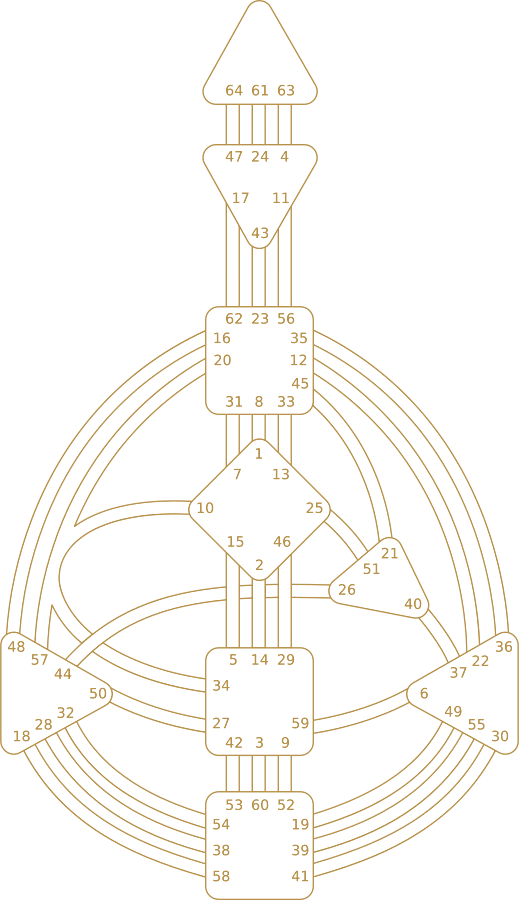
Chiron by Center
Every gate belongs to one of the nine Centers, and the center tells you the area of life your Chiron pattern works in. Open the center your Chiron gate belongs to.
Head Center · Gates 64, 61 and 63
Chiron in a Head Center gate (64, 61, or 63) creates a growth pattern around inspiration and mental pressure. You may feel a persistent drive to find answers to questions that don't have clean resolutions. The growth comes when you stop treating the pressure as a problem to solve and start recognizing it as a creative engine.
Ajna Center · Gates 47, 24, 4, 17, 43 and 11
Chiron in an Ajna gate (47, 24, 4, 17, 43, or 11) creates a growth pattern around how you process and conceptualize experience. You may struggle with feeling misunderstood or with mental frameworks that feel incomplete. The growth comes when you stop needing your thinking to be validated and start trusting the way your mind naturally organizes information.
Throat Center · Gates 62, 23, 56, 35, 12, 45, 33, 8, 31, 20 and 16
Chiron in a Throat Center gate (62, 23, 56, 35, 12, 45, 33, 8, 31, 20, or 16) creates a growth pattern around expression and manifestation. You may notice a recurring tension between what you want to say and what actually comes out, or a feeling that your voice, contribution, or creative output isn't being received. The growth comes when you align your expression with your Strategy rather than forcing it on your own timeline.
G Center (Identity) · Gates 1, 13, 25, 46, 2, 15, 10 and 7
Chiron in a G Center gate (1, 13, 25, 46, 2, 15, 10, or 7) creates a growth pattern around identity, direction, and love. You may feel a persistent questioning of who you are, where you belong, or whether you're on the right path. The growth comes when you stop searching for identity externally and let your direction reveal itself through correct movement.
Heart/Will Center · Gates 21, 51, 26 and 40
Chiron in a Heart Center gate (21, 51, 26, or 40) creates a growth pattern around willpower, value, and worthiness. You may experience a recurring pattern of overcommitting, undervaluing yourself, or needing to prove your worth through effort and output. The growth comes when you stop equating your value with what you produce and start trusting that your worth isn't something you need to earn.
Solar Plexus Center · Gates 6, 37, 22, 36, 30, 55 and 49
Chiron in a Solar Plexus gate (6, 37, 22, 36, 30, 55, or 49) creates a growth pattern around emotions, desire, and sensitivity to the feelings of others. You may notice recurring emotional intensity around specific themes, or a pattern of avoiding situations because of how deeply you'll feel them. The growth comes when you stop treating your emotional depth as a liability and start recognizing it as a powerful form of awareness.
Sacral Center · Gates 5, 14, 29, 59, 9, 3, 42, 27 and 34
Chiron in a Sacral Center gate (5, 14, 29, 59, 9, 3, 42, 27, or 34) creates a growth pattern around life force, sexuality, and sustainable commitment. You may find yourself in recurring cycles of overgiving your energy or struggling to know when something is truly yours to commit to. The growth comes when you learn to trust your Authority (with a defined Sacral, your gut-level response, or your emotional wave if your Solar Plexus is defined) without overriding it with what you think you should want.
Spleen Center · Gates 48, 57, 44, 50, 32, 28 and 18
Chiron in a Spleen Center gate (48, 57, 44, 50, 32, 28, or 18) creates a growth pattern around instinct, survival, and timing. You may notice recurring fears around safety, adequacy, or not being prepared. There might be a pattern of holding on to situations past their natural endpoint because letting go feels threatening. The growth comes when you start distinguishing between genuine instinct and conditioned fear.
Root Center · Gates 53, 60, 52, 19, 39, 41, 58, 38 and 54
Chiron in a Root Center gate (53, 60, 52, 19, 39, 41, 58, 38, or 54) creates a growth pattern around pressure, drive, and the compulsion to start or finish things. You may feel a persistent urgency that doesn't match your actual circumstances, or frustration with the pace of your progress. The growth comes when you learn to move with pressure rather than being moved by it.
Chiron and Your Type
Your Energy Type does not change what Chiron means. It changes how the pattern tends to surface and what meeting it well looks like.
Generator with Chiron
The pattern often shows up in what you say yes to: you respond to something in Chiron’s theme, then meet the same friction again. That does not mean you responded wrongly; this area simply takes more rounds. Your Sacral response (or your emotional wave, if your Solar Plexus is defined) is still your guide.
Manifesting Generator with Chiron
You meet the pattern at speed: into the theme, into the friction, pivot, back again. You cannot shortcut it, but your pace gathers experience quickly. Respond first and inform before you act, then let the pivots happen.
Projector with Chiron
Chiron often shows up as a sensitivity around being recognized. The growth comes when you stop proving the value of what you see and wait for invitations that match it. Bitterness around Chiron’s theme is a signal, not a verdict.
Manifestor with Chiron
Chiron shows up as friction when you initiate in its theme, a place where informing feels harder than usual. The growth comes when you inform yourself, as well as others, about what is happening there. Anger around the theme is information, not a flaw.
Reflector with Chiron
You may take in other people’s unresolved material in Chiron’s theme and mistake it for your own. A full lunar cycle of watching, about 28 days, is your clearest way to tell what is yours.
Chiron in Relationships
Chiron’s pattern shows most in close relationships, where another person can press on or soothe the sensitivity at your Chiron gate.
What partners notice
The people closest to you often see your Chiron pattern first, especially your unconscious Chiron: a reaction that seems bigger than the moment. With enough trust, their view is a real resource.
Where friction lives
If a partner’s Sun or another strong activation sits in your Chiron gate, their natural expression may keep pressing on your most sensitive spot. That area of the relationship carries more charge; how you meet it decides whether it strengthens or wears.
What helps
Name it plainly: this is my sensitive spot, and when it comes up my reaction may be bigger than the moment, and that is not your fault. It frees your partner from tiptoeing and helps you catch the pattern before you project it.
Chiron compatibility
Put two charts side by side in a compatibility chart and Chiron adds a layer. Chirons in the same gate can mirror each other strongly; neither outcome is set, and both depend on how much each person has met their own pattern.
Daily Awareness
Chiron needs no separate practice. Unmet, its pattern keeps coming back as the same kind of friction in different places; met, the sensitivity becomes your most practiced understanding, and often the thing you end up helping others with. Each of the 64 gates can be lived well or poorly: Chiron does not make your gate harder, it keeps bringing you back to it. Four ways to work with it:
Notice the trigger
Learn the moment Chiron’s theme is active: a charge bigger than the situation, showing up as defensiveness, avoidance or a sudden need to prove something. Pause and name the gate. The pause itself is the start.
Separate the two sides
Your conscious Chiron is the pattern you can describe; your unconscious Chiron is the one you need help to see. Ask someone close to you what they notice in you that you do not seem to notice yourself.
Use your Authority
In Chiron’s area, the sensitivity can make a situation feel more urgent or threatening than it is. Your Authority cuts through that: wait for emotional clarity, listen for the Sacral response or the Splenic knowing, whichever is yours.
Track it over time
Change shows over months and years, not days. Note when the theme comes up, how you responded and what happened next. Over time the triggers soften and the responses steady.
Chiron marks an area of your chart where repeated difficulty is not a sign that something is wrong. It is where your friction becomes your depth, your sensitivity becomes skill, and the pattern you could not escape becomes insight you can share.
FAQ: Chiron in Human Design
What is Chiron in Human Design?
Chiron is a small body orbiting between Saturn and Uranus. It is not one of Ra Uru Hu's 13 positions and never activates your BodyGraph, but many chart tools show its gate and line on both sides of your chart. Read alongside Human Design, that gate names one recurring growth pattern: a conscious one you recognize and an unconscious one others often see first.
Where is Chiron in my Human Design chart?
On your free chart, Chiron is row 14 of both planet columns, just under Pluto, with the ⚷ symbol. The right column is your conscious (Personality) Chiron, the left your unconscious (Design) Chiron. A number like 41.6 means Gate 41, Line 6.
What is the difference between Conscious and Unconscious Chiron?
Your Conscious (Personality) Chiron is the growth pattern you are aware of and can describe. Your Unconscious (Design) Chiron runs below awareness, and the people close to you often notice it before you do. Together they show one pattern from two sides: one you can see, and one that needs an outside view.
What center is my Chiron in?
Your Chiron gate belongs to one of the nine Centers, and the center names the area of life: Head for inspiration and pressure, Ajna for thinking, Throat for expression, G Center for identity and direction, Heart for willpower and value, Solar Plexus for emotions, Sacral for life force, Spleen for instinct and timing, Root for drive. Find your gate in the center list on this page.
Does my Type change how Chiron works?
Your Type does not change what Chiron means, only how the pattern tends to surface. Generators meet it in what they respond to, Manifesting Generators cycle through it quickly, Projectors feel it in how they are recognized, Manifestors meet it when they initiate, and Reflectors sample it from their surroundings. In every case your Strategy and Authority are the guide.
What is the Chiron Return in Human Design?
The Chiron Return comes around age 50, when Chiron completes its orbit and returns to where it was at your birth. Ra Uru Hu tied it to the start of the third phase of a 6th line life, when the 6th line comes off the roof. For anyone, it can feel like a consolidation of what the Chiron pattern has taught.
When exactly does the Chiron Return happen?
Usually between age 49 and 51. Chiron's orbit is uneven, so it moves through some parts of the sky faster than others, and your exact return can be calculated from your birth data. It is not a single day: it unfolds over months as Chiron approaches, reaches and passes its birth position.
What is the connection between Chiron and the 6th Line?
A 6th line Profile lives in three phases: trial and error until about 30 (the Saturn return), on the roof from about 30 to about 50, then off the roof from about 50. The Chiron Return around 50 marks the doorway into that third phase, from watching to taking part with the full weight of experience.
Can Chiron activate a gate or channel in my chart?
No. Chiron never activates a gate, completes a channel or defines a center, so it never changes your Type, Strategy, Authority, Profile or definition. Those come only from the 13 positions. Chiron's gate is something to read, not part of your mechanics.
How does Chiron affect relationships?
When a partner's strong activation, such as their Sun, sits in the same gate as your Chiron, that part of the relationship can carry extra charge: they may press on your sensitive spot simply by being themselves. Knowing each other's Chiron gates helps both people meet that friction with awareness instead of reactivity.