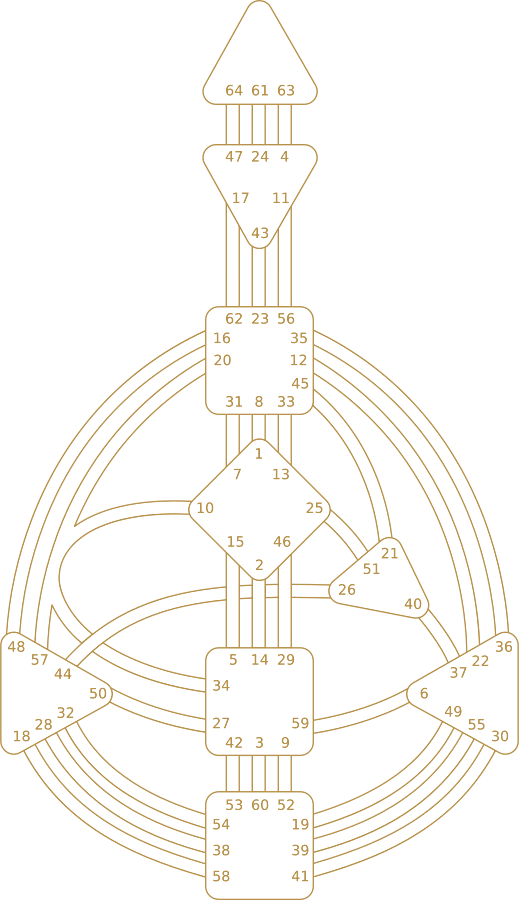

South Node in Human Design
The South Node in Human Design is the point of the past: the setting and theme of the first half of life, the backdrop you grew up in, shown by the gate and line it sits in.
This page is for anyone curious about the ground they came from. It explains what the South Node describes, how its conscious and unconscious sides differ, how it can show up in the way you were raised and the habits you carry, and how to read it beside the North Node without getting stuck looking backward. Start with your free chart below.
Simple way to think about it: Picture the South Node as the home you grew up in. You know where the light switches are without looking, even if you no longer live there.
Find your South Node: start with your free chart
Enter your birth date, time and place to get your free Human Design chart.
The South Node is row 4 in both planet columns. The Personality column on the right is your conscious South Node, where it stood at your birth. The Design column on the left is your unconscious South Node, where it stood about 88 days before. A number like 41.6 means Gate 41, Line 6. The chart symbols guide explains the rest of the chart.
What does the South Node mean in Human Design?
The South Node is about where you come from. It names the environment and theme of the first half of life, the early surroundings that shaped how you learned to move through the world. Its gate and line describe that backdrop, the way a stage set describes a play before any actor speaks.
This is not a judgment of your childhood or a list of what went wrong. It is a description of the setting that felt familiar, ordinary and close. Many people find that the South Node explains habits that seem to come from nowhere: a way of reacting, a comfort zone, a theme that feels easy to slide back into. It is the known ground you start from.
South Node at a glance
| Symbol | ☋ See all the chart symbols. |
|---|---|
| Meaning | The past. The environment and theme of the first half of life. |
| On your chart | Row 4 of the planet columns, on both sides: Personality on the right, Design on the left. |
| Time in one gate | About 3.5 months, moving backward through the wheel, always opposite the North Node. |
| One of thirteen | One of the 13 positions in every chart. See all of them on Human Design Planets Meaning. |
Conscious and unconscious South Node
Personality South Node (conscious)
The Personality South Node is the past you can name. You may recall the people, places and routines that fit its gate, and you can often tell the story of how they shaped you. It tends to feel like memory you can reach for, a set of habits you can point at and explain. Because it is conscious, you can choose to keep what still serves you and set the rest down. It becomes a problem only when familiar ground is mistaken for the only ground available.
Design South Node (unconscious)
The Design South Node sits below memory. It is the backdrop that shaped you without being noticed, like the accent you picked up before you could speak. You may not recall it, yet it still colors how you act. Others often see its mark in you first: a family resemblance, a reflex, a way of handling a room that you never decided on. It tends to feel like nature, not history, which is why it is easy to overlook.
Reading your two South Node gates together
Read your two South Node gates as one backdrop with two layers. The conscious gate is the past you can recall and describe. The unconscious gate is the older groundwork others may see before you do. Together they describe the setting you began in, not a limit on where you go.
How long the South Node stays in one gate
Each gate covers one sixty-fourth of the wheel: 5 degrees 37 minutes 30 seconds. The South Node spends about 3.5 months, moving backward through the wheel, always opposite the North Node in one gate, as an average over many years. Everyone born in that window shares the gate; the line and the side it sits on narrow it down.
What only the South Node does
South Node in daily life
In daily life, the South Node shows up as familiarity. You may notice you slip into certain roles, tones or routines without deciding to, and that they feel oddly comfortable. Through its gate, that comfort has a specific flavor, and the line shapes how it plays out. Familiar ground is often the easiest place to start.
In work and relationships, it can explain why some patterns repeat early in life, and why certain people feel like home right away. It can also explain why a role that once fit starts to feel too small. That is not a failure. It is the first half of life doing its job. Keep making choices through your Strategy and Authority, and let the past be a source of skill instead of a script.
Noticing your South Node gate
Common ways the South Node is misread
People often read the South Node as baggage, a weakness, or something to leave behind. It is none of those. It is a setting and theme, and it carries real skill from long familiarity. Another mistake is thinking it fixes who you are forever, when it simply describes where you started. It is also easy to read it like astrology. Human Design reads the gate and line the Node sits in, not an astrology label, so astrology-style descriptions will not match this page.
Your South Node gate: all 64 gates
Find your South Node number on your chart, then open its gate. Each gate guide covers all six lines.
Show all 64 gates
| Gate 1 | Self-Expression · G Center |
|---|---|
| Gate 2 | The Direction of the Self · G Center |
| Gate 3 | Ordering · Sacral Center |
| Gate 4 | Formulization · Ajna Center |
| Gate 5 | Fixed Rhythms · Sacral Center |
| Gate 6 | Friction · Solar Plexus Center |
| Gate 7 | The Role of the Self in Interaction · G Center |
| Gate 8 | Contribution · Throat Center |
| Gate 9 | Focus · Sacral Center |
| Gate 10 | The Behavior of the Self · G Center |
| Gate 11 | Ideas · Ajna Center |
| Gate 12 | Caution · Throat Center |
| Gate 13 | The Listener · G Center |
| Gate 14 | Power Skills · Sacral Center |
| Gate 15 | Extremes · G Center |
| Gate 16 | Skills · Throat Center |
| Gate 17 | Opinions · Ajna Center |
| Gate 18 | Correction · Spleen Center |
| Gate 19 | Wanting · Root Center |
| Gate 20 | The Now · Throat Center |
| Gate 21 | The Hunter/Huntress · Heart Center |
| Gate 22 | Openness · Solar Plexus Center |
| Gate 23 | Assimilation · Throat Center |
| Gate 24 | Rationalization · Ajna Center |
| Gate 25 | The Spirit of the Self · G Center |
| Gate 26 | The Egoist · Heart Center |
| Gate 27 | Caring · Sacral Center |
| Gate 28 | The Game Player · Spleen Center |
| Gate 29 | Saying Yes · Sacral Center |
| Gate 30 | Recognition of Feelings · Solar Plexus Center |
| Gate 31 | Influence · Throat Center |
| Gate 32 | Continuity · Spleen Center |
| Gate 33 | Privacy · Throat Center |
| Gate 34 | Power · Sacral Center |
| Gate 35 | Change · Throat Center |
| Gate 36 | Crisis · Solar Plexus Center |
| Gate 37 | Friendship · Solar Plexus Center |
| Gate 38 | The Fighter · Root Center |
| Gate 39 | Provocation · Root Center |
| Gate 40 | Aloneness · Heart Center |
| Gate 41 | Contraction · Root Center |
| Gate 42 | Growth · Sacral Center |
| Gate 43 | Insight · Ajna Center |
| Gate 44 | Alertness · Spleen Center |
| Gate 45 | The Gatherer · Throat Center |
| Gate 46 | The Determination of the Self · G Center |
| Gate 47 | Realization · Ajna Center |
| Gate 48 | Depth · Spleen Center |
| Gate 49 | Principles · Solar Plexus Center |
| Gate 50 | Values · Spleen Center |
| Gate 51 | Shock · Heart Center |
| Gate 52 | Stillness · Root Center |
| Gate 53 | Beginnings · Root Center |
| Gate 54 | Ambition · Root Center |
| Gate 55 | Spirit · Solar Plexus Center |
| Gate 56 | Stimulation · Throat Center |
| Gate 57 | Intuitive Clarity · Spleen Center |
| Gate 58 | Vitality · Root Center |
| Gate 59 | Sexuality · Sacral Center |
| Gate 60 | Acceptance · Root Center |
| Gate 61 | Mystery · Head Center |
| Gate 62 | Details · Throat Center |
| Gate 63 | Doubt · Head Center |
| Gate 64 | Confusion · Head Center |
Next steps
Run your free chart and find your two South Node gates. Read your Type, Strategy and Authority first, then use the planets guide to read the other twelve positions the same way.
FAQ: South Node in Human Design
What does the South Node mean in Human Design?
The South Node is the past. It describes the environment and theme of the first half of life, the backdrop you grew up in, until the Uranus opposition near age 40. Its gate and line show the kind of setting that felt familiar. It is a starting ground, not a verdict on your life.
What is the difference between the conscious and unconscious South Node?
The conscious South Node is the past you can recall and explain. The unconscious South Node is older groundwork that shaped you without notice, and others may see it first. Both come from a gate and line, one on each side of the chart. Neither outranks the other, and together they describe one backdrop.
Where is my South Node on my Human Design chart?
Run your free chart. The South Node is row 4 in both planet columns. The right column is your Personality South Node (conscious, at your birth) and the left column is your Design South Node (unconscious, about 88 days before). A number like 41.6 means Gate 41, Line 6.
How is the South Node different from the North Node?
They always sit in opposite gates. The South Node describes the first half of life, the setting you start in. The North Node describes the second half, the direction you grow toward. Each page reads one side, and the two work as a pair, with the past on one end and the future on the other.
How long does the South Node stay in one gate?
About 3.5 months on average. Each gate is one sixty-fourth of the wheel, 5 degrees 37 minutes 30 seconds, and the South Node spends about 3.5 months, moving backward through the wheel, always opposite the North Node in one.
Does my South Node replace my Strategy and Authority?
No. Your Type, Strategy and Authority always come first. The South Node adds detail about the backdrop you began in and the habits that feel familiar. It does not tell you what to decide, and it is not a reason to stay in old patterns or to leave them.