
Solar Plexus Center Human Design
The Solar Plexus Center in Human Design, also called the Emotional Center, is the only Center that is both a motor and an awareness Center. It generates the emotional wave. Defined, it runs its own wave and gives you Emotional Authority. Open, it takes in and amplifies the emotions around you.
Think of it as the tide. The water is always moving, and you only see the whole shoreline by watching it come in and go out. Clarity here comes with time, never in one moment.
Is your Solar Plexus Center defined or open? Check with the free chart calculator on this page. It takes your birth date, time and place.
Solar Plexus Center at a glance
The facts of the Solar Plexus Center in one place, from the Human Design canon. The shares are from Jovian Archive’s statistics.
Is your Solar Plexus Center defined? Find it in your chart
Your Centers are calculated from your birth date, birth time and birth place. Enter your details and your free chart shows this Center colored in if it is defined, and white if it is open.
Every Center has its own guide:
What is the Solar Plexus Center?
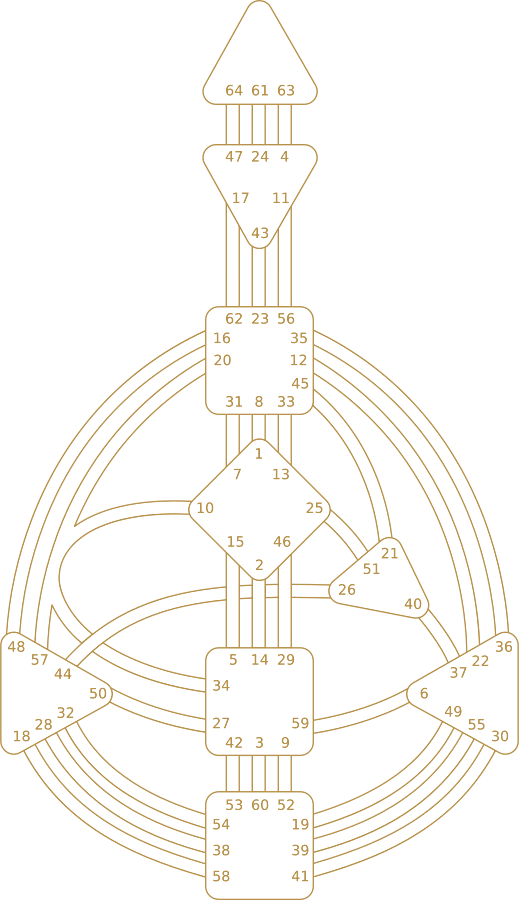
The Solar Plexus Center sits on the right side of the BodyGraph, drawn as a triangle. It governs emotional experience: feelings, desire, mood, relational chemistry, and the emotional wave that colors how everything in your life feels at any given moment. Jovian Archive describes it in one line: emotions and the wave, both a motor and an awareness center.
That dual classification is what makes this Center different from the other eight. It is one of three awareness Centers (with the Ajna and the Spleen) and one of four motors (with the Sacral, Heart, and Root). The motor side generates emotional energy; the awareness side perceives it. When you feel a strong emotion, both are happening at once, which is why emotions feel so much more consuming than a thought (Ajna) or an intuitive flash (Spleen): they carry motor energy the body physically feels.
It also explains the Center's central teaching, patience. A decision made at the emotional peak has the motor's high energy behind it, which can feel like enthusiasm but may be the wave inflating things. A decision made at the low has depleted energy behind it, which can feel like doubt but may be the wave deflating things. Only time lets the awareness separate what is true from where the wave happens to be.
Its 7 Gates: Gate 6, Gate 22, Gate 30, Gate 36, Gate 37, Gate 49 and Gate 55.
Its 7 Channels connect it to four other Centers. To the Throat: Channel 12-22, the Channel of Openness, and Channel 35-36, the Channel of Transitoriness. To the Root: Channel 39-55, the Channel of Emoting, Channel 30-41, the Channel of Recognition, and Channel 19-49, the Channel of Synthesis. To the Heart: Channel 37-40, the Channel of Community. To the Sacral: Channel 6-59, the Channel of Mating. Any one of these Channels defines your Solar Plexus.
The two Throat Channels matter for Type. 12-22 and 35-36 are manifesting channels: a motor connected to the Throat. With one of them and no defined Sacral, the chart is a Manifestor, whose Strategy is to inform. With a defined Sacral as well, it is a Manifesting Generator, whose Strategy is to respond, then inform before acting.
How the emotional wave works
The emotional wave is not random. Jovian Archive's dictionary names three kinds of wave, each tied to specific Gates in this Center and to the circuit those Gates belong to. Which wave you carry depends on which of these Gates and Channels are active in your chart, and many charts carry more than one.
The Tribal wave (Gate 6, Gate 37, Gate 49) is the wave Jovian Archive calls the Ratchet. Its theme is need. It builds a step at a time until it releases. If you carry it, you may notice feeling building quietly over days and then letting go all at once, which is the wave completing, not something going wrong.
The Individual wave (Gate 22, Gate 55) is the Spike. Its theme is uncertainty. It runs mostly even, with sudden spikes. Because the spikes do not follow an obvious outside cause, this wave is hard to explain to yourself or anyone else. The practice is accepting that it moves on its own rhythm and that neither a spike nor the flat stretch is the complete truth.
The Collective wave (Gate 30, Gate 36) is the Crash. Its theme is desire. It makes a gradual rise, then a sharp fall. It is the wave of wanting an experience, moving toward it, and then meeting the difference between what you hoped for and what happened. That fall is the nature of desire, not a failure.
Defined Solar Plexus Center
If your Solar Plexus is colored in on your chart, it is defined. At least one of its seven Channels is complete, so you generate your own emotional wave, consistently, whoever is in the room. Your emotional life is primarily self generated rather than absorbed from others. Jovian Archive's statistics put this at 49.0% of charts.
The strength of a defined Solar Plexus is emotional depth. You feel things fully: desire, joy, grief, excitement, love. As you learn your wave's patterns, you develop emotional wisdom: the ability to feel deeply without being run by what you feel. You also affect the people around you. Your wave sets the emotional climate in a room, especially for anyone whose Solar Plexus is open.
The challenge is reactivity. Because the motor runs continuously, there is always a wave moving. At the peak, everything feels possible. At the low, the same things feel doubtful or heavy. The growth edge is not making permanent decisions from temporary emotional states. Committing at the peak creates obligations that feel crushing at the low. Quitting at the low abandons things that may feel worth keeping once the wave lifts.
Undefined (Open) Solar Plexus Center
If your Solar Plexus is white on your chart, it is undefined (or open). You do not generate your own emotional wave. Instead, you take in the emotional energy of the people around you and amplify it. Around someone with a defined Solar Plexus, you feel their wave, often more intensely than they do. Jovian Archive's statistics put the undefined Solar Plexus with some Gates active at 39.3% of charts, and the completely open Solar Plexus at 11.1%.
The strength of an open Solar Plexus is emotional discernment. Because you experience emotions from the outside, you can read an emotional environment, sense what others are feeling, and tell different emotional qualities apart. You can become genuinely wise about emotions without being caught inside a wave of your own.
The open Center's Not-Self question is: "Am I avoiding confrontation and truth?" Because amplified emotion can feel overwhelming, many people with an open Solar Plexus learn to keep the emotional temperature low: avoiding confrontation, people-pleasing, managing other people's moods, or staying in light connection to avoid deep emotional engagement. It protects you from discomfort, but it also keeps honest conversations from happening.
The most useful test: when you leave an emotionally charged environment, notice how quickly the intensity drops. If it fades when you are alone, it was amplified rather than generated. Knowing this keeps you from making decisions on emotional energy that does not belong to you.
The Solar Plexus and Authority
The Solar Plexus has a unique rule: when it is defined, it is always the Authority. If your Solar Plexus is colored in, you have Emotional Authority, and it outranks every other Authority, whatever else is defined in your chart.
This rule exists because the emotional wave colors everything. When the wave is high, a Sacral response feels amplified. When the wave is low, even a genuine Sacral yes feels doubtful. Only by waiting for the wave to settle can you tell genuine guidance from the wave's current position. In Human Design there is no truth in the now for a defined Solar Plexus. Emotional clarity is never complete; the goal is enough clarity to act. For how long to wait and how to know you are there, see the Emotional Authority page and the Authority guide.
The not-self pattern of the Solar Plexus Center
The Solar Plexus not-self pattern is avoiding emotional discomfort, and it looks different on each side. With a defined Solar Plexus, it shows up as acting at the peak or the low to escape the wave's intensity: committing impulsively at the high, quitting impulsively at the low, or numbing the wave with constant busyness. With an open Solar Plexus, it shows up as the avoidance named in the question above: sidestepping confrontation and truth to keep everyone calm.
The antidote for both is letting emotions move without acting on them too soon. Defined, you ride the wave through its full cycle before deciding. Open, you let absorbed emotions pass through without claiming them as your own. Feel it fully, wait for it to settle, then choose from the clarity that remains.
The Solar Plexus at work
At work, the Solar Plexus shapes decision timing, how you speak under emotional charge, and whether your commitments hold up regardless of mood.
With a defined Solar Plexus, the most valuable practice is the "sleep on it" rule for any significant commitment: contract terms, hiring choices, a change of direction. Each benefits from at least one wave cycle of consideration. The clarity you gain consistently outweighs the speed you lose.
With an open Solar Plexus, the most valuable practice is noticing when the office's emotional climate is driving your stress. If you walk into a tense meeting and suddenly feel anxious, that may be the room's emotion amplified through your open Center. Pausing to ask, "Is this mine or theirs?" before you respond can prevent an escalation nobody needed.
The Solar Plexus in relationships
Emotional waves drive bonding, desire, intimacy, conflict, and the question of truth between two people. Aligned, they create depth and trust; misaligned, a cycle of explosion followed by repair.
The most common dynamic is the defined and open pairing. The partner with a defined Solar Plexus generates a wave the open partner takes in and amplifies. The defined partner may not realize how much their wave sets the climate of the relationship, and the open partner may not realize the intensity they feel is borrowed. Seeing this dynamic, without changing anything else, can take a lot of heat out of conflict. Two of the Center's Channels are about connection directly: Channel 6-59, the Channel of Mating and Channel 37-40, the Channel of Community.
To see how emotional definition meets between two charts, use the Human Design Compatibility Calculator.
Daily practice for the Solar Plexus Center
With a defined Solar Plexus, the daily practice is wave tracking. At the start and end of each day, note where you are: high, low, or in between. Over time this shows your wave's rhythm and makes it easier to recognize a peak or a low before an important decision. When you notice you are at an extreme, hold significant commitments until the wave moves.
With an open Solar Plexus, the daily practice is emotional discharge. After time in emotionally charged company, spend time alone and notice which feelings fade. The ones that leave when the people leave were borrowed. The ones that remain in solitude are yours and worth your attention.
Next steps
See how the Solar Plexus fits with the other eight on the Human Design Centers hub, compare consistent and open energy in Defined vs Undefined Centers, and if your Solar Plexus is defined, go deeper with Emotional Authority. Your Human Design reading covers your Solar Plexus in full across 60+ sections: which of its Gates and Channels you carry, your emotional wave, and how it shapes your decisions and relationships.
FAQ: Solar Plexus Center Human Design
What is the Solar Plexus Center in Human Design?
The Solar Plexus, also called the Emotional Center, is the only Center that is both a motor and an awareness Center. It generates the emotional wave and the awareness that comes with it over time.
What does a defined Solar Plexus mean?
You generate your own emotional wave and have Emotional Authority. Clarity comes with time, as you look at the same question from different points on the wave.
What does an undefined Solar Plexus mean?
You take in and amplify the emotions of the people around you. Your wisdom comes from telling your own feelings apart from borrowed emotional energy. Its Not-Self question is “Am I avoiding confrontation and truth?”
Is Emotional Authority the same as having a defined Solar Plexus?
Yes. When the Solar Plexus is defined, it is your Authority and outranks every other Authority, whatever else is defined. The emotional wave colors every other signal.
What are the three emotional wave types?
Jovian Archive names three. The Tribal wave (Gates 6, 37, 49), the Ratchet, is about need and builds a step at a time until it releases. The Individual wave (Gates 22, 55), the Spike, is about uncertainty and runs mostly even with sudden spikes. The Collective wave (Gates 30, 36), the Crash, is about desire: a gradual rise, then a sharp fall.
Why do I feel so different about the same thing on different days?
If your Solar Plexus is defined, this is your emotional wave. The same decision can feel exciting at the peak and doubtful at the low. Clarity comes from noticing what stays true across several points on the wave.
How do I stop absorbing other people's emotions?
If your Solar Plexus is undefined, spend time alone after emotionally charged environments. The emotions that fade when the people leave were borrowed. The ones that remain are yours.
How do I find the Solar Plexus on my chart?
Use the free chart calculator on this page and look for the triangle on the right side of the BodyGraph. If it is colored, your Solar Plexus is defined. If it is white, it is undefined.
How common is a defined Solar Plexus Center?
According to Jovian Archive's statistics, 49.0% of charts have a defined Solar Plexus. 39.3% have it undefined with some Gates active, and 11.1% have it completely open.