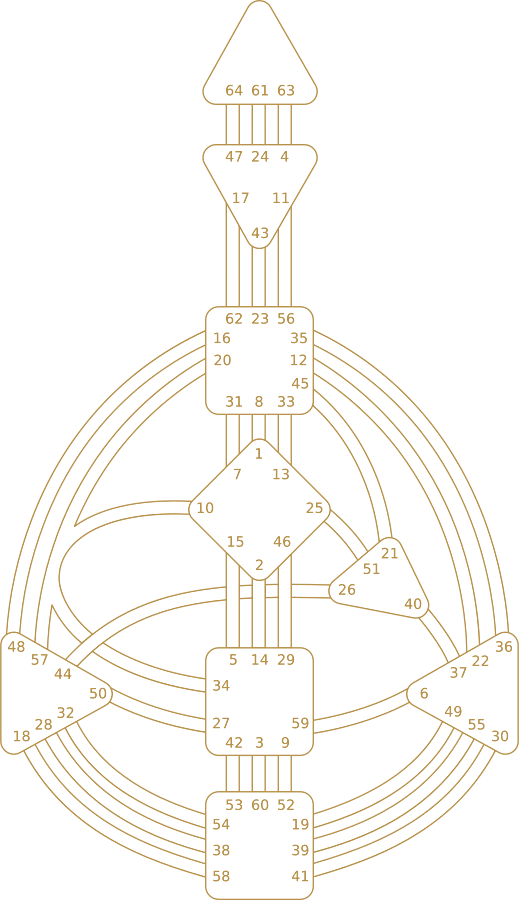

Root Center Human Design
The Root Center in Human Design is the only center that functions as both a pressure center and a motor center simultaneously. It creates the push to start, move and finish things. Defined, that drive is your own and steady; open, you take in and amplify the pressure around you.
Think of the Root as fuel under pressure. It gives you the push and the energy to move, but fuel is not a command to act now: your Strategy sets the timing and your Authority makes the decision.
Is your Root Center defined or open? Check with the free chart calculator on this page. It takes your birth date, time and place.
Root Center at a glance
The facts of the Root Center in one place, from the Human Design canon. The shares are from Jovian Archive’s statistics.
Is your Root Center defined? Find it in your chart
Your Centers are calculated from your birth date, birth time and birth place. Enter your details and your free chart shows this Center colored in if it is defined, and white if it is open.
Every Center has its own guide:
What is the Root Center?
The Root Center is the bottom square on the BodyGraph. In Human Design's own short description, its theme is adrenaline and stress, pressure and drive, the push to begin. It holds nine Gates and connects by nine Channels to the three Centers just above it: the Sacral, the Spleen and the Solar Plexus.
What makes the Root unique among the nine Centers is its dual classification. It is one of two pressure centers (with the Head) and one of four motor centers (with the Sacral, Solar Plexus, and Heart). A pure pressure center like the Head creates the push to think and question, but it has no motor energy to act on that push. The Root generates pressure AND provides the energy to act on it, which is why Root pressure is so much harder to ignore than Head pressure. It is felt in the body, so it needs somewhere to go: into correct action, or into plain physical movement while you wait.
The Root Center connects upward to the Sacral, the Spleen, and the Solar Plexus, creating pathways that channel its pressure-motor energy into work output (through the Sacral), survival instincts (through the Spleen), and emotions (through the Solar Plexus). Understanding these connections helps explain why Root pressure often feels like it is about survival even when the actual situation is not threatening. Root pressure does not distinguish between real danger and a work deadline. It simply generates the same push to resolve.
The Head-Root pressure polarity
The Head Center and the Root Center form the two poles of pressure in the Human Design chart. The Head creates pressure from the top: the drive to think, question, and understand. The Root creates pressure from the bottom: the drive to act, move, and resolve.
When both poles are active at once, the Head says "figure this out" while the Root says "do something about it now." If neither pressure goes through Strategy and Authority, you get thinking without resolution on top and urgency without correct action on the bottom. Seeing two poles rather than one big stress lets you address each separately.
Root Center Gates and Channels
The Root Center holds nine Gates: Gate 19, Gate 38, Gate 39, Gate 41, Gate 52, Gate 53, Gate 54, Gate 58 and Gate 60. Each Gate is one end of a Channel. When both Gates of a Channel are activated in your chart, the Channel is complete and the Root is defined. The Root has nine Channels, three to each Center above it:
- To the Sacral: the Channel of Mutation (3‑60), the Channel of Concentration (9‑52) and the Channel of Maturation (42‑53).
- To the Spleen: the Channel of Struggle (28‑38), the Channel of Judgment (18‑58) and the Channel of Transformation (32‑54).
- To the Solar Plexus: the Channel of Emoting (39‑55), the Channel of Recognition (30‑41) and the Channel of Synthesis (19‑49).
The three Root to Sacral Channels are the format energy Channels: each one sets a format for the whole circuit it sits in. No Channel runs from the Root straight to the Throat, so Root pressure only reaches expression through the Sacral, the Spleen or the Solar Plexus.
Defined Root Center
If your Root Center is colored in on your chart, it is defined: at least one of its nine Channels is complete. You generate your own consistent internal pressure and adrenaline-based motor energy, a steady drive to move, start, finish, and resolve that does not depend on outside stimulation. You are the person who creates urgency in the room rather than absorbing it.
The strength of a defined Root is reliable momentum. You can handle deadlines, push through challenges, and maintain forward movement with steady consistency. Your pressure is internal and predictable, which means you can learn its rhythms and work with them rather than against them.
The challenge of a defined Root is living in constant urgency. Because the pressure is always present, you may overschedule, over-commit, and push through exhaustion. The growth edge is learning that pressure is available energy, not a command. You can feel the pressure and still wait for correct timing through your Strategy and Authority.
A defined Root also tends to set the pace for the people around you. Your adrenaline output creates a pressure field that undefined Root people absorb and amplify, which means your urgency can inadvertently stress out your partner, team, or family. Awareness of this dynamic helps you modulate your pace in shared environments.
Undefined (Open) Root Center
If your Root Center is white on your chart, it is undefined (or open). This means you do not generate your own consistent pressure and adrenaline energy. Instead, you absorb and amplify the Root pressure of the people and environments around you. In the presence of someone with a defined Root, you may feel their urgency magnified through your open center, experiencing their pressure as even more intense than they do.
The strength of an undefined Root is wisdom about pressure and timing. Because you experience pressure from the outside, you can learn when urgency is real and when it is manufactured: which deadlines actually matter, and when "I have to do this now" is borrowed energy rather than correct timing.
The challenge of an undefined Root is the rushing pattern. Amplified pressure is uncomfortable, so you act, finish, or commit quickly to make it stop, not because the timing is correct: the "doing things just to get them over with" pattern.
The pressure you feel is usually not yours. Step away from a stressful environment or a high-pressure person and the urgency often dissolves within minutes. If it disappears when you change environments, it was borrowed.
The question Human Design asks of an open Root is direct: "Am I always in a hurry to be free of pressure?" If the honest answer is yes, the pressure is deciding for you, and the work is to let it pass before you choose.
The Root Center and Authority
No Authority comes from the Root Center. However strong its pressure, it never tells you whether a decision is correct for you, and that is true whether your Root is defined or open. Your decisions come from your Authority, which sits in another Center of your chart, and your Strategy tells you when to engage.
Root pressure is the push to decide early. Treat it as a sign that energy is available, then let your Authority decide.
The not-self pattern of the Root Center
The Root Center's not-self pattern belongs mostly to the open Root: rushing to relieve pressure: acting, deciding, or finishing because the pressure is uncomfortable, not because the timing is correct. It becomes a cycle. You act too quickly, the action creates consequences, the consequences create more pressure, and you rush again.
The defined Root’s challenge is different: treating every internal pressure signal as urgent and reading rest as falling behind. With an open Root, the pattern looks like converting other people's urgency into impulsive action: rushed decisions, deadlines you lack capacity for, tasks finished early just to escape the pressure.
Pressure versus correct timing
This is the central lesson of the Root Center: pressure is not timing. Pressure says "something needs to happen." Timing says "this is when it should happen." They are different signals coming from different sources, and confusing them is the root cause of most stress-driven mistakes.
So when you feel Root pressure, the first question is not "What should I do?" but "Is this the right time?" If your Strategy says yes and your Authority confirms, use the Root's motor energy and move with power. If not, acknowledge the pressure, move your body if you need to, and wait.
Your timing comes from your Type's Strategy: To respond for a Generator, To respond, then inform before acting for a Manifesting Generator, Wait for the invitation for a Projector, To inform for a Manifestor, and Wait a lunar cycle, about 28 days, for a Reflector.
The Root Center at work
At work, the Root Center drives productivity and how you respond to deadlines. Aligned, it gives focused work powered by genuine momentum. Misaligned, it becomes panic productivity: rushing deadlines that may not be real and treating every task as the most urgent thing in the world.
Defined Root Centers at work tend to be the pace-setters, steady under deadlines and targets. The trap is bringing that pace to every task, including the ones that need no urgency.
Undefined Root Centers at work are especially sensitive to high-pressure environments. Open-plan offices, deadline-driven cultures, and high-intensity colleagues can amplify your Root to the point where you feel constantly stressed even when your actual workload is manageable. The most effective intervention is environmental: choosing workspaces, teams, and rhythms that do not chronically activate your open Root.
The Root Center in relationships
In relationships, Root pressure often shows up as the need to fix things now or rush a conversation to closure. The urgency is real in the body, but the timing is often wrong, and forced resolution tends to create more conflict than it resolves.
A common Root dynamic is one partner with a defined Root generating steady pressure and one with an open Root absorbing and amplifying it. The first may not see how much stress their pace creates; the second may not see that the urgency is borrowed. Naming it openly, "I think I am absorbing your urgency right now," can defuse a tension before it becomes conflict.
For a deeper look at how pressure dynamics interact between two charts, use the Human Design Compatibility Calculator.
Daily practice for the Root Center
The simplest Root Center practice is the pressure check: when you feel the urge to rush, pause and ask "Is this urgency real, or is it pressure looking for an outlet?" If the answer is pressure, discharge it physically (movement, exercise, a walk) rather than converting it into impulsive action. If the answer is real urgency, check your Authority before committing and let Strategy guide the timing.
For defined Root Centers, build deliberate downshifts into your day. Your motor runs constantly, and without intentional recovery, the sustained pressure can leave you tired and stretched thin. Even five minutes of stillness between intense work blocks helps you reset.
For undefined Root Centers, step out of pressured environments before making significant decisions. The clarity that follows is a more reliable basis than the urgency you felt in the room.
Next steps
See how the Root fits with the other eight on the Human Design Centers page, compare all nine in Defined vs Undefined Centers, and read Human Design Authority to find where your decisions come from, since none come from the Root. Its opposite pole is the Head Center. A Human Design reading covers your Root Center in full across 60+ sections: which of its nine Gates you carry, the Channels that define it, and how its pressure meets your Strategy and Authority.
FAQ: Root Center Human Design
What is the Root Center in Human Design?
The Root Center is the only center that functions as both a pressure center and a motor center. It generates the pressure to act and the adrenaline-based energy to power that action. It sits at the bottom of the BodyGraph.
Is the Root Center a motor center?
Yes. The Root is both a pressure center and a motor center, one of four motors (Sacral, Solar Plexus, Heart, Root). Its motor energy is adrenaline, and it drives physical action and momentum.
What does a defined Root Center mean?
A defined Root means you generate consistent internal pressure and drive. You tend to set the pace in your environments. The growth edge is learning that not all pressure requires immediate action.
What does an undefined Root Center mean?
An undefined Root means you absorb and amplify pressure from others. The rushing pattern, acting just to relieve borrowed urgency, is the main conditioning challenge. Its question is: “Am I always in a hurry to be free of pressure?”
Why do I always feel rushed?
Rushing is the Root Center's not-self pattern. It means acting from pressure rather than correct timing. The fix is separating pressure (available energy) from timing (when to use it through Strategy and Authority).
How common is a defined Root Center?
According to Jovian Archive's statistics, 59.9% of charts have a defined Root Center, 35.6% have it undefined with some Gates active, and 4.1% have it completely open.
Which Gates are in the Root Center?
The Root Center holds nine Gates: 19, 38, 39, 41, 52, 53, 54, 58 and 60. Together they form nine Channels, three each to the Sacral, the Spleen and the Solar Plexus.
Does the Root Center have an Authority?
No. No Authority comes from the Root Center, whether it is defined or open. Your decisions come from the Authority in another Center of your chart, and your Strategy sets the timing.
How do the Head and Root Centers relate?
They are the two pressure poles of the chart. The Head creates pressure to think and understand (top). The Root creates pressure to act and resolve (bottom).
How do I find the Root Center on my chart?
Generate your free chart and look at the bottom square of the BodyGraph. If it is colored, your Root is defined. If it is white, it is undefined.