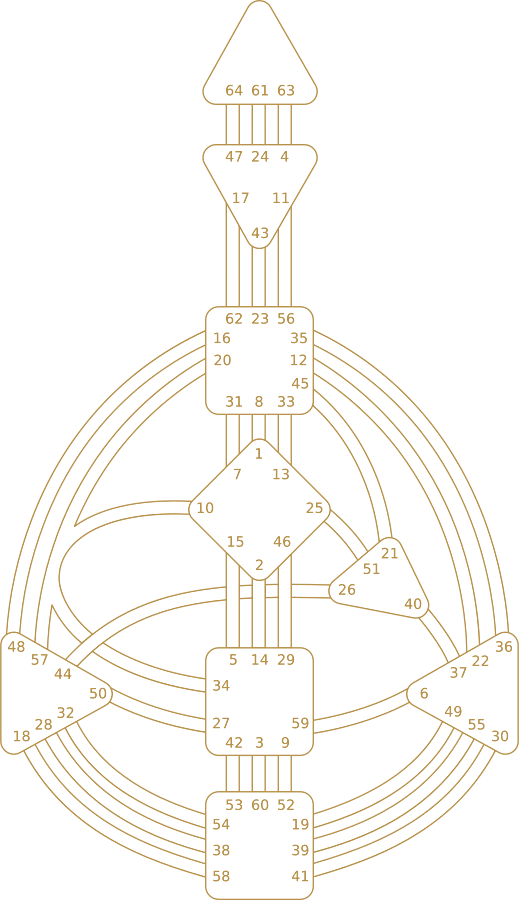

Daily Alignment Guidance in Human Design
Daily alignment guidance in Human Design is the practice of using your Type, Strategy, and Authority in ordinary choices, so that each day runs on your own design instead of on pressure from outside.
This page answers the question behind searches like human design daily impact: how your design shows up in an ordinary day. You will find what alignment means, a simple daily practice, how each Authority and Type decides, and how work and relationships change when you stop forcing. Start with your free chart below.
Simple way to think about it: Daily alignment is like checking the weather before you dress: the climate of your design never changes, but reading it each morning keeps you from fighting conditions you could simply plan for.
Find your Type and Authority: start with your free chart
Daily alignment starts from two facts about you, and your chart gives both in seconds. Enter your birth date, time, and place in your free chart below, and it names your Type and your Authority along with the rest of your design. It takes under a minute, and you do not need to know anything about Human Design first.
Once the chart loads, find the Type and Authority lines near the top and write them down. Your Type tells you how to approach the day, and your Authority tells you how to decide inside it. Everything below assumes you have those two answers in front of you. Keep this page open while you read, because the sections on Authority and Type will point you to the right line for you.
What does daily alignment mean in Human Design?
In Human Design, daily alignment means living by your Strategy and Authority in the small moments of an ordinary day. It is not a mood or a ritual. It is the habit of asking how you are built to move, and then letting that answer shape what you say yes to, what you wait on, and when you speak. Done well, it makes an ordinary Tuesday feel different: fewer second guesses, fewer evenings spent wondering why you said yes. If you are still getting to know your chart, start with Human Design chart meaning.
This is also the plain answer to what Human Design does for you day to day. Deconditioning is the long arc: over months and years you see which patterns were never yours. Alignment is today. It is the next decision, the next conversation, the next time someone asks you for something and you notice what your body and timing say before you answer. None of it asks you to become someone else, and none of it requires perfection. You will miss it some days, notice the cost, and begin again the next morning.
Clarity
Timing
Decision-making
Awareness
Today's energy: transits and affirmations
Your design stays the same every day, but the sky does not. The planets move through the Gates daily, and that moving imprint, called the transit, touches everyone's chart at once. Think of today's transit as weather, not a command. It can color the mood of the day, and it never overrides your Strategy or your Authority. Read it the way you read a forecast: notice it, plan around it, and carry on with your own method.
What daily alignment looks like in practice
A daily practice does not need to be long. Four short touchpoints are enough, and each one uses something you already have: your Type, your Authority, and your own attention. Pick the version you can repeat on a busy day, then adjust it as you learn how your design responds. Even two minutes, done on most days, beats an hour done once. Treat it as an experiment you run on yourself, with no score and no streak to protect.
Morning check-in
Energy check
Decision pause
Evening reflection
How Authority shapes your daily alignment
Authority is the center of daily alignment, because it is how you actually decide. The order below follows the hierarchy: if you have a defined Solar Plexus, that is your Authority, then the Sacral, and so on down the list. You only use one. Find yours, and read the line that shows what a normal day with it looks like. If your chart shows more than one possibility, use the first one that applies in this order.
Emotional Authority
Sacral Authority
Splenic Authority
Ego Authority
Self-Projected Authority
Mental Authority
Lunar Authority
How your Centers influence daily alignment
Your Centers show where your energy is dependable and where it is borrowed. A defined Center is consistent: it works the same way day after day, and it is what you can lean on when the day gets unpredictable. That steadiness is yours, even when it looks different from other people's. Think of your defined Centers as the people you can always call, and notice which of your habits come from them. When you feel steady in an area of life, a defined Center is often why.
An open Center takes in and amplifies the energy around you, which can feel like a mood or an urge you cannot place. Use each open Center's not-self question as a daily check. If you catch yourself asking it, you are probably taking on someone else's pattern, and you can set it down. The table lists all nine, and the Centers page explains each one. If a Center is open and shows up as a strong urge, such as the pull to prove something, hurry, or please, pause and ask whose urge it is. You do not have to fix it. Noticing it is already the practice.
The open Center question for each Center
| Head Center | Am I trying to answer everybody else's questions? |
|---|---|
| Ajna Center | Am I trying to convince everyone that I am certain? |
| Throat Center | Am I trying to attract attention? |
| G Center | Am I still looking for love and direction? |
| Heart (Ego) Center | Do I think I have something to prove? |
| Spleen Center | Am I holding on to what is not good for me? |
| Solar Plexus Center | Am I avoiding confrontation and truth? |
| Sacral Center | Do I know when enough is enough? |
| Root Center | Am I always in a hurry to be free of pressure? |
Daily alignment guidance by Human Design Type
Each Type has its own rhythm, which is why generic advice about productivity so often misses. The four short notes below, one set for each Type, describe what to lean into, what to skip, how alignment feels from inside, and the signs that something is off. Read your own first, then the others to understand the people around you.
The Manifestor: Daily alignment through honest movement
Manifestor: Strategy inform before you act; Signature Peace; Not-Self Anger.
Do this
Avoid this
Aligned sign
Watch for
The Generator: Daily alignment through response
Generator: Strategy to respond; Signature Satisfaction; Not-Self Frustration.
Do this
Avoid this
Aligned sign
Watch for
The Manifesting Generator: Daily alignment through response and movement
Manifesting Generator: Strategy to respond, then inform before acting; Signature Satisfaction; Not-Self Frustration.
Do this
Avoid this
Aligned sign
Watch for
The Projector: Daily alignment through recognition and energy protection
Projector: Strategy wait for the invitation; Signature Success; Not-Self Bitterness.
Do this
Avoid this
Aligned sign
Watch for
The Reflector: Daily alignment through environment and time
Reflector: Strategy wait a lunar cycle; Signature Surprise; Not-Self Disappointment.
Do this
Avoid this
Aligned sign
Watch for
Daily alignment at work
At work, daily alignment is mostly about timing and about who you spend the day with. Generators and Manifesting Generators do best when they can respond to real tasks rather than invent them. Projectors do their best work when their insight is invited. Manifestors need room to act and a habit of telling the team first. Reflectors need a good environment and time before they commit.
It also changes how you handle requests. Instead of agreeing in the meeting, you can say you will get back to them, then check your Authority before you answer. Meetings, deadlines, and sudden asks stop being tests of willpower and become moments to apply your method. Meetings are a good place to practice. A Projector can wait for the question before sharing, a Generator can let the room ask before committing, and a Manifestor can send a short note ahead of a decision.
A small shift matters here: choose projects and teams by how your body responds, not by how the role sounds. Over a few weeks you tend to notice which tasks feed you and which drain you, and the pattern is usually consistent. Do the same with your calendar: leave a gap for your Authority before any commitment that is hard to undo.
Daily alignment in relationships
In relationships, daily alignment means letting each person keep their own method. A Generator needs something to respond to. A Projector needs to be asked. A Manifestor needs to inform and be informed. Seeing these differences as design rather than attitude removes a lot of unnecessary arguments, such as why someone will not just decide. A short conversation about how each of you decides, held when nothing is wrong, is worth more than many arguments held when something is.
Alignment also means giving people the time their Authority needs. Someone with an emotional wave is not stalling when they say they will sleep on it, and a Splenic person is not careless for acting on a quiet first impression. Waiting for each other turns ordinary friction into respect. Try this for a week and compare notes with a partner, friend, or colleague. Most people find they were reading each other's design as personal behavior, and that reading was wrong.
How to start using daily alignment guidance
To start, do three things this week. Write your Type, Strategy, and Authority on a note you will see each morning. Choose one small decision a day, such as a lunch, a message, or a yes, and make it with your Authority. At night, jot one line about what happened, and look for patterns after seven days. Be patient with yourself: alignment is a skill, and the first week mostly teaches you where you usually override your own signal.
Keep reading
FAQ: Daily Alignment Guidance in Human Design
What is daily alignment guidance in Human Design?
Daily alignment guidance in Human Design means using your Type, Strategy, Authority, and chart awareness to make more natural decisions in everyday life. It is the practical side of the system: instead of studying your chart, you apply it to the next conversation, request, or choice, and notice how much less resistance you feel.
Is daily alignment guidance the same for every Type?
No. Each Type has a different Strategy, aura, and natural rhythm. Generators respond, Manifesting Generators respond and then inform, Projectors wait for the invitation, Manifestors inform before acting, and Reflectors wait a lunar cycle. Alignment looks different in each case, which is why the practice starts with knowing your Type.
How does Authority affect daily alignment?
Authority shows you how to make decisions in a way that matches your design. Strategy helps with timing and movement, while Authority helps you arrive at clarity. Whether you decide in the gut, across an emotional wave, or by talking it out, using that method daily is what keeps your choices consistent.
How do Centers influence daily alignment?
Your Centers influence daily alignment by showing where your energy is consistent and where you absorb and amplify the people around you. Defined Centers are dependable. Open Centers are sensitive to outside energy, and each carries a not-self question that works as a daily check on what is yours and what is not.
Where should I start if I am new to Human Design?
Start with your Type, then learn your Strategy and Authority. Those three pieces create the strongest practical foundation for daily alignment. Generate your free chart, write the three down, and use them on one small decision a day. The deeper parts of the chart can wait until that feels natural.
How do I know if I am out of alignment?
Your Not-Self Theme is a clear signal. Frustration for Generators and Manifesting Generators, bitterness for Projectors, anger for Manifestors, and disappointment for Reflectors can all act as feedback that something about your timing, environment, or decisions is off. Treat it as information to adjust from, not as a verdict.
Do I need my full chart before I can use daily alignment guidance?
No, but it helps. You can begin with only your Type, Strategy, and Authority, all of which appear at the top of the free chart. Then the rest of your design, such as Centers, Profile, and channels, adds more personalized detail over time as you notice which parts of it you recognize in daily life.
What is the difference between daily alignment and deconditioning?
Daily alignment is the practice of following your design in everyday decisions. Deconditioning is the longer process of releasing patterns that were never correct for you. Daily alignment supports deconditioning over time, because each aligned choice gives you evidence of what feels like you and what came from outside.