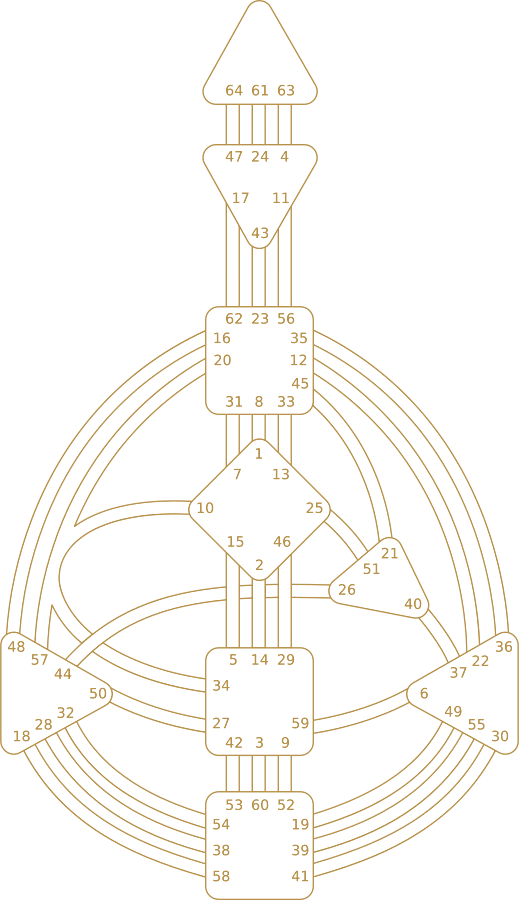

G Center Human Design
The G Center in Human Design, also called the Identity Center, is the center of identity, direction, and love. It is an identity center, not a motor, awareness or pressure center. Defined, your sense of self stays consistent; open, it reflects the people and places around you.
Think of the G Center as an internal compass. You do not steer it: you follow your Strategy and Authority, and it orients your life toward the direction that emerges from those choices.
Is your G Center defined or open? Check with the free chart calculator on this page. It takes your birth date, time and place.
G Center at a glance
The facts of the G Center in one place, from the Human Design canon. The shares are from Jovian Archive’s statistics.
Is your G Center defined? Find it in your chart
Your Centers are calculated from your birth date, birth time and birth place. Enter your details and your free chart shows this Center colored in if it is defined, and white if it is open.
Every Center has its own guide:
What is the G Center?
The G Center is the identity center of the Human Design chart: the diamond shape at the center of the BodyGraph, below the Throat and above the Sacral. It is not an awareness center (those are the Ajna, Spleen and Solar Plexus), not a motor and not a pressure center. It holds your sense of self, your experience of love, and your direction through life, and it is also where your sense of correct place lives.
The G Center governs three connected themes. Identity is how you experience yourself, what feels like you across different environments and phases of life. Direction is the path your life follows when you are making correct decisions: not a mental map but a trajectory that reveals itself through experience. Love is your capacity for self-love, your experience of belonging, and how you give and receive love. When identity is aligned, direction becomes clearer and love flows more naturally.
Unlike the Sacral, which generates energy, or the Solar Plexus, which creates emotional waves, the G Center does not give you a signal to decide by. It orients. Your Authority decides.
The G Center's 8 Gates and 10 Channels
The G Center holds 8 Gates: Gate 1, Gate 2, Gate 7, Gate 10, Gate 13, Gate 15, Gate 25 and Gate 46. Any of them activated in your chart is a Gate in your G Center, even when the Center is white. When one of them meets its partner Gate in another Center, the Channel between them is defined, and so is your G Center. These are the 10 Channels that can define it, grouped by the Center on the other end:
- With the Throat: Channel 1-8, Channel of Inspiration; Channel 10-20, Channel of Awakening; Channel 7-31, Channel of The Alpha; Channel 13-33, Channel of The Prodigal.
- With the Sacral: Channel 2-14, Channel of The Beat; Channel 10-34, Channel of Exploration; Channel 5-15, Channel of Rhythm; Channel 29-46, Channel of Discovery.
- With the Heart: Channel 25-51, Channel of Initiation.
- With the Spleen: Channel 10-57, Channel of Perfected Form.
Gate 10 is the busiest Gate here. It reaches three different Centers: the Throat through Channel 10-20, the Sacral through Channel 10-34, and the Spleen through Channel 10-57. The four Channels to the Throat matter for one more reason: they are what makes Self-Projected Authority possible (see below).
The magnetic monopole: how direction works
Inside the G Center sits what Human Design calls the magnetic monopole. Unlike a regular magnet with two poles, the monopole only attracts. It pulls you along your trajectory, drawing you toward the people, places and experiences that align with your design when you are making correct decisions.
You cannot direct the monopole mentally. When you follow your Strategy and Authority, it draws you toward the right environments, relationships and life direction. When you override your Authority with mental pressure, fear or conditioning, the monopole still operates, but your decisions keep placing you where it is not trying to take you. This is the mechanical reason correct decisions feel like flow and incorrect ones feel like constant resistance. You do not need to know where you are going. You need to make the next correct choice, and the trajectory takes care of itself.
Defined G Center
If your G Center is colored in on your chart, it is defined: at least one of its 10 Channels is defined. You carry a consistent sense of identity that stays relatively stable across environments, relationships and life phases. You tend to know who you are at a core level, even when you cannot always put it into words, and others can feel that steadiness. Jovian Archive's statistics put a defined G Center at 58.7% of charts.
The strength of a defined G Center is consistency. You carry the same essential self into every room, and your direction tends to follow an identifiable thread: your life often makes sense in hindsight even when individual steps seemed unclear. You also tend to love in stable, recognizable patterns.
The challenge is rigidity. Because your sense of self is fixed, you may resist changes to your identity even when growth asks for them, or defend a version of yourself you have outgrown. The question here is not usually "Can I love?" but "Can I be loved as I am?" The growth edge is keeping your core consistent while letting the way you express it develop.
Undefined (Open) G Center
If your G Center is white on your chart, it is undefined (or open). Your sense of identity is fluid and responsive to environment: you experience yourself differently depending on where you are, who you are with, and what energy is around you. Jovian Archive's statistics count 33.2% of charts with an undefined G Center that still has some Gates, and 7.9% with a completely open one.
The strength of an undefined G Center is adaptability and wisdom. Because you experience identity from many angles, you come to understand what identity is and what it means to be authentic. You can see through false identity in others, and you are naturally perceptive about how context shapes who someone appears to be.
The open G Center's Not-Self question is "Am I still looking for love and direction?" Because your identity shifts with environment, you may feel lost or unsure who you "really" are. That uncertainty can drive you to cling to relationships, roles, job titles, communities or beliefs that lend a temporary sense of self, even when they are not correct for you.
Environment and the G Center
The G Center's directional function is closely tied to physical location: the space you occupy and the people who share it shape how it orients you. Environment matters for every G Center, but for an undefined G Center it matters more than almost anything else. In the right place, with the right people, your sense of self steadies on its own. In the wrong one, identity goes foggy and direction feels lost. This is why some people find clarity when they travel, move to a new city, or simply change where they work.
So when you feel lost, the first move is environmental. Before you analyze your purpose, rethink your career or question your relationship, check your surroundings. Are you in a place that feels like you? If not, change the room, change the city, or at least change how much time you spend in the places that drain your sense of self.
The G Center and Authority
The G Center is the basis of one Authority: Self-Projected Authority. It appears only in Projectors whose G Center is connected to the Throat, through Channel 1-8, 10-20, 7-31 or 13-33, with no defined Solar Plexus, Sacral, Spleen or Heart to take priority. For these Projectors, decisions come from speaking their truth out loud and hearing whether a direction sounds genuinely like them.
For everyone else, the G Center is not an Authority. It shapes identity and direction, but the decision comes from your own Authority: the Solar Plexus, the Sacral, the Spleen, the Heart, talking it through with trusted people (Mental Authority), or, for Reflectors, the lunar cycle. When you follow it, the G Center's direction follows.
The not-self pattern of the G Center
The G Center's not-self pattern is searching for love, identity, or direction outside yourself. In a defined G Center it often looks like forcing others to validate your fixed identity, or refusing to change because change feels like losing yourself. In an undefined G Center it looks like merging with partners, communities or roles to borrow a sense of self, then feeling lost when those structures change.
The antidote for both is following your Strategy and Authority. When decisions are correct, identity steadies on its own; when they are not, no amount of searching produces the clarity the G Center needs.
The G Center at work
At work, the G Center shapes how career direction unfolds and whether your professional identity feels authentic or performed. Aligned work feels like an extension of who you are. Misaligned work feels like a role you put on for eight hours.
With a defined G Center, your work history often tells a coherent story in hindsight, and others can recognize and rely on your professional identity. The challenge is updating it when your field or interests change. With an undefined G Center, career direction is usually more exploratory: several careers, shifts between industries, a professional identity that is hard to sum up. That is your design trying different expressions of work until it finds the environments where you feel most like yourself. The right team and the right physical space can make an ordinary job feel aligned, and the wrong ones can make a dream job feel hollow.
The G Center in relationships
Because the G Center governs love as well as identity, it shapes bonding, belonging and who you become around another person. A defined G Center brings consistency: you are the same person alone or with your partner. The challenge is that this can feel inflexible to a partner who needs you to adapt, and it can hurt when a partner does not accept you as you are.
An undefined G Center is more sensitive to the dynamic. You may take on a partner's identity, interests, opinions or direction, especially early on. That can feel like deep connection when it is actually absorption. The question to ask is: "Do I feel more like myself around this person, or less?" For a deeper look at how identity and love work between two charts, use the Human Design Compatibility Calculator.
How to work with the G Center
The G Center does not respond to pressure. It responds to correct decisions and correct environments. Three practices help.
First, notice where you feel most like yourself. Track which rooms, cities and natural settings bring clarity, and when you feel foggy, change the environment before trying to think your way out. Second, release the need to force direction. Direction is a byproduct of correct decisions, so make the next correct choice through your Authority and let the trajectory unfold. Third, honor your identity without defending it. With a defined G Center, hold your sense of self lightly enough to let it evolve. With an undefined G Center, notice who you become around different people and choose the places where you feel most authentic.
Next steps
See how the G Center fits with the other eight Centers in the Human Design Centers guide, and read Defined vs Undefined Centers to compare definition and openness across the whole chart. If you are a Projector with your G Center joined to your Throat, Self-Projected Authority is the page to read next. A Human Design reading walks through your own G Center across 60+ sections: which of its 8 Gates you carry, which Channels define it, and how your Type and Authority set your direction.
FAQ: G Center Human Design
What is the G Center in Human Design?
The G Center, also called the Identity Center, is the center of identity, direction, and love. It holds the magnetic monopole and shapes your sense of self and your trajectory through life.
What does a defined G Center mean?
A defined G Center means you carry a consistent sense of identity that remains relatively stable across environments. Your direction tends to follow an identifiable thread over time.
What does an undefined G Center mean?
An undefined G Center means your identity is more fluid and sensitive to environment. You experience yourself differently depending on where you are and who you are with. The right environment is especially important for clarity.
How common is a defined G Center?
According to Jovian Archive's statistics, the G Center is defined in 58.7% of charts. It is undefined with some Gates in 33.2%, and completely open in 7.9%.
Why do I feel lost with an undefined G Center?
An undefined G Center does not produce a fixed sense of direction. This can feel like being lost when you are in the wrong environment. The fastest fix is usually changing your physical space rather than thinking harder about your purpose.
What is the magnetic monopole?
The magnetic monopole sits inside the G Center and only attracts. It pulls you toward the people, places, and experiences that align with your design when you are making correct decisions through your Authority.
Is the G Center an Authority?
The G Center itself is not an Authority, but it is the basis for Self-Projected Authority, which appears in some Projectors. For everyone else, the G Center shapes direction but does not make decisions.
Why does environment matter so much for the G Center?
The G Center's directional function is tied to physical location. The right environment naturally clarifies identity and direction, especially for undefined G Centers. The wrong environment creates fog.
How do I find my G Center on my chart?
Generate your free chart and look for the diamond shape at the center of the BodyGraph. If it is colored, your G Center is defined. If it is white, it is undefined.