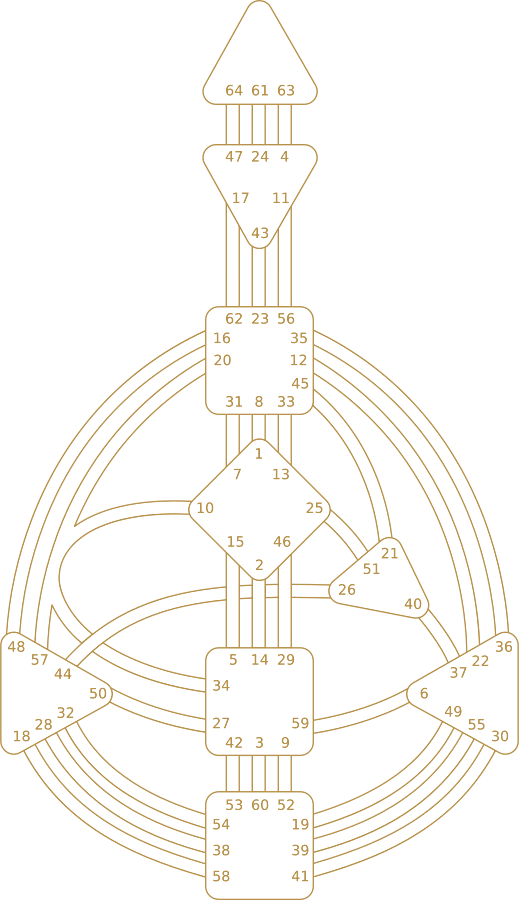

Splenic Authority Human Design
Splenic Authority in Human Design means your decisions are designed to come from an immediate, quiet, body-based instinct that arrives in the present moment and does not repeat. It works through a defined Spleen Center, appears in Projectors and Manifestors, and decides in the moment, once, quietly.
A Splenic no is like a door quietly closing: no drama, no story, just "not this." A Splenic yes is the opposite, a calm sense that this is safe and right, and it knows before you can explain why.
Not sure this is your Authority? Check with the free chart calculator on this page. It takes your birth date, time and place.
Splenic Authority at a glance
The facts of Splenic Authority in one place, from the Human Design canon and Jovian Archive.
Do you have Splenic Authority? Find it in your chart
Your Authority is calculated from your birth date, birth time and birth place, not from a quiz. Enter your details and your free chart shows your Type, Strategy and Authority.
Your chart shows a different Authority? Each one has its own guide, in the order your chart checks them:
What is Splenic Authority?
In Human Design, your Inner Authority is your most reliable decision-making system. Splenic Authority means your decisions come through the Spleen Center, an awareness center connected to instinct, survival, health, and present-moment knowing. Unlike Sacral Authority, which generates energy for what is correct, or Emotional Authority, which processes through a wave over time, Splenic Authority is instantaneous: it recognizes what is safe, healthy, and aligned right now.
This is Splenic awareness. It does not think, analyze, or plan. It perceives the present moment and delivers a signal, often so subtle that it arrives and departs before the conscious mind registers it. The signal is accurate, but it is easy to miss when the mind drowns it out with analysis.
Who has Splenic Authority?
Splenic Authority appears in Projectors and Manifestors. The chart rule: the Spleen is defined, and both the Solar Plexus and the Sacral are undefined. In the Authority hierarchy the Spleen comes third. A defined Solar Plexus always decides first (Emotional Authority), then a defined Sacral (Sacral Authority), and only then the Spleen. Splenic Authority shows up in about 11 in every 100 charts (Jovian Archive statistics: 10.65%). For how Splenic Authority plays out in an ordinary day, see Human Design daily alignment.
To confirm it, use the free chart calculator above and check the Inner Authority line. If it says Splenic, your decisions are designed to come from instant intuitive awareness rather than gut response, emotional processing, or willpower.
How Splenic Authority works: the signal speaks once
The single most important thing to understand about Splenic Authority is that the signal arrives once and does not repeat. You can ask your Sacral the same question ten times and get a consistent response because the Sacral is a motor, and energy is consistent. The Spleen is an awareness center, not a motor. It perceives the present moment and delivers a signal. Once the moment passes, the signal passes with it.
So the central skill is learning to catch the first signal. Not the second thought, and not the pros-and-cons list the mind builds after the signal has passed. The question to ask is "What does my body know right now, before my mind weighs in?" The first reaction, before conscious processing begins, is the Spleen speaking. Everything after that is the mind.
This is why people with Splenic Authority so often say "I knew" in retrospect. You look back on a decision and realize you had a warning at the beginning that you overrode with reasoning. The signal was not unclear. You did not trust it because it had no rational explanation attached.
What Splenic Authority feels like in the body
Splenic signals are subtle, specific, and embodied. They rarely arrive as dramatic feelings or loud inner voices. A Splenic yes feels like a calm, clean "this is correct." Your body relaxes slightly and there is an absence of tension. It is not excitement or enthusiasm, which are emotional signals. It is more like recognition: your body recognizing that this option is safe, healthy, and aligned with the present moment.
A Splenic no feels like a quick, specific warning: a subtle contraction, a pulling back, a flash of "something is off" that disappears almost immediately. The warning does not come with a story. It just says "not this" and moves on.
When neither signal is clear, the question is usually outside the Spleen's domain. The Spleen evaluates safety, health, timing, and present-moment correctness. Questions about long-term strategy or life direction may not produce a clear Splenic signal.
Splenic intuition versus anxiety
Learning to tell genuine Splenic intuition from anxiety is one of the most important distinctions for anyone with this Authority. Both can show up as a "something is wrong" feeling, and confusing them leads either to ignoring real warnings or to deciding out of fear.
Splenic intuition is quick, specific, and calm. It arrives once, delivers a clear signal about a specific situation, and then passes. It does not loop, it does not escalate, and it does not tell stories about worst-case scenarios. Anxiety is repetitive, escalating, and nonspecific. It loops through the same worries, builds on itself, and often attaches to future possibilities rather than the situation in front of you.
The practical test: if the signal arrived once, was specific, and does not need a story to sustain it, it is likely Splenic intuition. If it is looping and building elaborate scenarios, it is likely anxiety. Splenic intuition is the body reading the present moment. Anxiety is the mind projecting into the future. The Spleen has its own fears too, and they belong to the moment and pass. Worry that loops and builds stories about the future is the mind.
Splenic Authority by Type
Splenic Authority expresses slightly differently for a Projector and a Manifestor, because each Type's Strategy shapes how you meet the decisions the Spleen evaluates.
Splenic Projector
Projectors with Splenic Authority experience the intuitive signal within their Strategy, to wait for the invitation. When an invitation arrives, your Spleen delivers an immediate assessment of whether it is safe, healthy, and correct right now. The Splenic Projector's skill is catching this first signal before the mind starts constructing reasons to accept or decline based on prestige, fear, or obligation. If the Spleen says no to an invitation that looks impressive, the no is more reliable than the mind's reasoning about why you should accept. Learn more on the Projector page or the Projector Strategy page.
Splenic Manifestor
Manifestors with Splenic Authority experience the intuitive signal within their Strategy: to inform before they act. When the urge to initiate arises, the Spleen provides an instant check on timing and safety. The Splenic Manifestor's skill is trusting the Spleen's timing signal even when the mind says "move now." If the Spleen delivers a warning about timing, even a subtle one, pausing to honor it prevents the resistance that comes from initiating at the wrong moment. Learn more on the Manifestor page or the Manifestor Strategy page.
How to practice Splenic Authority in daily life
Learning to trust your Spleen starts with creating the conditions for the signal to be noticed: less noise, more presence, and trust built in low-stakes situations before you rely on it for big decisions.
The simplest daily practice is the first-signal drill. When a small decision appears, notice your body's very first reaction before the mind weighs in. What did your body do when the phone rang? What was your first response when someone asked you to do something? These micro-observations train your awareness to catch the Splenic signal in real time.
The second practice is honoring your no without explanation. "I am going to pass" is a complete response. The more you practice clean nos in small situations, the more trusted the signal becomes for larger ones. The third is reducing overstimulation. Splenic signals are quiet, and in an environment full of screens, multitasking, and constant input they get lost. Even five minutes of stillness gives the Spleen a window to be heard.
Splenic Authority at work
At work, Splenic Authority gives you a real-time read on opportunities, environments, people, and timing. Your Spleen can read a room, assess a deal, or sense whether a colleague is trustworthy in seconds, often before you can explain what you are sensing. When you walk into a meeting and something feels off, that is data. When a new role feels clean and correct from the first moment, that is also data.
The work trap is overriding warnings because they are not rational enough. Your manager presents a plan that sounds logical but triggers a quiet unease. Your mind says "this makes sense, everyone agrees." Your Spleen says "something is off." Often it is reading something the logic missed: a timing issue, a hidden risk, a misalignment that has not surfaced yet. Honoring the warning, even just by asking for more time or more information, often proves correct in retrospect.
Splenic Authority in relationships
In relationships, Splenic Authority gives an immediate read on safety and alignment. Your body often knows within the first minutes of meeting someone whether the dynamic is healthy and correct. The challenge is trusting this read when the mind builds reasons to override it.
The most common pattern when this Authority is not followed is staying too long. The Spleen delivered a warning early, a moment where something felt off, but the mind built a case for staying: the person has good qualities, the relationship has potential, leaving would be too disruptive. If your first impression of a person is a clean, open, safe feeling, that is a strong positive signal. If it includes a warning, even a subtle one, take it seriously rather than dismissing it as paranoia. The Spleen is not paranoid. It is precise.
For a deeper look at how your energy interacts with another person's, use the Human Design Compatibility Calculator or read about Human Design Relationships.
Common Splenic Authority mistakes
Splenic Authority gets distorted by anything that keeps you from noticing or trusting the first signal: rushing, noise, reasoning past it, or fear of what saying no will cost socially. These are the patterns to watch for.
Thinking past the signal
The Splenic signal arrives and departs quickly. By the time you have built a pros-and-cons list, the signal is gone and you are making a mental decision, not an intuitive one.
Confusing anxiety with intuition
Anxiety loops and escalates. Splenic intuition is quick, specific, and calm. If it arrived once and passed, it was probably the Spleen.
Needing a reason before trusting
Splenic Authority does not come with an explanation. "It is probably fine" and "I am just being paranoid" are the mind overriding a signal it is not equipped to evaluate.
Ignoring warnings to keep the peace
"I just have a bad feeling about it" rarely counts as a reason socially. For Splenic Authority, that is exactly what a correct no sounds like.
Staying too long after the warning
The Spleen often delivers its clearest signal early. Staying in a situation your body warned you about compounds the cost of ignoring the original signal.
Not creating enough quiet to hear the signal
Overstimulation drowns the Spleen. If you cannot hear your intuition, the first fix is reducing noise, not trying harder to think your way to clarity.
Next steps
Splenic Authority is one layer of your design, and it works inside your Type's Strategy. As a Projector, pair it with waiting for the invitation on the Projector Strategy page; as a Manifestor, with informing before you act on the Manifestor Strategy page. To compare all seven Authorities, start at the Human Design Authority guide. A Human Design reading covers your Splenic Authority in full across 60+ sections, explaining how your Spleen Center, Gates, and Channels shape your instincts, timing, and decisions.
FAQ: Splenic Authority Human Design
What is Splenic Authority in Human Design?
Splenic Authority is a decision-making system based on immediate, subtle, body-based intuition. Your Spleen Center delivers a quiet knowing about what is safe, healthy, and correct in the present moment.
How do I know if I have Splenic Authority?
Generate your free chart and check the Inner Authority line. If it says Splenic, your Spleen is defined and both your Solar Plexus and Sacral are undefined, so your decisions come from instant intuition rather than gut response, emotional processing, or willpower.
Why does the Splenic signal only speak once?
The Spleen is an awareness center, not a motor. It perceives the present moment and delivers a signal, and once the moment passes, the signal passes with it. This is why catching the first reaction is the central skill.
What does Splenic Authority feel like?
A Splenic yes feels like calm, clean recognition that something is correct. A Splenic no feels like a quick, specific warning or contraction. Both are subtle and arrive before the mind starts analyzing.
Is Splenic Authority the same as anxiety?
No. Anxiety loops, escalates, and builds stories. Splenic intuition is quick, specific, calm, and does not repeat. If the signal arrived once and passed, it is likely the Spleen.
How is Splenic Authority different from Sacral Authority?
Sacral Authority is a gut energy response that can be queried repeatedly. Splenic Authority is a one-time intuitive flash that does not repeat. Sacral asks "Do I have energy for this?" Spleen asks "Is this safe and correct right now?"
Which Types have Splenic Authority?
Splenic Authority appears in Projectors and Manifestors with a defined Spleen and an undefined Solar Plexus and Sacral. Generators, Manifesting Generators and Reflectors never have it.
What is a Splenic Projector?
A Splenic Projector is a Projector whose Inner Authority is the Spleen. Their Strategy is to wait for the invitation, and when one arrives, the first quiet signal in the body says whether it is correct right now.
How do I strengthen my Splenic signal?
Reduce overstimulation, practice catching your first reaction in low-stakes situations, honor your no without needing to explain it, and build quiet moments into your day so the signal can be heard.
What is the rarest Authority in Human Design?
In Jovian Archive statistics the rarest inner Authorities are Ego (about 1 in 100: Ego Manifested 0.8%, Ego Projected 0.45%) and Lunar, the Reflector's Authority (about 1.4 in 100). Emotional is the most common at about 47 in 100, then Sacral at about 35. Splenic Authority appears in about 11 in every 100 charts (10.65%).