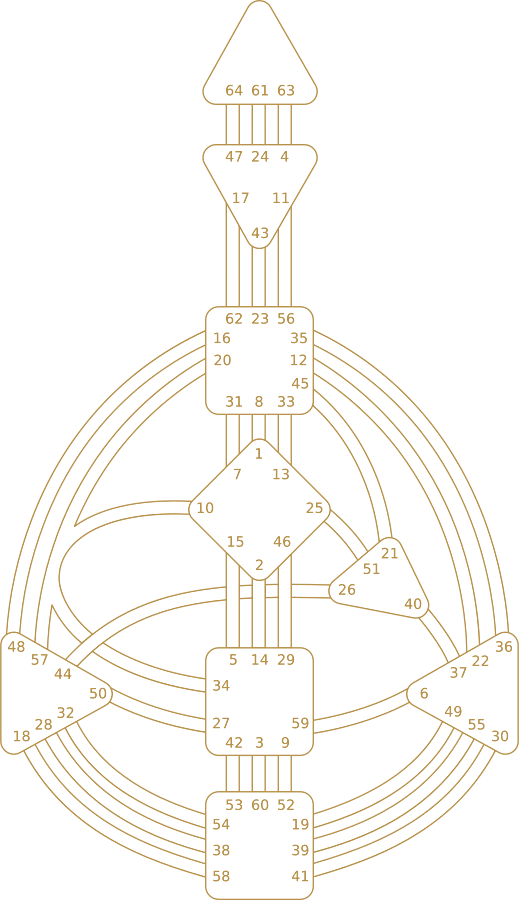

Ego Authority Human Design
Ego Authority in Human Design means your decisions are designed to come from honest desire and genuine willpower. It works through a defined Heart (Ego) Center, appears only in Manifestors and Projectors, and decides with one question: do I truly want this, and am I willing to commit to it?
Think of it like giving your word. You give it only to what you truly want, and then it holds.
Not sure this is your Authority? Check with the free chart calculator on this page. It takes your birth date, time and place.
Ego Authority at a glance
The facts of Ego Authority in one place, from the Human Design canon and Jovian Archive.
Do you have Ego Authority? Find it in your chart
Your Authority is calculated from your birth date, birth time and birth place, not from a quiz. Enter your details and your free chart shows your Type, Strategy and Authority.
Your chart shows a different Authority? Each one has its own guide, in the order your chart checks them:
What is Ego Authority?
In Human Design, your Inner Authority is your most reliable decision-making system. Ego Authority, sometimes called Will Authority, means your correct decisions come from the Heart (Ego) Center, a motor Center associated with desire, willpower, and the capacity to commit. Unlike Sacral Authority, which responds with a gut yes or no, or Emotional Authority, which requires riding an emotional wave, Ego Authority operates through direct honest desire. You either want something and are willing to stand behind it, or you do not.
This sounds simple, and mechanically it is. But most people with Ego Authority have been conditioned to distrust their wants. The world teaches that wanting something for yourself is selfish and that good people say yes even when they do not want to. For an Ego Authority person, following that conditioning leads to overcommitment, resentment, and the gradual depletion of the willpower that fuels the whole design.
Ego Manifested and Ego Projected Authority
Ego Authority appears only in Manifestors and Projectors. You have it when your Heart (Ego) Center is defined and your Solar Plexus, Sacral and Spleen are all undefined, so no emotional wave overrides the signal and no sacral response competes with it. In a Manifestor the Heart connects straight to the Throat: this is Ego Manifested Authority, and the desire is often tied to initiating, a clear want to start or create something. In a Projector the Heart connects to the G Center: this is Ego Projected Authority, and the will is spoken through the G to the Throat, as a genuine willingness to commit your insight and guidance to a specific invitation.
How Ego Authority decision-making works
Ego Authority asks one question and gives one answer: "Do I truly want this, and am I willing to commit my will to it?" The answer is either a clear yes backed by genuine willingness, or anything else, which means no. If you have to convince yourself, it is not correct.
It often becomes clearest through speaking. Many people with this Authority discover their truth when they hear themselves say it out loud. This is not about convincing anyone or seeking approval. It is about hearing your own truth in your own voice. The desire that sounds true and resonant when you say it is usually the correct one. The desire that sounds hollow, or like you are trying to talk yourself into it, is usually conditioning.
The Heart Center is also connected to material commitment: deals, agreements, promises, and exchanges of value. That makes Ego Authority particularly reliable for contracts, business commitments and any situation where you are putting your word on the line. The commitments your will genuinely endorses are the ones you follow through on. The ones it never wanted become the promises you break.
The Ego motor is not unlimited. It works in cycles of exertion and rest, and it can commit powerfully but not to everything. Every commitment draws from the same reserve of willpower. Commitments made from genuine desire sustain themselves; the ones made from pressure or obligation drain it. Ego Authority people who push through commitment fatigue without rest begin deciding from desperation rather than desire, which reverses the whole mechanism. For how Ego Authority plays out in an ordinary day, see Human Design daily alignment.
What Ego Authority feels like
The signal tends to be direct. It does not build gradually like Emotional Authority or flash and disappear like Splenic Authority. It shows up as a plain statement of want or not-want, often felt in the chest as a sense of expansion, willingness and readiness to commit.
A correct yes feels like: "I want this, and I am willing to stand behind it." There is no bargaining and no mental gymnastics to justify the choice. A correct no feels like absence. The desire simply is not there, or it shows up as heaviness, obligation, or the realization that you are only considering it because someone else expects it.
The trickiest signal is "I should want this." The mind builds a case for why the commitment makes sense logically, socially or financially, but the will is not engaged. For Ego Authority, that is a no, however good the reasoning sounds.
How to practice Ego Authority in daily life
It starts with one habit: asking "Do I want this?" before every significant commitment and being honest about the answer. Most Ego Authority people have overridden this question for so long that reconnecting with it takes deliberate practice.
First, say the commitment out loud in one clear sentence. "I want to take this project." "I want to invest in this." Then notice how it sounds. Does it ring true? Does your chest feel open and willing? Or does it sound like a script someone else wrote?
Second, make the commitment specific. Vague commitments drain willpower because the scope keeps expanding. "I will help with this project" is vague. "I will commit four hours a week to this project for the next month" is specific, and the will can assess it far more clearly.
Third, practice saying no without apologizing or explaining. Ego Authority needs clean boundaries. The strength of your yes is directly proportional to the cleanliness of your no.
Ego Authority at work
Used correctly, Ego Authority makes you someone whose word carries weight. When you say "I will do this" and the desire is genuine, follow-through is highly likely.
The work trap is committing from ambition rather than desire. They can look alike, but they come from different places. Desire comes from the Heart: "I want this." Ambition comes from the mind: "I should want this because it would impress people." Commitments built on ambition drain the will and create the familiar cycle of overwork, resentment and, eventually, breaking the commitment.
Practically, that means choosing fewer projects with deeper commitment, being honest in negotiations about what you are willing to deliver rather than overpromising to win the deal, and building rest into your work cycle so the motor can recover between periods of intense commitment.
Ego Authority in relationships
In relationships, Ego Authority creates the most integrity when agreements are honest and specific. The healthiest dynamic is one where you are free to want what you want without disguising it as something more selfless. A partner who understands that your desire is your guidance system, not your selfishness, gives the relationship a foundation that works.
The common pattern when you are not following your design is overgiving from obligation: committing to what your partner wants because saying no feels selfish, and suppressing your own desires to keep the peace. Each suppressed want accumulates as resentment, which eventually surfaces as conflict, withdrawal or broken promises. "I want to do this with you" makes a cleaner, more lasting agreement than "I guess I should." Relationships built on this truth tend to have fewer promises and higher follow-through.
For a deeper look at how your energy interacts with another person's, use the Human Design Compatibility Calculator or read about Human Design Relationships.
Common Ego Authority mistakes
Ego Authority gets distorted by conditioning that teaches you to ignore, suppress or distrust your wants, usually starting in childhood and reinforced by cultural messages about duty and selflessness. These are the patterns it creates.
Committing from obligation
Saying yes because you should rather than because you want to. The Ego can power through obligation for a while, but it creates resentment and eventual collapse.
People-pleasing
Agreeing because saying no would create conflict or feel socially uncomfortable. Each people-pleasing yes spends willpower on something your will did not endorse, leaving less for the commitments that are actually correct.
Proving worth through effort
Committing to things because they prove you are valuable. Using willpower to earn approval rather than to follow genuine desire depletes the motor without the satisfaction correct commitments produce.
Overpromising in the moment
The Ego motor can feel powerful when it is charged, leading to commitments that exceed what the will can sustain. Making commitments specific and bounded prevents this.
Confusing ambition with desire
Ambition comes from the mind: "I should want this." Desire comes from the Heart: "I do want this." Commitments built on ambition drain. Commitments built on desire sustain.
Skipping rest between commitments
The Heart Center is a finite motor that needs recovery. Chaining intense commitments without rest depletes the will and distorts future decisions.
Apologizing for honest desire
Qualifying, justifying or softening what you want weakens the signal. Clean desire spoken directly is the foundation of Ego Authority integrity.
Next steps
Ego Authority is one layer of your design. Your Type and Strategy shape how you engage with life, and your Authority shapes how you decide within that. If you are a Manifestor, pair it with the Manifestor Strategy, to inform before you act. If you are a Projector, pair it with the Projector Strategy, to wait for the invitation. To compare all seven, return to the Human Design Authority guide.
A Human Design reading goes further, with 60+ sections on how your willpower, Centers, Gates and Channels shape your commitments and decisions.
FAQ: Ego Authority Human Design
What is Ego Authority in Human Design?
Ego Authority, also called Will Authority, is a decision-making system based on honest desire and genuine commitment. Your correct choices come from a direct "I want this" rather than mental logic, emotional waves, or obligation.
How do I know if I have Ego Authority?
Generate your free chart and check the Inner Authority line. If it says Ego, Will, or Ego Manifested/Projected, your decisions are designed to come from genuine desire. In the chart, the Heart (Ego) Center is defined and the Solar Plexus, Sacral and Spleen are all undefined.
What is the difference between Ego Manifested and Ego Projected Authority?
Both decide from the willpower of a defined Heart (Ego) Center and sit at the same place in the hierarchy. In Ego Manifested Authority the Heart connects straight to the Throat, which happens in Manifestors. In Ego Projected Authority the Heart connects to the G Center, which happens in Projectors, and the will is spoken through the G to the Throat.
What is the rarest Authority in Human Design?
In Jovian Archive's statistics the rarest inner Authorities are Ego (about 1 in 100 charts: Ego Manifested 0.8% and Ego Projected 0.45%) and Lunar (Reflectors, about 1.4 in 100). Emotional is the most common, at about 47 in 100, then Sacral at about 35. So Ego Authority is one of the two rarest.
Is Ego Authority the same as being selfish?
No. Ego Authority is about honesty, not selfishness. When you commit to what you truly want, your agreements become cleaner, more reliable, and better for everyone involved.
Why do I overpromise with Ego Authority?
Overpromising usually comes from proving, people-pleasing, or the Ego motor feeling powerful in the moment. Making commitments specific, bounded, and paced prevents this pattern.
How do I make decisions correctly with Ego Authority?
Ask: "Do I truly want this?" and "Am I willing to commit?" Say your answer out loud. If it is not a clean yes, wait, renegotiate, or say no.
How is Ego Authority different from Sacral or Emotional Authority?
Ego Authority is desire and commitment from the Heart Center. Sacral Authority is a gut yes or no response. Emotional Authority requires riding an emotional wave to reach clarity over time.
Which Types can have Ego Authority?
Ego Authority appears only in Manifestors (Ego Manifested) and Projectors (Ego Projected). Generators and Manifesting Generators do not have Ego Authority because their defined Sacral takes priority.
Does the Ego motor need rest?
Yes. The Heart/Ego Center is a finite motor that works in cycles of exertion and recovery. Chaining intense commitments without rest depletes willpower and distorts future decisions.