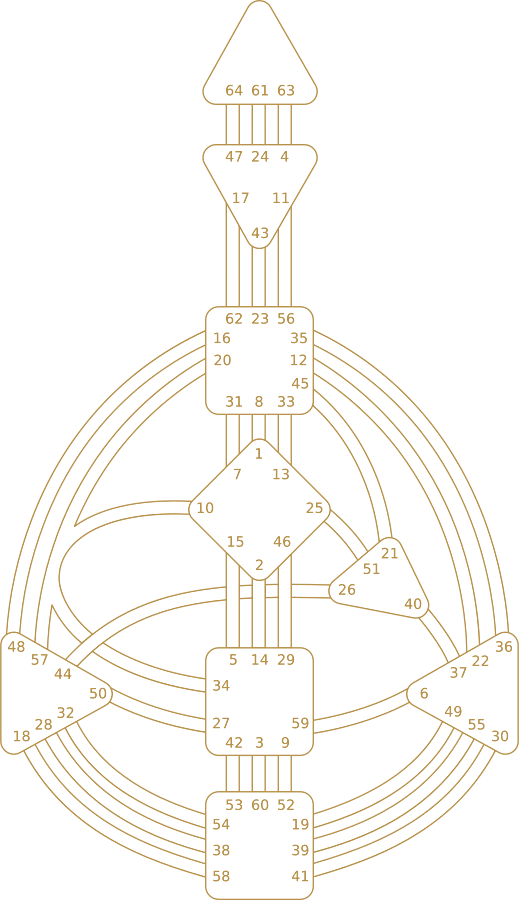

Ajna Center Human Design
The Ajna Center in Human Design, sometimes called the Mind Center, is the center of conceptualization, opinions, and mental processing. It is one of three awareness centers, with the Spleen and the Solar Plexus. Defined, you process information in a consistent way. Open, your thinking stays flexible and takes in other people's certainty.
Think of the Head Center as the search engine generating queries and the Ajna as the processor that organizes the results into something meaningful.
Is your Ajna Center defined or open? Check with the free chart calculator on this page. It takes your birth date, time and place.
Ajna Center at a glance
The facts of the Ajna Center in one place, from the Human Design canon. The shares are from Jovian Archive’s statistics.
Is your Ajna Center defined? Find it in your chart
Your Centers are calculated from your birth date, birth time and birth place. Enter your details and your free chart shows this Center colored in if it is defined, and white if it is open.
Every Center has its own guide:
What is the Ajna Center?
The Ajna Center is an awareness center that sits between the Head Center above and the Throat Center below. It receives inspiration and questions from the Head, processes them into concepts, opinions, theories, and explanations, and prepares them for expression through the Throat. In this way, the Ajna acts as the mind's processing hub: it takes raw input and organizes it into structured thought. Jovian Archive sums it up as conceptualization: concepts, opinions, certainty.
Unlike the Sacral, which generates energy, or the Solar Plexus, which creates emotional waves, the Ajna does not produce energy or drive action. It is purely an awareness center. It observes, compares, analyzes, and conceptualizes. This means the Ajna is excellent at understanding but not designed for decision-making. Your mind can build a compelling case for any option, but it cannot reliably tell you which option is correct for your design. That is your Authority's job.
In Human Design, the Ajna represents the second awareness to evolve, after the Spleen's survival awareness. Where the Spleen asks "Is this safe right now?" the Ajna asks "What does this mean? How do I make sense of it?"
The Head and Ajna connection
The Head Center and the Ajna Center work together as the mind's two-part system. The Head Center generates pressure in the form of questions, inspiration, and the drive to understand. The Ajna takes that pressure and processes it into concepts, answers, opinions, and mental frameworks.
One important structural note: if your Ajna is undefined, your Head Center is also always undefined, because every Channel from the Head runs to the Ajna. The reverse is not always true. You can have a defined Ajna with an undefined Head. When both are undefined, you have a completely open mind that does not generate its own consistent mental pressure or processing patterns. You can see many perspectives, and you also absorb and amplify the mental pressure of everyone around you.
Ajna Center Gates and Channels
The Ajna Center holds six Gates: Gate 4, Gate 11, Gate 17, Gate 24, Gate 43 and Gate 47. They form six Channels, three upward to the Head and three downward to the Throat. To the Head: the Channel of Awareness (24‑61), the Channel of Logic (4‑63) and the Channel of Abstraction (47‑64). To the Throat: the Channel of Structuring (23‑43), the Channel of Acceptance (17‑62) and the Channel of Curiosity (11‑56).
The Ajna is defined when at least one of these six Channels is complete in your chart, with both of its Gates activated. One Gate on its own, with no full Channel, leaves the Ajna undefined.
Defined Ajna Center
If your Ajna Center is colored in on your chart, it is defined. This means you have a consistent, reliable way of processing information and forming opinions. Your mind follows established patterns, you tend to approach problems in repeatable ways, and you can often articulate your perspective with clarity and confidence. You can develop deep expertise because your thinking builds on previous knowledge in a structured way, and other people often experience your mental clarity as grounding.
The challenge of a defined Ajna is mental rigidity. Because your processing patterns are fixed, you may find it difficult to genuinely consider perspectives that contradict your established viewpoint. You may also fall into the trap of needing to be right, where your identity becomes attached to your opinions and being wrong feels threatening rather than informative.
The growth edge for a defined Ajna is staying open. You can hold your opinion strongly while remaining willing to update it when better information arrives.
Undefined (Open) Ajna Center
If your Ajna Center is white on your chart, it is undefined (or open). This means your mental processing is naturally flexible and adaptable. You do not have one fixed way of thinking. Instead, you can see things from multiple angles, adopt different frameworks depending on the situation, and understand perspectives that seem contradictory to people with more fixed thinking patterns. You can synthesize ideas from diverse sources and make connections that more structured thinkers miss.
The challenge of an undefined Ajna is the pressure to be certain. Around people with defined Ajnas, whose certainty is strong and clear, you take in and amplify that certainty and can feel unsure of your own opinions. The open Ajna's Not-Self question is "Am I trying to convince everyone that I am certain?" The conditioning pattern is to force yourself to pick a viewpoint and defend it, even though your design is built to hold multiple perspectives at once.
The growth edge for an undefined Ajna is releasing the need for certainty. You do not need to know the answer to move forward. You do not need a fixed opinion to be intelligent. Your wisdom comes from the breadth of your perspective, not from the strength of your conviction.
The not-self pattern of the Ajna Center
The Ajna Center's not-self pattern is pretending to be certain. When a defined Ajna goes off track, it shows up as clinging to opinions that are no longer true because changing your mind feels like a threat to your identity. For undefined Ajnas, the not-self pattern shows up as adopting other people's certainty and presenting it as your own because having no strong opinion feels unsafe.
Both patterns share the same root: the belief that you must be mentally certain to be safe, competent, or worthy. This belief drives over-explaining, defensive arguments, endless research, and the persistent feeling that you need to know more before you can act. The antidote is the same for both: let your mind process, but let your Authority decide. Certainty is not a prerequisite for correct action.
How the Ajna creates overthinking
If you have ever been stuck in a mental loop, replaying scenarios, rehearsing conversations, building cases for and against the same decision, you have experienced Ajna pressure doing what it does: processing without a stopping point. The Ajna is designed to conceptualize endlessly. And because it has no motor energy, it cannot act on any of its conclusions. It just keeps processing.
The practical fix is to notice when you have shifted from useful analysis to circular processing. If you are revisiting the same question for the third time without new information, the Ajna has done its job. The remaining uncertainty is going to be resolved by checking your Authority: your gut response, your emotional wave, your splenic signal, what your will commits to, or hearing your own voice. That is where the final answer lives, not in one more round of analysis.
The Ajna Center and Authority
The Ajna Center is not an Authority for any Type. This is one of the most important distinctions in Human Design: the mind is for processing and communicating, not for making personal decisions. Even if your Ajna is defined and your thinking is consistent and clear, it is still not designed to have the final say on what is correct for you.
There is, however, a related Authority called Mental (Environmental) Authority, which appears in some Projectors. It does not mean the mind decides. It means clarity comes through the right environment and through speaking your thoughts out loud with trusted sounding boards. The thinking itself is not the Authority.
The Ajna Center at work
When the Ajna is out of alignment at work, it typically shows up as over-planning, over-explaining, or delaying action because the mental answer does not feel certain enough yet. You might build the perfect strategy and then hesitate to execute because the analysis never reaches the level of certainty the mind demands, or over-prepare for meetings and produce more documentation than anyone asked for.
The practical fix at work: use your mind for the research, then use your Authority for the decision. "I have analyzed this enough. Now, what does my Authority say?" That handoff from Ajna to Authority is the single most productive habit you can develop for Ajna-related work pressure.
The Ajna Center in relationships
In relationships, Ajna pressure often shows up as needing an explanation. "What does this mean?" "Why did they do that?" Defined Ajna people may analyze their partner's behavior through a fixed framework and struggle when the partner does not fit the model. Undefined Ajna people may absorb their partner's mental certainty and lose track of their own perspective, or feel pressured to have strong opinions about the relationship when their natural mode is more open and exploratory.
The practice in relationships is replacing "I need certainty" with "I need presence." Let time and experience reveal what is consistent and true, and return to your Authority for the big decisions. For a deeper look at how your thinking patterns interact with another person's design, use the Human Design Compatibility Calculator.
How to work with the Ajna Center
The first practice is noticing when you have crossed from useful thinking into circular processing. Useful thinking produces new insight. Circular processing replays the same considerations without new input. When you catch yourself in circular mode, that is the signal to stop thinking and check your Authority instead.
The second practice is treating thoughts as drafts, not final answers. Your mind is allowed to revise. The defined Ajna can practice holding opinions lightly. The undefined Ajna can practice not absorbing other people's certainty as its own.
Next steps
See where the Ajna sits in the whole system in the Human Design Centers guide and in Defined vs Undefined Centers, and read the Head Center guide for the other half of the mind. Because no Authority comes from the Ajna, the Human Design Authority page shows where your decisions are made, and Mental (Environmental) Authority covers the Projectors whose clarity comes through speaking. A Human Design reading shows your own Ajna, its Gates and Channels, and how your mind connects to the rest of your chart, across 60+ sections.
FAQ: Ajna Center Human Design
What is the Ajna Center in Human Design?
The Ajna Center, also called the Mind Center, is the center of conceptualization, opinions, and mental processing. It organizes information into frameworks and perspectives but is not designed for decision-making.
How common is a defined Ajna Center?
Jovian Archive's statistics show the Ajna defined in 44.2% of charts, undefined with some of its Gates in 46.8%, and completely open in 9.0%.
What are the Gates and Channels of the Ajna Center?
The Ajna holds Gates 4, 11, 17, 24, 43 and 47. Its Channels to the Head are Awareness (24‑61), Logic (4‑63) and Abstraction (47‑64); its Channels to the Throat are Structuring (23‑43), Acceptance (17‑62) and Curiosity (11‑56).
Is the Ajna Center an Authority?
No. The Ajna processes information but does not make decisions. Your Authority, whether Sacral, Emotional, Splenic, Ego, Self-Projected, Mental, or Lunar, handles the final choice.
What does a defined Ajna Center mean?
A defined Ajna means you have consistent, reliable mental processing patterns. You tend to approach ideas in repeatable ways. The growth edge is staying open rather than rigid in your certainty.
What does an undefined Ajna Center mean?
An undefined (open) Ajna means your thinking is naturally flexible and multi-perspective. Its Not-Self question is "Am I trying to convince everyone that I am certain?" The growth edge is releasing the pressure to be certain before you move.
What is the not-self pattern of the Ajna?
The not-self pattern is pretending to be certain. When a defined Ajna goes off track, it clings to fixed opinions. For undefined Ajnas, this is adopting other people's certainty and presenting it as your own.
How do I stop overthinking with Ajna pressure?
Notice when useful thinking has become circular processing. Once you catch the loop, stop thinking and check your Authority instead. The remaining uncertainty will not be resolved by more analysis.
What is the connection between the Head and Ajna Centers?
The Head Center generates questions and inspiration. The Ajna processes them into concepts, opinions, and explanations. They work together as one system of the mind.
How do I find my Ajna Center on my chart?
Use the free chart calculator on this page and look for the triangle just below the Head Center. If it is colored, your Ajna is defined. If it is white, it is undefined.