
Human Design Deconditioning: How the 7-Year Process Works
Most of what you call your personality was borrowed. Deconditioning is the practice of finding out what was actually yours all along.
On this page
Ra Uru Hu taught deconditioning as a seven-year cycle, tied to the way the body renews itself. The claim of Human Design is that your personality runs on the same clock. Deconditioning is what happens when you stop interrupting the process.
If you have ever wondered why you keep falling back into the same patterns, the same exhaustion, the same arguments with yourself, the answer is rarely a lack of effort. It is more often the quiet weight of conditioning. Patterns absorbed from other people, environments, and culture that you mistook for your own.
Most of what we think of as our personality is borrowed. Deconditioning is the work of finding out what actually belongs to you.
This is not a quick reframe or a single decision. It is a multi-year process, and it works through a specific mechanism your chart shows you in detail. This guide explains what deconditioning actually is, why it takes seven years, how it looks for each Type, and exactly how to begin.
New here? Start by generating your chart: Generate your free Human Design chart.
In this post
- What deconditioning actually is
- The seven-year cycle
- Deconditioning vs shadow work
- How conditioning enters through open centers
- Your Type's Signature and Not-Self theme
- The two tools that actually decondition you
- What deconditioning looks like for each Type
- Year one vs year seven
- How to start
What Is Deconditioning in Human Design?
Deconditioning is the practice of releasing patterns, beliefs, and behaviors that were absorbed from other people and environments, rather than carried in your own design. In Human Design, those absorbed patterns enter primarily through your open centers, the white spaces on your chart that pull in energy from everyone around you.
When an open center is taking in outside energy, that energy is amplified. You feel it more strongly than the person it actually belongs to. Over years, you start to mistake the amplified version for who you are. Deconditioning is what happens when you stop doing that.
It is not about removing other people from your life. It is about learning to tell the difference between energy that is yours, and energy that is moving through you on its way somewhere else.
Ra was direct about this. You do not remove conditioning. You stop being run by it.
The Seven-Year Cycle: Why Deconditioning Takes Time
Human Design describes deconditioning as roughly a seven-year process. Ra framed it around the body's renewal cycle. The idea is that conditioning is held not just in thoughts and habits but in how you live in your body, so releasing it takes time.
That timeline is not a deadline. Plenty of people notice meaningful shifts inside the first six months of following their Strategy and Authority. What the seven-year frame really points to is the depth of the change. The first year is often loud. The third feels lighter. The fifth and seventh, people describe as quietly different. Less reactive. More themselves.
The first year of deconditioning is loud. The seventh is quietly different. You do not become someone else. You stop performing who you were never meant to be.
Deconditioning vs Shadow Work
One of the most common questions about Human Design deconditioning is whether it is the same as shadow work. They are related, but mechanically different.
Shadow work, in the Jungian tradition, is the practice of recognizing and integrating disowned parts of yourself. The qualities you push away, refuse to claim, or judge harshly in others. It is psychological. The work happens primarily in the mind and through reflection.
Deconditioning in Human Design works on a different layer. It is not about integrating parts of yourself that you have disowned. It is about recognizing patterns that were never yours to begin with. The absorbed energy of an open center. The borrowed identity of an open G. The inherited drive of an open Sacral. The work happens through your body, by way of decisions made through your Strategy and Authority.
Both can be valuable. They are not the same practice, and they do not produce the same kind of insight. Shadow work asks, "What am I refusing to see about myself?" Deconditioning asks, "What did I think was me, that was actually just amplified energy from someone else?"
How Conditioning Enters Through Your Open Centers
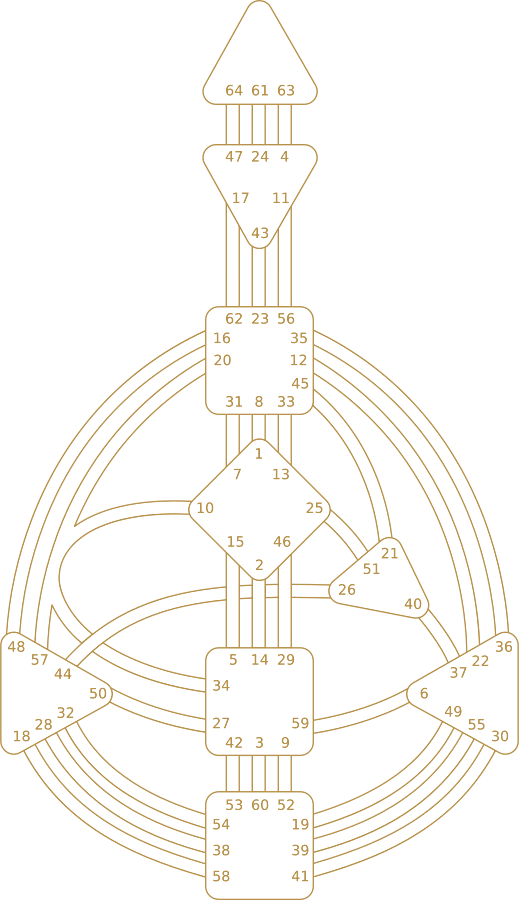
Your chart has nine centers. Some are defined, shown in color, and represent energy that is consistent and reliable in your design. Others are open, shown in white, and represent energy you absorb from the people and environments around you. Both matter. Neither is better.
Conditioning lives in the open ones. An open Sacral takes on the pressure of other people's drive and starts to believe it has to keep up. An open Solar Plexus picks up other people's emotional weather and reports it as its own. An open G center borrows other people's sense of identity and direction, then wonders why nothing feels like home. An open Heart center inherits the constant need to prove worth.
None of this is a flaw. Open centers are how Human Design says you are designed to learn, to read other people, to be wise about energy you are not stuck inside. The problem is not the openness. It is the unconscious absorption.
If you want to see exactly which centers are open in your design, the chart calculator will show you in seconds: Generate your free Human Design chart.
Your Type's Signature and Not-Self Theme
Each Type in Human Design has two emotional signals. The Signature is what you feel when you are aligned with your design. The Not-Self theme is what you feel when you are not. These signals are the immediate feedback. Deconditioning is the deeper, cumulative release that builds over years of following them.
Generators and Manifesting Generators feel satisfaction when aligned and frustration when not. Projectors feel success and bitterness. Manifestors feel peace and anger. Reflectors feel surprise and disappointment. None of these emotions are wrong. They are diagnostic. They tell you, in real time, whether the decision you just made was yours or someone else's.
This is why deconditioning is not really an intellectual project. You do not think your way through it. You notice your Type's Not-Self theme, you trace it back to the moment it appeared, and you let your Strategy and Authority handle the next decision instead.
The Two Tools That Actually Decondition You
Deconditioning sounds abstract until you realize there are only two practical tools, and your chart names both. Your Strategy is how your Type is designed to engage with the world. Your Authority is how your Type is designed to make decisions.
Strategy handles the question of when to engage. Generators wait to respond. Manifesting Generators respond, then inform before acting. Projectors wait for the invitation. Manifestors inform before acting. Reflectors wait a full lunar cycle on major decisions. Each Strategy is built to keep you from forcing what is not designed for you.
Authority handles the question of what is right for you. Emotional Authority needs time for clarity. Sacral Authority responds in the body. Splenic Authority speaks once, quietly, in the present moment. Each Authority is a built-in signal that tells you whether something belongs in your life.
Used together, these two are the entire mechanism of deconditioning. The chart shows them. You practice them. Over time, decisions made by Strategy and Authority replace decisions made by conditioning, and the open centers stop running the show.
Strategy and Authority are not a self-improvement program. They are the only two tools that change which decisions are actually yours.
What Deconditioning Looks Like for Each Type
The mechanism of deconditioning is the same for everyone. The texture is different for each Type. Here is what to watch for in your own design.
Generator Deconditioning
A Generator's deconditioning shows up in moments of frustration. The friend who asks for help moving, and you say yes before checking your sacral response. The job you took because the offer felt flattering. The volunteer commitment you agreed to because it felt rude to decline. Each yes that was not a sacral yes adds to the frustration meter.
Deconditioning, for a Generator, is the practice of waiting long enough to hear the response before the mind takes over. The uh-huh or the uh-uh. The body's actual answer, not the rehearsed one.
Manifesting Generator Deconditioning
Manifesting Generators feel the same frustration as Generators, with a second edge. They feel it again when they skip the informing step before pivoting. The half-finished project. The relationship they left without explaining. The career swerve that surprised everyone, including them.
Their deconditioning is two-part. Wait for the sacral response. Then inform before changing direction. The shortcut Manifesting Generators are famous for only works when both steps are intact.
Projector Deconditioning
A Projector's deconditioning shows up in bitterness. The unsolicited advice that landed wrong. The energy poured into proving worth to a room that never asked you to. The role you took on because someone needed you, not because someone recognized you.
Deconditioning for a Projector is the patience of waiting for the invitation. Not just any invitation. The recognition that comes from someone who actually sees you. Saving your insight for the people who actually want it is not a personality flaw. It is how the design works.
Manifestor Deconditioning
A Manifestor's deconditioning shows up in anger. The friction that comes from not informing before acting. The walls people put up when you initiate without warning. The exhaustion of fighting resistance that you could have avoided with a single sentence ahead of time.
Deconditioning for a Manifestor is the discipline of informing. Not asking permission. Giving the people around you enough notice that they can adjust to what you are about to do.
Reflector Deconditioning
A Reflector's deconditioning shows up in disappointment. The decision made too quickly that turned out to be someone else's environment, not your own. The phase of life that felt right while you were inside the wrong people's energy, and wrong the moment you stepped away.
Deconditioning for a Reflector is the patience of waiting a full lunar cycle, twenty-eight days, before locking in a major decision. The signal a Reflector is looking for shows up over a complete cycle of the moon. Anything faster than that is the conditioning talking.
Year One vs Year Seven: What Each Phase Feels Like
The seven-year frame is not a uniform path. It moves through phases. Here is roughly what people report.
Year one is loud. Following your Strategy and Authority for the first time exposes how many of your day-to-day decisions were being made by conditioning. The Not-Self theme shows up constantly. Old commitments start to feel different. Conversations get harder before they get easier. Some relationships shift, some go quiet, some get closer.
Years two and three feel lighter. The decisions that felt foreign at first start to feel normal. You catch the Not-Self signal earlier, sometimes before you act on it. The reactive patterns that used to fire automatically take a beat longer.
Years four and five settle. The new pattern stops feeling like a practice and starts feeling like a baseline. The Signature shows up more often. Satisfaction for a Generator. Success for a Projector. Peace for a Manifestor. Surprise for a Reflector.
Years six and seven feel different in a way that is hard to describe. You are not chasing alignment anymore. You are mostly inside it. The conditioning that ran your first three decades has not vanished. You have just stopped letting it make decisions for you.
How to Start Deconditioning
You do not need a seven-year plan. You need three things, in this order. Your chart, your Type's Strategy, and your Authority.
Generate your chart and identify your Type, Strategy, and Authority. Over the next week, watch for your Not-Self theme. Each time it shows up, look back at the decision that led to it. Was it a Strategy decision, or a forced one? Was it an Authority decision, or a borrowed one? You do not need to fix anything in the past. You just need to start noticing the pattern.
From there, the rest is repetition. The seven-year timeline is the cumulative effect of small decisions made by your design, instead of by conditioning. Every Strategy decision adds to it. Every Authority check adds to it. The depth of the change comes from the consistency, not the intensity.
You do not need to be perfect about it. You just need to keep noticing what is yours and what is not.
If you want a complete walkthrough of your own chart, including your Type, Strategy, Authority, every open center, and the specific conditioning patterns your design picks up, your full Human Design reading is built for that. 60+ sections written for your exact chart, plus a personal AI guide who already knows your design and can answer questions as they come up. See what is included in your full reading.
Frequently Asked Questions
What is deconditioning in Human Design?
Deconditioning in Human Design is the process of releasing patterns and beliefs absorbed from other people, environments, and culture, rather than carried in your own design. It happens primarily through the open centers, where energy from outside is amplified and often mistaken for your own. The release happens by following your Strategy and Authority, not by trying to remove conditioning directly.
How long does deconditioning take in Human Design?
Ra Uru Hu described deconditioning as approximately a seven-year process. Ra tied the timeline to the way the body renews itself, and to the cumulative effect of following your Strategy and Authority over time. Many people notice meaningful shifts inside the first year, with deeper changes settling over several years.
What does deconditioning feel like?
Early deconditioning often feels like noticing your Type's Not-Self theme more often. Anger for Manifestors, frustration for Generators and Manifesting Generators, bitterness for Projectors, and disappointment for Reflectors. Over time, that signal weakens and your Type's Signature shows up more often instead.
How do I start deconditioning?
Start by generating your free Human Design chart and identifying your Type, Strategy, and Authority. From there, practice using your Strategy and Authority in everyday decisions. The pattern is simple. The discipline is in repeating it.
Is Human Design deconditioning the same as shadow work?
They are related but mechanically different. Shadow work, in the Jungian tradition, is the practice of recognizing and integrating disowned or repressed parts of the psyche. Deconditioning in Human Design is recognizing patterns that were never yours to begin with, absorbed through your open centers. Both are valuable. They work on different layers.
What does year one of deconditioning feel like?
Year one is usually the loudest. Following your Strategy and Authority for the first time exposes how many of your day-to-day decisions were made by conditioning instead of by your design. Friction with old patterns, awkward conversations, and clearer recognition of your Not-Self theme are all common.
Can you decondition without getting a Human Design reading?
Yes. The basic mechanism is following your Type's Strategy and Authority, both of which are visible on the free chart. A full reading speeds the process by walking through your specific open centers and showing where your design picks up conditioning most easily, but it is not required to begin.
Continue your journey
