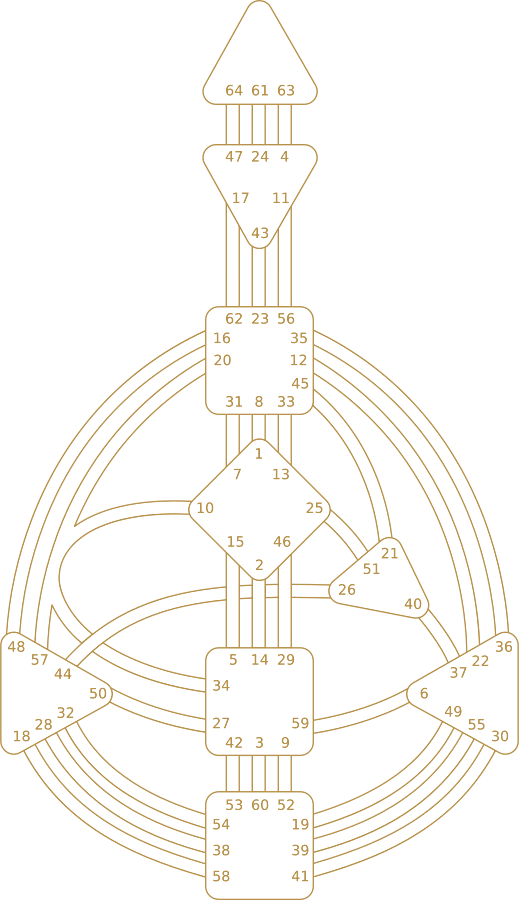

Mental Authority Human Design
Mental Authority in Human Design, also called Environmental Authority or Outer Authority, means you have no inner Authority. It belongs only to Projectors whose only defined Centers are the Head, Ajna and Throat. You decide by talking it through with trusted people in the right environment and hearing what comes out.
Think of a good listener as a mirror, not a guide: you are not asking for their answer, you are listening for yours as it leaves your mouth.
Not sure this is your Authority? Check with the free chart calculator on this page. It takes your birth date, time and place.
Mental Authority at a glance
The facts of Mental Authority in one place, from the Human Design canon and Jovian Archive.
Do you have Mental Authority? Find it in your chart
Your Authority is calculated from your birth date, birth time and birth place, not from a quiz. Enter your details and your free chart shows your Type, Strategy and Authority.
Your chart shows a different Authority? Each one has its own guide, in the order your chart checks them:
What is Mental Authority?
In Human Design, your Inner Authority is your most reliable decision-making system. For most people, this is a body-based signal: a gut response (Sacral Authority), an emotional wave (Emotional Authority), an instinctive hit (Splenic Authority), or a willpower pulse (Ego Authority). Mental Authority is what remains when none of these, and no G Center, are defined.
The Mental Authority Projector has no defined motor centers (no Sacral, no Heart/Ego, no Solar Plexus, no Root) and no defined Spleen. What can be defined is the Head, Ajna and Throat; the G Center is undefined too. The only consistent processing in the chart is mental and communicative, not physical or emotional. So instead of listening inward for a physical response, you take your processing outside through conversation and let your environment filter what is true.
Who has Mental Authority?
Mental Authority belongs only to Projectors. No other Type can have it. Generators and Manifesting Generators always have Sacral or Emotional Authority. Manifestors always have Emotional, Splenic, or Ego Authority. Reflectors always have Lunar Authority. Only a Projector can have a chart where every motor and the Solar Plexus and Spleen are undefined, leaving the Head, Ajna and Throat as the only defined processing system.
To confirm yours, generate your free chart and check the Inner Authority line. If it says Mental, Environmental, or None/Outer Authority, this page is for you. If it says Self-Projected, that is a different Authority: there the G Center is defined.
Why the name "Mental Authority" is misleading
The name creates a misunderstanding. "Mental Authority" sounds like it means "trust your mind to decide." It does not. In Human Design, the mind is never the decision-maker for any Type. The mind is designed to be a valuable resource for others, an outer authority that can observe, analyze, and share insight, but it is not designed to make your own life decisions reliably. For how Mental Authority plays out in an ordinary day, see Human Design daily alignment.
What the name actually means is this: once every inner Authority is ruled out, what remains is a mental process that has to be externalized to work. You cannot think your way to clarity by analyzing internally. The mind, left to its own loops, will spin indefinitely. The answer is to take the process outside: speak it out loud, hear your own words in a supportive setting, and let clarity come from the conversation rather than from the analysis.
This is why "Environmental Authority" is often the more accurate name. The right setting calms the mental noise and lets genuine insight surface. The wrong setting amplifies loops and indecision. Where you process matters as much as how you process.
How Mental Authority decision-making works
Mental Authority works through three things together: environment, conversation, and time. You do not decide by thinking harder. You decide by talking it out in the right place and noticing which words feel simple, stable, and true when they leave your mouth. Skipping any of the three creates the loops, indecision, and people-pleasing that Mental Authority Projectors often struggle with.
Environment shapes clarity. Some spaces amplify mental noise: loud, chaotic, pressured, or emotionally charged settings. Others settle your thoughts naturally: calm, private, familiar, or physically comfortable ones. Before processing a major decision, choose a setting that supports your clarity. If you cannot think clearly where you are, the environment is wrong.
Conversation externalizes processing. A sounding board is not someone who gives you advice. It is someone who listens without steering so you can hear what comes out of your own mouth. When you speak a decision out loud, the words either feel clean and true, or forced and uncertain. You are not processing the other person's response. You are processing your own words.
Time reveals stability. Genuine clarity does not change depending on who you talk to or what room you are in. If your decision shifts every time the setting changes, it is not yet stable. When Mental Authority is working, the same answer emerges across several conversations and settings. That consistency is your signal.
What Mental Authority feels like
Mental Authority does not produce a physical sensation the way Sacral or Splenic Authority does. It produces a shift in mental state: from spinning thoughts to settled clarity, from complex analysis to simple knowing. Many Mental Authority Projectors describe it as "the loop stops" or "my words get simpler."
When it is working, your words feel clean when you say the decision out loud, you feel calmer as you talk, you stop needing reassurance, and the answer stays the same across conversations. When it is not yet clear, thoughts loop without resolving, you feel urgency that is not coming from clarity, you change your mind depending on who you talk to, and you over-explain, which is a sign you are trying to convince yourself of something that has not become clear yet.
What blocks Mental Authority
Mental Authority gets blocked by pressure, rushing, and the conditioning to decide like other Types. These are the four most common blocks.
Isolation
Trying to decide entirely alone keeps the mental process internal, where it cannot resolve.
Urgency
Pressure to commit before the clarity has stabilized produces an answer, not the correct one.
The wrong environment
Chaotic, stressful, or emotionally charged settings amplify mental noise instead of settling it.
Leaning on advice
Asking for guidance when you need a sounding board, then following other people's direction instead of hearing your own clarity.
Most Mental Authority Projectors grew up in a world that rewards fast, confident answers. They learned to override their natural process (slow, conversational, environment-dependent) with mental analysis that answers quickly but not correctly. Deconditioning means letting the natural process work: slowing down, choosing the right setting, speaking out loud, and waiting for the words to become stable before committing.
How to practice Mental Authority in daily life
Practice 1: The one-sentence test. Before committing to any decision, say it out loud in one simple sentence: "I am choosing ___." If the sentence feels clean and calm, the clarity may be real. If it feels forced, complicated, or like you are performing certainty you do not have, you need more time or a different environment.
Practice 2: Environment audit. Notice where you naturally feel calm, clear, and settled, and where you feel tense, rushed, or mentally noisy. Process important decisions only in the places that support your clarity: a specific room, a time of day, a walk, sitting outside, a quiet coffee shop. The environment is not incidental. It is part of how you decide.
Practice 3: Choose sounding boards wisely. A good sounding board does not push you toward an answer, offer unsolicited advice, or react emotionally to what you are processing. If someone consistently pushes you toward their preferred outcome, they are not a sounding board. They are a lobbyist. Your clarity depends on neutral reflection, not persuasion.
Practice 4: Test consistency. After you reach clarity in one conversation or setting, check whether it holds in a different one. If your answer stays the same, it is likely correct. If it shifts, you need more processing time. This is the closest thing Mental Authority has to a confirmation signal.
Mental Authority at work
At work, Mental Authority Projectors do best when they have time and space to process before committing. Environments that demand instant answers, on-the-spot commitments, or rapid-fire decisions are misaligned with your design. Your best professional decisions come after you have talked things through in the right setting and let the clarity stabilize.
The sentence that protects your Authority at work is: "Let me process this and get back to you." This is not indecisiveness. It is how your design works, and it builds a reputation for reliability rather than speed. The Projector's Strategy (wait for the invitation) naturally supports this: invitations create space for consideration rather than pressure for an immediate response.
Mental Authority in relationships
In relationships, Mental Authority needs room to process. The healthiest partnerships give you space to speak without pressure, to change environments when you need clarity, and to take time before significant decisions. Partners who demand immediate answers, read processing time as rejection, or push you toward conclusions before your words have stabilized will keep you under constant pressure.
The practice is naming your process out loud. "I need to talk this through" does not mean "I do not know what I want." It means "my design needs conversation and the right setting to find genuine clarity." When partners understand this, processing becomes something you share rather than a source of friction. When they do not, you may commit from pressure rather than clarity, which creates resentment on both sides.
To see how your design interacts with someone else's, use the Human Design Compatibility Calculator.
Next steps
Mental Authority only works alongside your Strategy, so read Projector Strategy and the Projector Type guide next, then compare the other six on the Human Design Authority hub. A Human Design reading goes further, with 60+ sections showing how your Mental Authority works with your own Profile, Centers and definition.
FAQ: Mental Authority Human Design
What is Mental Authority in Human Design?
Mental Authority, also called Environmental Authority, is a decision-making process where clarity comes through speaking out loud in the right environment. It does not mean trusting your mind's analysis. It means externalizing your thoughts through conversation and noticing which words feel simple, stable, and true.
Who can have Mental Authority?
Only Projectors can have Mental Authority. It occurs when no motor centers (Sacral, Heart, Solar Plexus, Root), no Spleen and no G Center are defined, leaving the Head, Ajna, and Throat as the only possible defined centers.
How do I know if I have Mental Authority?
Generate your free chart and read the Inner Authority line. It may say Mental, Environmental, or None/Outer Authority. In the chart this means a Projector whose only definition is among the Head, Ajna and Throat, with the G Center undefined.
Does Mental Authority mean I should trust my mind?
No. The name is misleading. In Human Design, the mind is never the correct decision-maker for your own life. Your processing needs to be externalized through conversation, not analyzed internally.
What is a sounding board?
A sounding board is someone who listens without steering. They do not give advice, push you toward an answer, or react emotionally. They hold space for you to hear your own words and notice which ones feel clear.
Why does environment matter for Mental Authority?
The right setting calms mental noise and allows genuine clarity to surface. The wrong setting amplifies mental loops. Choosing where you process is part of how you decide.
How do I know when a decision is clear?
Your words feel simple and stable, the same answer emerges across several conversations and settings, and you feel calmer after saying it out loud. If your answer keeps changing, you need more processing time.
How is Mental Authority different from Self-Projected Authority?
Self-Projected Authority has a defined G Center that gives an identity-based signal ("this is me" or "this is not me"). Mental Authority has no defined G Center and relies on environment and conversation instead. Both are Projector-only Authorities.
Is Mental Authority rare?
Yes, it is uncommon. Jovian Archive's statistics count about 3.6 in every 100 charts with no inner Authority, which is Mental Projectors and Reflectors together. Most people have Emotional, Sacral, or Splenic Authority.
What is the rarest Authority in Human Design?
In Jovian Archive's statistics the rarest inner Authorities are Ego (about 1 in 100 charts) and Lunar (Reflectors, about 1.4 in 100). Emotional is the most common (about 47 in 100), then Sacral (about 35). Mental Authority sits in the group with no inner Authority, about 3.6 in 100 together with Reflectors.