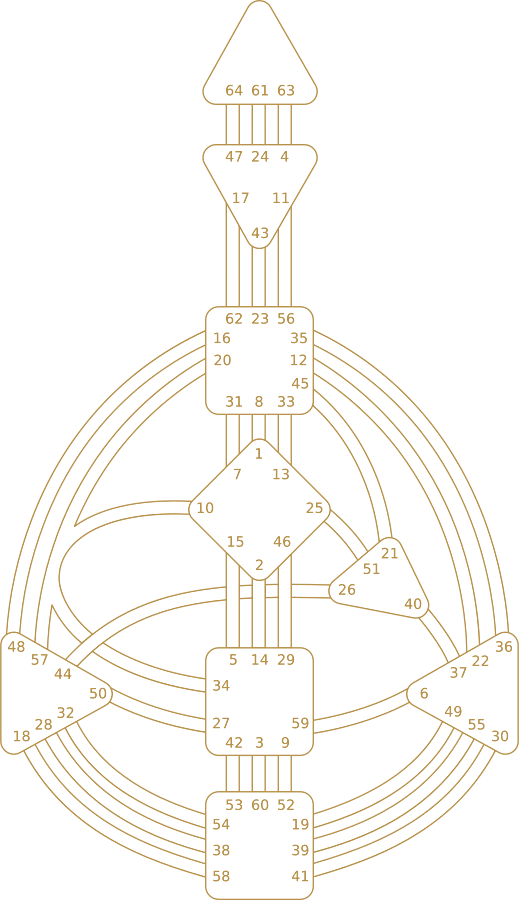

Self-Projected Authority Human Design
Self-Projected Authority in Human Design means your decisions are designed to come from your sense of identity and direction. It works through a defined G Center connected to the Throat, and only Projectors have it. You decide by talking it out and listening: the choice that sounds true and like you is correct.
Think of your voice as the instrument that carries your direction. Speak the decision out loud and listen: if it sounds steady, true and like you, it is yours; if it sounds edited, forced or like someone else's script, it is not.
Not sure this is your Authority? Check with the free chart calculator on this page. It takes your birth date, time and place.
Self-Projected Authority at a glance
The facts of Self-Projected Authority in one place, from the Human Design canon and Jovian Archive.
Do you have Self-Projected Authority? Find it in your chart
Your Authority is calculated from your birth date, birth time and birth place, not from a quiz. Enter your details and your free chart shows your Type, Strategy and Authority.
Your chart shows a different Authority? Each one has its own guide, in the order your chart checks them:
What is Self-Projected Authority?
In Human Design, your Inner Authority is your most reliable decision-making system. Self-Projected Authority means your decisions come through the G Center, the Center associated with identity, direction, love, and your sense of self. When the G Center is defined and connected to the Throat, your truth has a direct channel to expression. This is what makes speaking such a powerful decision-making tool for this Authority: your identity projects through your voice.
Unlike Sacral Authority, which provides a gut yes or no, or Emotional Authority, which requires riding a wave, Self-Projected Authority operates through identity resonance. You are not asking "Do I have energy for this?" You are asking "Is this me? Does this direction align with who I am?" The answer arrives not as a body sensation or an emotional shift but as a quality of truthfulness in your own words when you speak the decision out loud.
Who has Self-Projected Authority?
Self-Projected Authority appears exclusively in Projectors, in about 3 in every 100 charts (Jovian Archive statistics: 2.84%). The chart configuration is a defined G Center connected to the Throat, with the Solar Plexus, Sacral, Spleen and Heart all undefined. That means no emotional wave, no sacral response, no splenic intuition and no Ego willpower to take priority over the G Center. Your identity and direction become how you decide. For how Self-Projected Authority plays out in an ordinary day, see Human Design daily alignment.
Because this Authority belongs to Projectors, it works within the Projector Strategy, to wait for the invitation. The invitation opens the door (Strategy), and Self-Projected Authority decides whether to walk through it: "Is this invitation leading me toward who I am, or away from it?"
How Self-Projected Authority decision-making works
Self-Projected Authority operates through a mechanism that is unfamiliar to most people. When you are considering a decision, you speak it out loud and listen to the quality of your own voice. The core question is "Is this me? Is this my direction?", not "Is this smart?" or "Will this work out?" The G Center does not evaluate strategy. It recognizes alignment between the decision and your identity.
This works because the G Center to Throat connection creates a direct channel from your sense of self to your expression. When you speak about something that aligns with your identity, the words flow naturally. The statement feels grounded and real. When you speak about something that does not align, you might notice hesitation, qualification, over-explaining, or the sense that you are constructing a case rather than stating a truth.
The clarity is not always instant. Sometimes you need to speak about the decision several times, in different conversations, before the truth becomes clear. Each time you hear a slightly different aspect of your response, and the cumulative effect is a deepening sense of whether the direction is genuinely yours or borrowed from someone else's expectations.
Why speaking creates clarity
For most people, thinking is the main tool for decisions. For Self-Projected Authority, thinking is actually the obstacle. Your mind can construct a logical case for any decision, but logic does not reveal whether the decision aligns with your identity. Only hearing yourself speak about it does. The G Center's sense of direction is not a thought; it is a knowing below conscious reasoning. This is why the Authority is called Self-Projected: you project your self outward through speech and then hear it reflected back.
You are not speaking to convince anyone or to get advice. You are speaking to hear yourself. The people you speak with are mirrors, not judges: their role is to create the space for your truth to emerge, not to evaluate it. Choosing the right sounding board, someone who listens without advising, judging or fixing, is one of the most important practical skills for this Authority. You can also speak to yourself: voice memos, journaling out loud, or simply talking the decision through alone use the same mechanism.
Self-Projected Authority vs Ego Authority
Self-Projected and Ego Authority are sometimes confused because both can involve speaking as a clarity tool. But they operate through different Centers, ask different questions, and produce different types of certainty.
Ego Authority comes from the Heart/Ego Center and asks: "Do I want this? Am I willing to commit my will to it?" The signal is desire and willingness. Self-Projected Authority comes from the G Center and asks: "Is this me? Is this my direction?" The signal is identity resonance.
The practical difference: Ego Authority can want something that is not necessarily aligned with identity (desire and direction can diverge). Self-Projected Authority can be aligned with identity even when desire is mild: you may not feel strong desire, but the direction feels unmistakably right. Ego asks "Do I want?" Self-Projected asks "Is this me?"
How to practice Self-Projected Authority in daily life
Strengthening your relationship with Self-Projected Authority starts with regular chances to speak your truth without editing. The more you practice unfiltered expression in safe spaces, the more clearly you can hear the G Center's direction when a real decision arrives.
The simplest daily practice is the identity sentence. Each morning, speak one honest statement out loud: "What is true for me today is..." and let the sentence complete itself without planning. Notice the quality of your voice. Does it sound steady and real, or like you are performing? Over time this sharpens your ability to tell authentic expression from conditioned performance.
For significant decisions, speak the decision to a trusted person. Frame it clearly: "I am not looking for advice. I need to talk this through and hear myself." Then describe each option and notice which description sounds most like you. The option that produces the steadiest, most natural voice is usually the correct direction. The option that requires defending, justifying or over-explaining is usually the conditioned choice. If no sounding board is available, record a voice memo and play it back: the distance between speaking and listening often reveals what you missed in the moment.
Self-Projected Authority at work
In work, Self-Projected Authority creates the most alignment when your role, direction and daily expression match your identity. The correct work for a Self-Projected Projector is not necessarily the most prestigious, highest-paying or most logical path. It is the one where you feel most like yourself while doing it.
When a professional invitation arrives, speak about it. Describe the role and the direction it would take your career to a trusted person, and listen to whether your voice sounds aligned or whether you are selling yourself on something your identity does not endorse. Once you are in a role, the ongoing check is whether the work still feels like an expression of who you are. When it requires you to perform a version of yourself that is not genuine, or the direction of the work diverges from your identity, the alignment has shifted and the role may need to change.
Self-Projected Authority in relationships
In relationships, Self-Projected Authority means choosing connections where you can be yourself without editing. The healthiest relationships for this Authority are the ones where your partner hears your truth, respects your direction, and does not require you to perform a version of yourself that is not real.
The key dynamic is safety of expression. When you can speak honestly about who you are, what your direction is and what feels true, the relationship supports your Authority. When you have to suppress, edit or perform your identity to keep the relationship, it is working against your Authority, and the long-term cost is a growing sense of being lost. The practice is the same as everywhere else: "This is who I am in this relationship." "This is what feels true for me right now." Statements that sound steady and natural are your G Center confirming the direction.
For a deeper look at how your energy interacts with another person's, use the Human Design Compatibility Calculator or read about Human Design Relationships.
Common Self-Projected Authority mistakes
Self-Projected Authority gets distorted by any conditioning that teaches you to suppress, edit or perform your identity rather than express it honestly. The most common distortions come from environments where being yourself was not safe, welcome or rewarded, and they show up as these mistakes.
Deciding in your head instead of speaking
The G Center's truth does not live in your thoughts. It lives in your expression. If you are stuck in a mental loop, the fix is not to think harder. It is to speak.
Editing your truth for the audience
Saying what will be accepted or create the least friction produces conditioned choices, not identity-aligned ones. The words sound polished but feel hollow. The value of speaking is hearing the unedited version.
Seeking advice instead of using sounding boards
The purpose of speaking is to hear yourself, not to collect opinions. Sounding boards listen without advising. Advice-givers insert their own direction, which can override yours.
Choosing from logic or external validation
Career paths that look impressive or choices that match what your family or culture values can override your direction with someone else's map. Ask: "Is this path genuinely mine, or did someone else draw it?"
Forcing clarity in unsafe environments
Speaking your truth in a pressured, judgmental or rushed space distorts the signal, because you edit yourself without noticing. If the environment is wrong, the clarity will be wrong. Change the room first.
Confusing identity with desire
Self-Projected Authority asks "Is this me?" not "Do I want this?" You can want something that is not aligned with your identity, and you can feel aligned with something you do not strongly desire.
Next steps
Self-Projected Authority works within your Projector design. Pair it with the Projector Strategy, to wait for the invitation: the invitation opens the door, and your Authority decides whether the direction behind it is yours. Go deeper into the G Center, or compare all seven on the Human Design Authority hub. A Human Design reading goes further, with 60+ sections on how your G Center, Gates and Channels shape your identity, direction and the way your truth comes through your voice.
FAQ: Self-Projected Authority Human Design
What is Self-Projected Authority in Human Design?
Self-Projected Authority is a decision-making system based on identity and direction, working through a defined G Center connected to the Throat. Your clarity comes when you speak your truth out loud and hear whether it sounds authentically like you.
How do I know if I have Self-Projected Authority?
Generate your free chart and check the Inner Authority line. If it says Self-Projected, your G Center connects to the Throat and the Solar Plexus, Sacral, Spleen and Heart are all undefined. Only Projectors have this Authority.
Why does speaking out loud help?
Your G Center is connected to the Throat, creating a direct channel from identity to expression. Speaking projects your sense of self outward, and hearing it reflected back reveals whether the direction is genuinely yours.
Do I need other people to make decisions?
Not necessarily. Sounding boards help, but you can also speak to yourself, record voice memos, or journal out loud. The mechanism is hearing your truth expressed, not getting advice from others.
How is Self-Projected different from Ego Authority?
Self-Projected asks "Is this me?" (identity and direction from the G Center). Ego Authority asks "Do I want this?" (desire and commitment from the Heart Center). Identity alignment and desire can diverge.
What if my voice feels unclear when I speak?
Unclear expression usually means the environment is too pressured or judgmental, the timing is off, or the decision is not aligned. Change the setting, try again later, or consider that the lack of clarity is itself the answer.
Which Types have Self-Projected Authority?
Only Projectors. It appears in Projectors with a defined G Center connected to the Throat and no defined Solar Plexus, Sacral, Spleen or Heart.
How does Self-Projected Authority work with Projector Strategy?
The invitation opens the door (Strategy). Self-Projected Authority decides whether the direction behind the invitation aligns with your identity. The invitation tells you that you are wanted; your Authority tells you whether it is your path.
What is the rarest Authority in Human Design?
In Jovian Archive statistics the rarest inner Authorities are Ego (about 1 in 100: Ego Manifested 0.8%, Ego Projected 0.45%) and Lunar (Reflectors, about 1.4 in 100). Emotional is the most common, at about 47 in 100, then Sacral at about 35. Self-Projected is also uncommon, at about 3 in every 100 charts (2.84%).