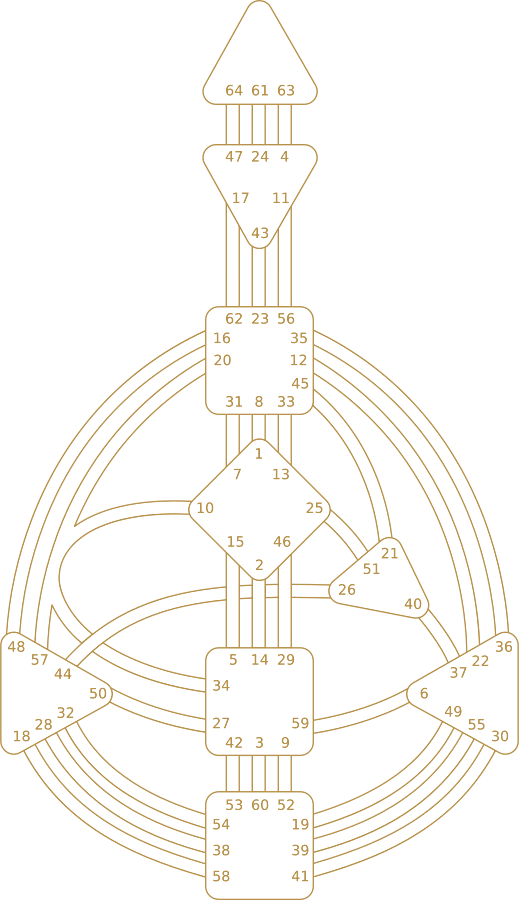

Head Center Human Design
The Head Center in Human Design, sometimes called the Crown Center, is one of two pressure centers in the chart. It creates inspiration and questions, the pressure to think, but never the answers. Defined, that pressure runs steadily from inside you. Open, you take in and amplify the questions around you.
Think of the Head Center as the doorbell of the mind. It rings with questions, ideas and doubts, and it was never meant to be the one who answers the door.
Is your Head Center defined or open? Check with the free chart calculator on this page. It takes your birth date, time and place.
Head Center at a glance
The facts of the Head Center in one place, from the Human Design canon. The shares are from Jovian Archive’s statistics.
Is your Head Center defined? Find it in your chart
Your Centers are calculated from your birth date, birth time and birth place. Enter your details and your free chart shows this Center colored in if it is defined, and white if it is open.
Every Center has its own guide:
What is the Head Center?
The Head Center is the topmost center on the BodyGraph, represented by the triangle at the very top of the chart. It is one of two pressure centers in Human Design, paired with the Root Center at the bottom. Where the Root creates pressure to act and move, the Head creates pressure to think, question, and understand. Jovian Archive sums up the Head as inspiration: the pressure to think, to wonder, to question.
The Head Center generates three kinds of mental input: inspiration (sudden ideas and creative sparks), questions (the drive to understand why things are the way they are), and doubt (the questioning of what you think you know). None of these is a problem in itself. The problem arises when you treat the pressure as something that must be resolved immediately, turning inspiration into obligation, questions into urgency, and doubt into worry.
That is why it matters that the Head is a pressure center, not an awareness center. It is often grouped with the Ajna as "the mind," but the three awareness centers in Human Design are the Ajna (mental awareness), the Spleen (body awareness), and the Solar Plexus (emotional awareness). If you treat Head activity as awareness, you follow every question, idea, or doubt as if it were direction. If you understand it as pressure, you recognize it as a push, not a signal, and you can acknowledge it without being controlled by it.
The Head and Ajna partnership
The Head Center and the Ajna Center work together as a two-part mental system. The Head generates the raw input: inspiration, questions, and the pressure to understand. The Ajna takes that input and processes it into concepts, opinions, frameworks, and structured thought. Neither center is designed to make decisions. Together, they create the thinking mind, which is a tool for understanding and communication, not for choosing.
Every Channel from the Head runs to the Ajna, and to no other Center. So if your Head Center is defined, your Ajna is always defined too, and if your Ajna is undefined, your Head is always undefined as well. When both are open, you have a completely open mind: enormous mental range, and a high sensitivity to other people's questions and ideas.
Head Center Gates and Channels
The Head Center holds three Gates: Gate 61, Gate 63 and Gate 64. Each pairs with a Gate in the Ajna to form one of three Channels: the Channel of Awareness (24‑61), the Channel of Logic (4‑63) and the Channel of Abstraction (47‑64). The Head is defined only when at least one of these Channels is complete in your chart, with both of its Gates activated. One Gate on its own leaves the Head undefined. A defined Head is the rarest defined Center of all nine in Jovian Archive's statistics.
Defined Head Center
If your Head Center is colored in on your chart, it is defined. This means you generate your own consistent mental pressure internally. Ideas, questions, and inspiration arrive with a steady rhythm that does not depend on outside stimulation. You tend to return to the same types of questions over time, building deeper understanding in particular domains, and you often spark curiosity in others just by sharing what you are thinking about.
The challenge of a defined Head Center is mental fixation. Because the pressure is internally generated and always on, you may struggle to let questions go. An unresolved question can loop in your mind, creating the sense that you must find the answer before you can relax. The growth edge is learning to hold questions lightly, to let inspiration arrive without treating every idea as an obligation, and to recognize that not every question deserves your energy.
Undefined (Open) Head Center
If your Head Center is white on your chart, it is undefined (or open). This means you do not generate consistent internal mental pressure. Instead, you absorb and amplify the mental pressure of the people and environments around you. In a room full of curious, questioning people, your Head Center picks up their energy and magnifies it, which can feel like your own intense mental pressure even though the source is external.
The strength of an undefined Head Center is wisdom through discernment. Because you experience many different questions and inspirations from many sources, you learn to tell the questions that genuinely matter from the ones that are just noise, and which ideas lead somewhere and which do not.
The open Head's Not-Self question is "Am I trying to answer everybody else's questions?" You may leave a conversation buzzing with questions you did not have when you walked in, or feel flooded after an hour of feeds and headlines. That urgency may not be yours. Your clarity often improves when you reduce stimulation: less information intake, fewer screens, more quiet time alone. The wisdom of the open Head Center reveals itself in quiet, not in noise.
The Head Center and Authority
No Authority comes from the Head Center. Its questions are not decisions, and neither are the concepts the Ajna builds from them. The Head asks the question. The Ajna organizes it into a concept. Your Authority makes the final decision about what to do. When these roles are respected, the mind becomes a tool for understanding. When they are confused, the mind tries to run your life and creates the mental noise that most people call overthinking.
The not-self pattern of the Head Center
The Head Center's not-self pattern is feeling pressured to answer questions that are not yours to answer. This shows up as the compulsive need to find answers, figure things out, or resolve mental tension before you can feel at ease. The pressure feels urgent, as though the question must be answered now, even when the question has no practical relevance to your life or your decisions.
The antidote is straightforward: notice the pressure, name it as Head Center activity, and let it pass without acting on it unless your Authority confirms that the question is relevant to a real decision. The questions that are genuinely important will return. The ones that were just pressure will not.
How to work with mental pressure
Mental pressure from the Head Center is not something to eliminate. It is something to relate to differently. "I have a question" is neutral. "I must answer this question right now or something bad will happen" is the not‑self distortion.
The most effective technique for Head Center pressure is the parking lot method. When a question or idea arrives with urgency, write it down. Do not solve it. Do not research it. Just park it. If the question is genuinely important, it will return tomorrow with the same or greater relevance. If it was just pressure, it will fade overnight.
The Head Center at work
At work, Head Center pressure typically shows up as research loops, planning paralysis, and the feeling that you need to understand everything before you can start. You research the best approach, then the best tool for that approach, then what other people did with that tool, and by the time you finish, the day is over and you have not taken a single action.
The fix is simple in concept and challenging in practice: research enough to form a question, then hand the decision to your Authority. "Do I have enough information to take the next step?" If your Authority says yes, move. If it says no, gather one more piece of information and ask again. Defined Head Centers at work tend to generate ideas that inspire teams but may need to learn that not every idea requires a project. Undefined Head Centers tend to absorb the mental pressure of the office and may need quiet time in their day to discharge the accumulated mental noise.
The Head Center in relationships
In relationships, Head Center pressure often turns connection into a puzzle to solve. "What did they mean by that?" "Where is this going?" "Why did they respond that way?" The mind wants to understand the relationship conceptually before it feels safe, and this drive can push the relationship faster than it is ready to develop.
The healthiest Head Center expression in relationships is curiosity without interrogation. You can be interested in your partner without needing to decode their every word. You can hold unanswered questions about the relationship without treating them as emergencies, and let time and experience reveal more than any amount of mental analysis. For a deeper look at how mental dynamics interact between two charts, use the Human Design Compatibility Calculator.
Daily practice for the Head Center
For undefined Head Centers specifically: build at least one block of reduced-input time into your day. No screens, no content, no conversations for 20 to 30 minutes. This clears the accumulated mental pressure from other people's energy and lets your natural clarity surface.
For defined Head Centers specifically: practice choosing which ideas to follow rather than following all of them. Your inspiration is consistent and abundant, which means your filtering is more important than your generating. Not every question is worth your time, and letting go of an idea does not mean it was wasted.
Next steps
See where the Head sits in the whole system in the Human Design Centers guide and in Defined vs Undefined Centers, then read the Ajna Center guide for the other half of your mind. Because no Authority comes from the Head, the Human Design Authority page is where to learn how your decisions are actually made. A Human Design reading shows your own Head Center, its Gates and Channels, and how its pressure shapes your thinking, across 60+ sections.
FAQ: Head Center Human Design
What is the Head Center in Human Design?
The Head Center, also called the Crown Center, is a pressure center that generates inspiration, questions, and mental drive. It is the top triangle on the BodyGraph and the entry point for all mental activity.
Is the Head Center an awareness center?
No. The Head Center is a pressure center. The three awareness centers are the Ajna, Spleen, and Solar Plexus. The Head Center generates pressure to think and question, not awareness or answers.
How common is a defined Head Center?
A defined Head Center is the rarest defined Center. Jovian Archive's statistics show it defined in 24.3% of charts, undefined with some of its Gates in 40.7%, and completely open in 35.2%.
What are the Gates and Channels of the Head Center?
The Head Center holds Gates 61, 63 and 64. They form three Channels to the Ajna: the Channel of Awareness (24‑61), the Channel of Logic (4‑63) and the Channel of Abstraction (47‑64).
What does a defined Head Center mean?
A defined Head Center means you generate consistent internal mental pressure. You are a natural source of inspiration for others. The growth edge is choosing which ideas to follow rather than following all of them.
What does an undefined Head Center mean?
An undefined (open) Head Center means you absorb and amplify the mental pressure of people and environments around you. Its Not-Self question is "Am I trying to answer everybody else's questions?" Reducing input and spending quiet time alone helps you discharge borrowed pressure.
Does the Head Center have an Authority?
No. No Authority comes from the Head Center. It creates questions, and your Authority makes the decisions.
Why do I overthink so much?
Overthinking often comes from treating Head Center pressure as something that must be resolved immediately. The fix is not more thinking. It is noticing the pressure, parking the question, and returning to your Authority for any real decisions.
What is the difference between the Head Center and the Ajna?
The Head Center generates questions and inspiration (pressure). The Ajna Center organizes those questions into concepts and opinions (processing). Neither makes decisions. That is your Authority.
How do I find the Head Center on my chart?
Use the free chart calculator on this page and look at the top triangle. If it is colored, your Head Center is defined. If it is white, it is undefined.