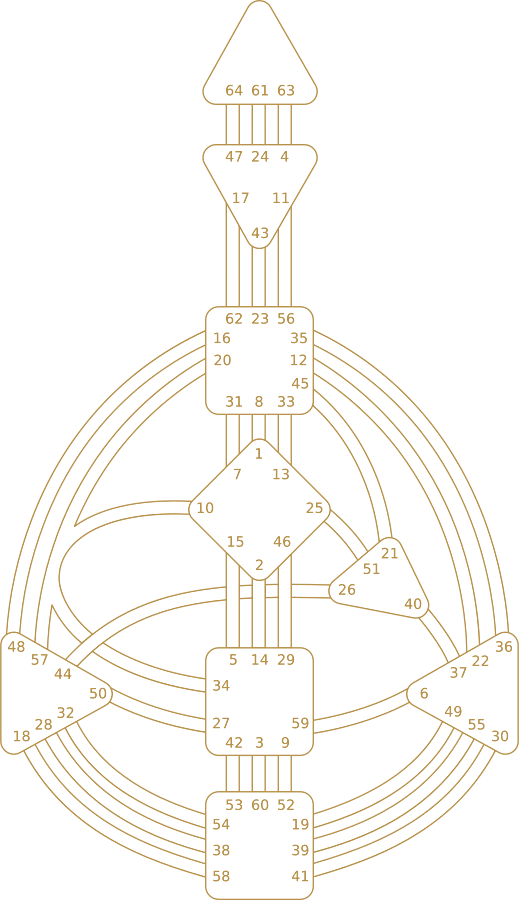

Spleen Center Human Design
The Spleen Center in Human Design is the body's awareness center for survival, health, intuition, and instinct. It speaks once, in the present moment. Defined, it gives you a consistent instinctive read on what is safe and correct. Open, it takes in and amplifies the Splenic awareness of the people around you.
Think of the Spleen as a quiet tap on the shoulder rather than an alarm: it taps once, right now, and if you miss it, it does not tap again.
Is your Spleen Center defined or open? Check with the free chart calculator on this page. It takes your birth date, time and place.
Spleen Center at a glance
The facts of the Spleen Center in one place, from the Human Design canon. The shares are from Jovian Archive’s statistics.
Is your Spleen Center defined? Find it in your chart
Your Centers are calculated from your birth date, birth time and birth place. Enter your details and your free chart shows this Center colored in if it is defined, and white if it is open.
Every Center has its own guide:
What is the Spleen Center?
The Spleen Center is an awareness center, not a motor center. It is one of three awareness centers, with the Ajna and the Solar Plexus, and it is the oldest of the three, operating from the body's primal intelligence rather than mental concepts or emotional waves. It generates awareness, not energy: the body's present-moment perception of what is safe, healthy, and correct right now. In Human Design, the Spleen Center corresponds to the spleen, the lymphatic system and the immune system.
The Spleen's awareness covers three domains. Survival and safety is the primal instinct that reads danger and risk. Health and vitality is the body's sense of what supports it and what depletes it. Intuition is the spontaneous knowing that arrives without logical explanation, the flash of certainty that tells you something is right or wrong before your mind can construct a reason.
The Spleen Center holds seven Gates: 18, 28, 32, 44, 48, 50 and 57. They form nine Channels linking the Spleen to five other Centers:
- To the Root: the Channel of Judgment (18‑58), the Channel of Struggle (28‑38) and the Channel of Transformation (32‑54).
- To the Sacral: the Channel of Power (34‑57) and the Channel of Preservation (27‑50).
- To the Throat: the Channel of The Brainwave (20‑57) and the Channel of The Wavelength (16‑48).
- To the G Center: the Channel of Perfected Form (10‑57).
- To the Heart: the Channel of Surrender (26‑44).
Your Spleen Center is defined when at least one of these nine Channels is complete in your chart.
The signal speaks once
The most important thing to understand about the Spleen Center is that it speaks once, in the moment, and does not repeat. The Ajna can revisit the same thought for hours. The Solar Plexus moves in waves that cycle back through the same emotional territory. The Spleen delivers one flash of awareness, and if you do not catch it, it is gone.
This one-time quality makes Splenic awareness both powerful and easy to miss. The signal is usually subtle: a quick body contraction, a flash of knowing, an instant sense of ease or unease, a quiet "no" that arrives before your mind has formed an opinion. If you are in your head, distracted, or waiting for mental certainty before trusting your body, you miss it.
The Spleen rewards presence: the more grounded you are in your body, the more likely you are to notice its signals. If it becomes a repeating thought, it has moved from the body to the mind and is no longer the same signal.
Splenic intuition versus fear
The Spleen Center houses both intuition and fear, and distinguishing between them is the central skill of Splenic awareness.
Splenic intuition is a one-time, present-moment signal. It arrives without explanation, lasts a moment, and carries a clear direction: move toward this, move away from that, this is safe, this is not. Even when the signal is a "no" or a warning, it arrives with a quality of clarity rather than panic.
Fear is repetitive and looping. It replays the same scenario over and over, trying to create certainty about the future, and pushes you to analyze until you feel safe. Fear is the mind attempting to use Splenic territory (safety assessment) with mental tools (analysis, prediction, worry) rather than body tools (present‑moment sensing).
The practical test is simple: did it arrive once and deliver a clear signal? That is likely Splenic awareness. Is it repeating in your mind, growing louder, and creating stories about what might happen? That is likely fear. The Spleen speaks once. Fear keeps talking.
Defined Spleen Center
If your Spleen Center is colored in on your chart, it is defined: at least one of its nine Channels is complete. You have consistent access to Splenic awareness, a present-moment body intelligence that runs continuously in the background. You tend to have a natural sense of what is healthy for you and what is not. Jovian Archive's statistics count a defined Spleen Center in about 59.0% of charts.
The strength of a defined Spleen is instinctive reliability. You can walk into a room and sense whether the energy is safe or off. You can meet someone and know within seconds whether the connection feels healthy.
The challenge is overriding the signal with mental doubt. The Spleen's signal is quiet and the mind is loud. When the Spleen says "no" and the mind says "but logically this makes sense," many people with a defined Spleen follow the mind and later regret it. The growth edge is learning to trust the first body signal even when you cannot explain it.
Undefined (Open) Spleen Center
If your Spleen Center is white on your chart, it is undefined (or open). You do not have consistent Splenic awareness of your own. Instead, you take in and amplify the Splenic energy of the people around you. In the presence of someone with a defined Spleen, you may feel unusually alert, safe, or intuitively sharp, but this borrowed awareness fades when you leave their presence. Jovian Archive's statistics count the Spleen undefined with some of its Gates active in about 32.9% of charts, and completely open, with none of its seven Gates, in about 8.7%.
The question the open Spleen Center keeps asking is "Am I holding on to what is not good for me?" Without a consistent internal safety signal, familiar can feel like safe. You may hold onto people, relationships, jobs, habits, and environments long past their time, because leaving the known feels more threatening than staying in the uncomfortable.
The strength of an undefined Spleen is wisdom about fear, health, and what is genuinely worth holding onto versus what should be released. Because you experience Splenic awareness from the outside, you come to understand the difference between real safety and false familiarity, and that "comfortable" and "healthy" are often not the same thing.
The most important practical insight for an undefined Spleen: when something no longer feels healthy, let it go sooner rather than later. Your design does not consistently produce the "it is time to leave" signal that a defined Spleen receives. You recognize the signs and choose to release, which takes courage, because the open Center can amplify fear about what comes next.
The Spleen Center and Authority
The Spleen Center is the basis for Splenic Authority, which appears in some Manifestors and Projectors whose Spleen is defined but whose Solar Plexus and Sacral are not. When the Spleen is the Authority, the body's present-moment intuition becomes the primary decision-making signal: the instant yes or no that tells you whether something is correct right now.
Splenic Authority is immediate because the signal arrives in the moment and does not need time to develop. Unlike Emotional Authority, which requires waiting for a wave to settle, Splenic Authority delivers its answer at once. It asks you to act on knowing before understanding.
For everyone else, the Spleen provides awareness but is not the final decision-maker. If your Authority is Sacral, Emotional, Self-Projected, Ego, Mental, or Lunar, the Spleen's signals are valuable data but should be processed through your designated Authority before committing.
The not-self pattern of the Spleen Center
The Spleen Center's not-self pattern is holding onto what is no longer healthy because it feels familiar. It is the pattern of the undefined (open) Spleen, because the absence of a consistent internal safety signal makes the known feel safer than the unknown.
When a defined Spleen goes off track, it overrides intuition with mental justification: "My body says no, but it makes sense logically." The Spleen sent the signal. The mind overruled it.
For an undefined Spleen, the pattern shows up as clinging: staying in relationships that drain you because being single feels scarier, keeping a job that wears you down because the alternative feels worse, keeping habits because change feels destabilizing. The practice is recognizing that familiar and healthy are not synonyms, and choosing what is good for you over what is comfortable, even when the transition feels frightening.
The Spleen Center at work
At work, the Spleen Center shapes your relationship with risk, timing, and sustainable pace. When aligned, it helps you recognize unhealthy work patterns early and trust your instinct about people and opportunities. When misaligned, fear keeps you stuck in draining situations.
A defined Spleen at work tends to read situations instantly: sensing when a deal is off, when a colleague is not trustworthy, or when a project is heading for trouble before the data confirms it. The challenge is acting on these reads when the evidence has not caught up to the instinct.
An undefined Spleen at work takes in the mood of an environment strongly but may stay in an unhealthy one longer than is correct. If a workplace keeps feeling draining, take that seriously rather than waiting for certainty.
The Spleen Center in relationships
In relationships, the Spleen Center shows itself through what you tolerate and how long you hold onto connections that are no longer healthy. When aligned, you trust early body signals about people: the instant ease that says "this is safe" or the subtle contraction that says "something is off here." When misaligned, fear of being alone keeps you in dynamics your body has already moved on from.
The defined and undefined Spleen polarity creates a common dynamic: the defined Spleen partner provides a sense of safety that the undefined Spleen partner takes in and amplifies. It can turn into dependency when the undefined partner stays mainly because the other person's Splenic energy makes them feel safe, not because the relationship itself is correct. For a deeper look at how intuitive and safety dynamics meet between two charts, use the Human Design Compatibility Calculator.
Daily practice for the Spleen Center
For a defined Spleen, the daily practice is honoring the first signal. When your body sends an instant read, before the mind has time to analyze, pause and acknowledge it. Over time, tracking these first reads against how things turned out builds trust in your Splenic awareness.
For an undefined Spleen, the daily practice is the release audit. Ask yourself regularly: "Is there anything I am holding onto that is no longer healthy?" Identify one thing and begin to let it go. Each release creates space for something that genuinely supports you.
Next steps
See how the Spleen fits among all nine in the Human Design Centers guide, compare consistent and open awareness in Defined vs Undefined Centers, and if your Spleen is defined with the Solar Plexus and Sacral undefined, read Splenic Authority. A Human Design reading takes your own Spleen Center, with its Gates and Channels, and shows across 60+ sections how your instinct and intuition shape your decisions, work and relationships.
FAQ: Spleen Center Human Design
What is the Spleen Center in Human Design?
The Spleen Center is an awareness center that governs intuition, instinct, health, and survival. It produces present-moment body signals about what is safe and correct.
Why does the Spleen only speak once?
The Spleen operates in the present moment only. Its signal is a one-time flash of awareness that arrives and then passes. If it repeats in your mind, it has become mental processing (likely fear), not Splenic intuition.
What does a defined Spleen Center mean?
A defined Spleen means you have consistent access to instinctive body awareness. You tend to know instantly whether something is safe, healthy, or correct. The growth edge is trusting the signal before the mind overrides it.
What does an undefined Spleen Center mean?
An undefined Spleen means you absorb and amplify Splenic energy from others. The conditioning pattern is holding onto what feels familiar even when it is no longer healthy. The wisdom is learning to release sooner.
What does an open Spleen Center mean?
Open is another word for undefined: the Spleen Center is white in your chart and you take in the Splenic awareness of the people around you. Its Not-Self question is "Am I holding on to what is not good for me?" Jovian Archive's statistics also count a completely open Spleen, with none of its seven Gates active, in about 8.7% of charts.
How common is a defined Spleen Center?
Jovian Archive's statistics count a defined Spleen Center in about 59.0% of charts, an undefined Spleen with some Gates in about 32.9%, and a completely open Spleen in about 8.7%.
How do I tell the difference between intuition and fear?
Splenic intuition arrives once, in the present moment, with clarity. Fear repeats, loops, and creates mental stories. If it speaks once and is clear, it is likely intuition. If it keeps talking, it is likely fear.
Is Splenic Authority the same as the Spleen Center?
Splenic Authority is a decision-making authority based on the defined Spleen, available to some Manifestors and Projectors. Having a defined Spleen does not automatically mean Splenic Authority. It depends on your full chart configuration.
Is the Spleen Center a motor center?
No. The Spleen is purely an awareness center. It perceives and signals but does not generate motor energy. The three awareness centers are the Spleen, Ajna, and Solar Plexus (which is also a motor).
How do I find the Spleen on my chart?
Generate your free chart and look for the triangle on the left side of the BodyGraph. If it is colored, your Spleen is defined. If it is white, it is undefined.