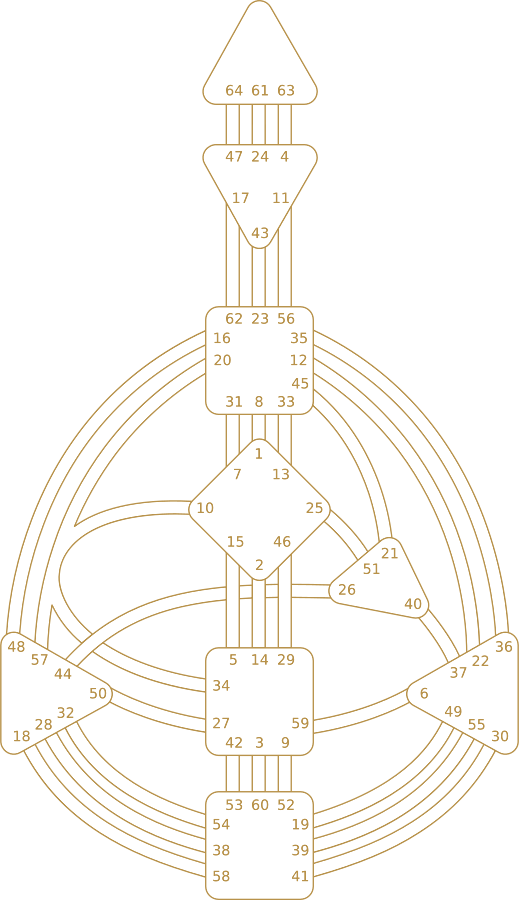

The Collective Circuit in Human Design
The Collective circuit in Human Design is the pattern of energy built for sharing, where what one person works out through logic or lived experience is meant to be passed on to everyone, including strangers.
This page explains what the Collective circuit does, how its two sub-circuits, Understanding (Logic) and Sensing (Abstract), face opposite directions, and why its energy needs an audience. You will also see how to find your Collective channels in your free chart and four ways to live with them. Start with your free chart below.
Simple way to think about it: The Collective circuit is like a library that keeps growing: each person adds what they have tested or lived, and the whole community can borrow it.
Find your Collective channels: start with your free chart
Your chart already shows whether you carry Collective energy. Enter your birth date, time, and place in your free chart below, and every Channel you have defined appears in the chart, ready to compare with the lists on this page. It takes under a minute.
To spot a defined Channel, look for a colored line running unbroken between two Centers, with a Gate number at each end. Write down the two numbers, such as 47-64, then match them against the Understanding and Sensing lists below. Any that appear are your Collective channels, and the Channels page explains how to read the rest. If none appear, your sharing runs through other circuits, and that is a complete design too.
What the Collective circuit does
The Collective circuit carries sharing. What it works out is meant for everyone, including strangers, and its energy moves outward from the individual to the group as knowledge, pattern, and shared experience. Fourteen of the 36 channels belong to it, which makes it the second-largest circuit, and its channels are split evenly between two sub-circuits. Think of it as the circuit of contribution. Where Tribal energy asks who is yours, and Individual energy asks who you are, Collective energy asks what everyone can learn from this. That explains the pull many people with these channels feel to teach, write, organize, or simply explain things to anyone who will listen, and the restlessness when they cannot.
Those sub-circuits are Understanding, also called Logic, and Sensing, also called Abstract. Four streams run through them. Taste and Understanding sit in the Logic half, and Sensing and Feeling sit in the Abstract half. Each stream is a pair of channels that carries awareness from the Spleen, Ajna, or Solar Plexus toward the Throat, where it can be spoken. The circuit also holds two format energy channels, 9-52 in Logic and 42-53 in Abstract, which set the format for the circuit they sit in. Because each stream ends at the Throat, Collective energy is built to be said, written, or shown. The format energy channels matter in daily life: they set the pace and pattern for the other channels around them, so they tend to shape how the whole half of the circuit feels.
The emotional wave here is the one Jovian Archive calls the Crash. Its theme is desire, and it rises gradually, then falls sharply. If your Solar Plexus is wired into this circuit, that rhythm may be familiar: a long build of wanting, a peak, and a drop that feels sudden even though the climb was slow. Learn your own version of the wave before applying it to anyone else. Notice when wanting builds in you and what you usually do with it. That small observation tells you more about your Collective energy than any description can.
Collective Snapshot
| Channels | 14, every one listed below |
|---|---|
| Sub-circuits | Understanding (7), Sensing (7) |
| Emotional wave | The Crash wave of desire: it a gradual rise, then a sharp fall. Gates 30, 36. |
| Streams | Taste (Spleen, Channels 18-58, 16-48); Understanding (Ajna, Channels 4-63, 17-62); Sensing (Ajna, Channels 47-64, 11-56); Feeling (Solar Plexus, Channels 30-41, 35-36) |
| Format energy | Channel 42-53, Channel 9-52, a Root to Sacral Channel that sets the pulse of the whole circuit. |
Two halves running in opposite directions
The two halves of the Collective circuit face opposite directions. Understanding, or Logic, looks to the future. It studies patterns, runs them against evidence, and asks whether something will hold next time. Doubt is built into that process, and repetition is its method: the more often a pattern repeats, the more it can be trusted and shared. A simple way to remember it is that Logic asks whether it will work, and Abstract asks what it was like. Logic gives the collective a method it can repeat. Abstract gives the collective a story it can recognize itself in.
Sensing, or Abstract, looks back. It works through experience, and meaning only becomes available once the experience has run its course. People with these channels often cannot say what something meant while they are in it. The wave of desire adds to this, because feeling and wanting arrive first and the lesson arrives afterward. The difference matters most in conversation. A Logic person usually wants evidence before agreeing. An Abstract person usually wants to hear how it felt. Each can seem odd to the other, yet each completes the other when they work together.
Both halves exist for the same reason: to share with the collective. Logic offers what has been tested. Abstract offers what has been lived. They complement each other, and a chart that carries both holds two ways of contributing, one that predicts and one that reflects. Neither is complete without an audience.
Seeing the two halves clearly also stops you judging yourself. If you tend to doubt, that is Logic doing its job. If you need time before you can explain, that is Abstract doing its job. Neither needs to be fixed.
Understanding: the Logic channels
The Understanding sub-circuit is the logical half of the Collective, and its seven channels share a theme of patterns that can be repeated and relied on. This is where the mind tests an idea against what has happened before, then asks whether it will work again. Formal organizations, procedures, and shared methods all come from this kind of thinking.
Because it projects forward, Logic energy is naturally questioning. It asks what could go wrong, what is missing, and what the evidence says. That doubt is the quality control of the circuit, not a lack of faith, and it protects the collective from something that was shared too soon. Two of its streams, Taste and Understanding, carry this thinking from the Spleen and the Ajna to the Throat, so it tends to come out as judgments, standards, and clear explanations. It is the part of you that says this works, or this does not.
If you carry Logic channels, you may find yourself noticing structure everywhere, in people, in systems, in routines. The challenge is patience: an idea needs time to prove itself before it is offered. The channels below list each keynote and link to its own page. The same energy that makes Logic people careful also makes them dependable, because what they offer has been checked.
| Channel 4-63: Logic | Ajna to Head Center. A Design of Mental Ease Mixed with Doubt. |
|---|---|
| Channel 5-15: Rhythm | G to Sacral Center. A Design of Being in the Flow. |
| Channel 7-31: The Alpha | G to Throat Center. A Design of Leadership for Good or Bad. |
| Channel 9-52: Concentration | Root to Sacral Center. A Design of Determination. |
| Channel 16-48: The Wavelength | Spleen to Throat Center. A Design of Talent. |
| Channel 17-62: Acceptance | Ajna to Throat Center. A Design of an Organizational Being. |
| Channel 18-58: Judgment | Root to Spleen Center. A Design of Insatiability. |
Sensing: the Abstract channels
The Sensing sub-circuit is the abstract half of the Collective, and its seven channels share a theme of experience that becomes meaning. It does not predict. It lives through something, reflects on it, and then shares what it learned. Stories, art, culture, and the human record come from this kind of processing.
Because it looks back, Abstract energy cannot be rushed. Meaning arrives after the experience finishes, and trying to explain it from the middle often produces a story that later turns out to be wrong. The Crash wave of desire is part of this, rising and falling before the lesson settles. Its two streams, Sensing and Feeling, carry this from the Ajna and the Solar Plexus to the Throat, so it tends to come out as stories, images, and honest accounts of what a thing was like. It is the part of you that says here is what happened.
If you carry Abstract channels, you may feel curious, restless, and eager to share, yet unable to say why until later. The skill is letting the experience finish. Each channel and its keynote is listed below, with a link to its own page. Done well, this makes Abstract people memorable storytellers and honest witnesses, because what they offer has been lived, not guessed.
| Channel 11-56: Curiosity | Ajna to Throat Center. A Design of a Searcher. |
|---|---|
| Channel 13-33: The Prodigal | G to Throat Center. A Design of a Witness. |
| Channel 29-46: Discovery | G to Sacral Center. A Design of Succeeding Where Others Fail. |
| Channel 30-41: Recognition | Root to Solar Plexus Center. A Design of Focused Energy. |
| Channel 35-36: Transitoriness | Solar Plexus to Throat Center. A Design of a Jack of All Trades. |
| Channel 42-53: Maturation | Root to Sacral Center. A Design of Balanced Development. |
| Channel 47-64: Abstraction | Ajna to Head Center. A Design of Mental Activity and Clarity. |
Living with Collective definition
Collective definition is a gift for sharing, and it works best when you pay attention to timing and audience. The four practices below help most people with these channels, and they share one idea: what you carry is meant to leave you, but only when it is ready. These are practices, not rules, so adjust them to your own design and let your Authority have the final say. Take one practice at a time, and give it a week before you judge it. People around you will notice the change before you do, usually as clearer conversations and fewer false starts. Notice, too, which of the four feels hardest. That one usually points to where your energy leaks most.
Share it, but not early
Doubt is not negativity
Let the experience finish
Find an audience
Next steps
The Circuitry page puts the three circuits side by side. From here you can read about the Individual circuit, which is about empowering the self, and the Tribal circuit, which is about supporting a specific group, or open any channel page for its full detail. Each one fills in a different part of the picture, and reading all three shows how your energy moves between self, group, and world.
Keep reading
FAQ: The Collective Circuit in Human Design
What is the Collective circuit in Human Design?
The Collective circuit carries sharing. What it works out is meant for everyone, including strangers. Fourteen of the 36 channels belong to it, split evenly between the Understanding (Logic) and Sensing (Abstract) sub-circuits, which makes it the second-largest of the three circuits, behind Individual, and the one most focused on the wider world.
What is the difference between Logic and Abstract?
Logic, also called Understanding, faces forward and tests whether a pattern will hold next time, getting there through repetition. Abstract, also called Sensing, faces backward and works out what an experience meant after living through it. Both exist to share what they find with the wider collective.
Can I have both Logic and Abstract channels?
Yes. It tends to feel like wanting to predict and to reflect at the same time, which is two directions rather than a contradiction. You may find that you test ideas carefully in some areas and wait for meaning to arrive in others, and each way of working has its own timing.
Why do I want to tell everyone what I have learned?
Because Collective energy is built to move outward. Knowledge that stays with the person who found it tends to produce restlessness. The output does not have to be large, but it does need somewhere to go, whether that is a small group, a team, or a regular conversation.
Is doubt a problem with Logic channels?
No, it is the function. Asking whether a pattern will actually hold is quality control, and it is what stops something being shared before it has been proven. The challenge is not the doubt itself but giving it enough time to work before you decide whether to share.
Why can I not explain what I am going through?
If you carry Abstract channels, meaning only becomes available after the experience finishes. Trying to explain it from inside usually produces a story that later turns out to be wrong. Give it time, and expect the explanation to arrive on its own once the experience is complete.