
Boundaries for Open Centers
Open centers take in and amplify what is around them. How to tell your own feelings from what you picked up, and what a real boundary looks like.
On this page
You leave a difficult meeting carrying something. Twenty minutes later, standing in the corridor with a coffee, it has gone.
Whose was it?
Most conversations about boundaries assume the problem is other people asking for too much. Sometimes that is true. But there is a different version, and it has nothing to do with what anyone asked you for. It is about what you absorbed simply by being in the room.
What an open center actually does
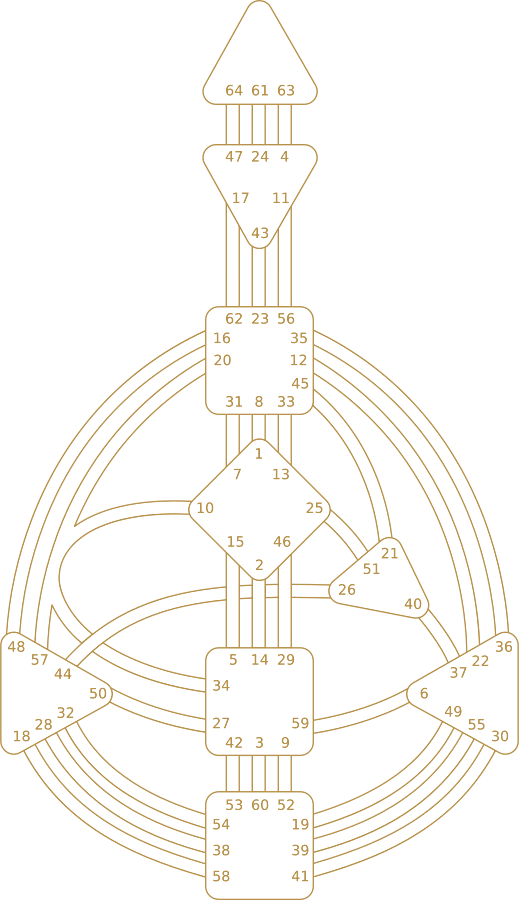
Your chart has nine centers. Some are defined, meaning they run on their own steady energy. The rest are open, meaning they do not.
An open center is not empty. It takes in whatever is around it and turns the volume up.
So if you have an open Solar Plexus and you sit next to someone anxious, you do not just notice their anxiety. You feel a version of it that is stronger than what they are feeling, and it shows up with no label saying where it came from.
An open center does not just receive. It amplifies. That is why what you pick up often feels more intense than the person you picked it up from.
The twenty minute test
This is the most useful thing on this page, and it costs nothing.
When you notice a strong feeling, check whether it survives twenty minutes of being somewhere else. Not distraction. Actual physical distance from whoever was nearby.
Feelings that fade were probably picked up. Feelings that stay are more likely yours.
Most people are surprised how much falls into the first group. Not everything, and the point is not to dismiss what you feel. The point is that you have been carrying things home that were never yours to carry, and putting them down is allowed.
Where this shows up in ordinary life
Open Spleen: hanging onto relationships, jobs and situations past the point they were good, because letting go feels unsafe rather than like a choice.
Open Heart: proving yourself. Over-promising. Taking on things to demonstrate you are worth something, then resenting the load.
Open G Center: reinventing yourself around whoever you are close to, and quietly wondering which version is real.
Open Throat: talking to be noticed, and afterwards feeling like you said too much.
Open Root: rushing. A constant sense of pressure to finish so the pressure will stop, which it never does, because it was never coming from inside you.
None of these are personality defects. They are what happens when an open center goes unnoticed for thirty years.
Three situations where this gets expensive
Open plan offices. If you have several open centers, eight hours in a room with forty people is not neutral. You are processing all of it. This is why some people are wrecked by 3pm in an office and completely fine doing the same work at a kitchen table, and why that difference gets misread as not being a team player.
Living with someone whose centers are defined where yours are open. You will consistently feel their version of that center and mistake it for your own. A person with an open Solar Plexus living with someone who has a defined one will spend years riding a wave that was never theirs. Nothing is wrong with either person. Nobody explained the mechanics.
Making decisions in groups. The room has an opinion before you do, and an open center will have picked it up before anyone speaks. Deciding anything important while surrounded by people is difficult for anyone. If you are open, it is close to impossible.
None of these mean you have to live alone in a field. They mean you should know what you are dealing with, and stop treating a predictable mechanical effect as a personal weakness.
So what does a boundary look like here
Not a rule about what people can ask of you. That is the other kind of boundary and it is a different tool.
This kind is quieter. Three things, roughly in order of how much they help.
Know which centers are open. That is one look at your chart, and it changes how you interpret your own reactions permanently. You stop asking why am I like this and start asking whose is this.
Build in the gap. Time alone is not indulgence if you have several open centers, it is how you work out what you actually think. The people who most need it are usually the ones who schedule it last.
Choose the rooms more carefully. If you amplify what is around you, then what is around you matters more for you than it does for most people. That is not being too sensitive. That is how it works.
You cannot stop an open center taking things in. You can get much better at noticing what got in.
The question people ask next
"So am I supposed to avoid everybody?"
No, and that reading gets things exactly backwards.
Open centers are how you connect. They are the part of you that meets other people rather than broadcasting at them. Someone with an open G Center can genuinely meet many different kinds of person, which is a real gift and not a defect.
The goal is not less contact. It is knowing which parts of what you feel came in through the door.
There is a difference between "I am an anxious person" and "I am in a room with three anxious people." The first is an identity and you will build a life around it. The second is a fact about Tuesday.
Most of the relief people describe when they learn this comes from that swap. Not from feeling less. From stopping the habit of taking everything they feel as a statement about who they are.
The part that takes years
Here is what makes open centers worth having rather than merely surviving.
A defined center experiences one thing consistently for a lifetime. An open center experiences everything, from everyone, over and over. Which means over decades you learn an unusual amount about how that thing works in people.
Someone with an open Solar Plexus has felt more emotional weather than someone with a defined one ever will. Once they can tell their own from everyone else's, that turns into real insight instead of noise.
That is the trade. Being open costs you clarity early and pays you wisdom late. Most people give up in the middle, because nobody told them it was a trade.
Start here
- Generate your free chart and see which centers are colored in and which are white
- Defined and undefined centers explained
- Deconditioning, which is the longer process this belongs to
- When your chart does not match your life
- Why the right decision still feels uncomfortable
- Understanding your BodyGraph
Frequently asked questions
What is an open center in Human Design?
An open or undefined center is one with no consistent energy of its own. It takes in and amplifies the energy of whoever is nearby. Open centers are where most conditioning happens, and also where a great deal of wisdom develops over time.
How do I tell my own feelings from what I picked up?
Notice what changes when you are alone. Feelings that fade within about twenty minutes of leaving a room were usually amplified from that room. Feelings that stay are more likely to be yours.
Are open centers a weakness?
No. Open centers take in more information than defined ones, which is why people with many open centers often read situations accurately. The difficulty is not the openness, it is mistaking what you are picking up for what you are.
Want to go deeper?
Your free chart shows which centers are open. It does not tell you what each one has been doing to you.
Get your personalized Human Design reading: 60+ sections written from your exact chart, all 27 workbooks, 40 meditations, a 24-lesson course, two recordings, a Self-Discovery Notebook, and Jessica, an AI guide who knows your design. Yours for life.
