

Where Confidence Actually Comes From in Your Chart
Where Confidence Actually Comes From in Your Chart
You can be good at something for fifteen years and still not feel entitled to say so.
The gap between what you can do and what you feel allowed to claim is where most people put a personal failing.
It is often mechanical.
The center that runs this
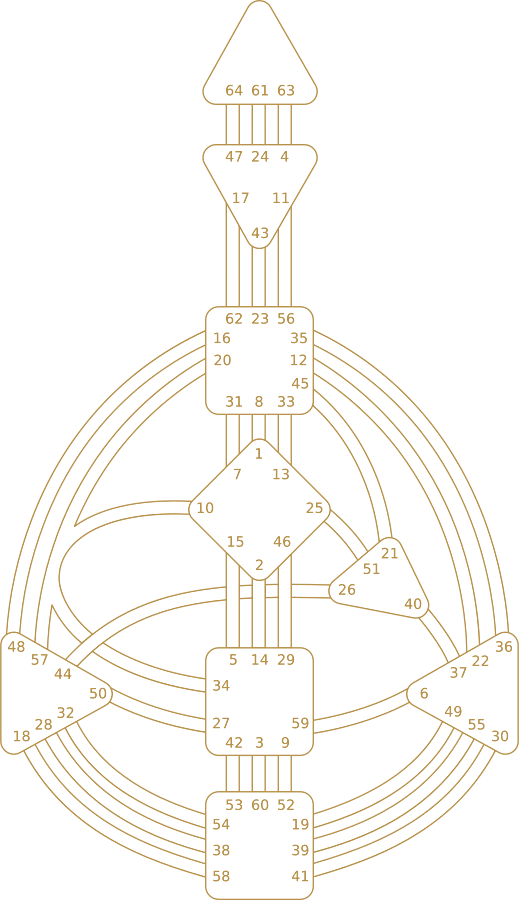
The Heart center, sometimes called the Ego or the Will center. Small, and defined in only about a third of charts, by Jovian Archive's statistics.
Defined, it gives you a steady inner sense of worth. You know what you are worth and it does not need topping up.
Open, and there is no steady reading of your own value coming from inside. So the center does what open centers do: it takes in whatever is nearby and amplifies it.
Which means what you think you are worth on a Tuesday is mostly a reading of the room, not of yourself.
Two thirds of people are working out what they are worth from whoever happens to be standing near them.
What that produces
Four patterns, and plenty of people with an open Heart will recognize at least two.
Proving. A running background project to show you are worth something. It never completes, because the proof does not pile up anywhere inside.
Over-promising. Saying yes to more than is sensible, because the moment of promising feels like worth. Then living with the promise.
Undercharging. Naming a price by reading the other person instead of the work. Covered in more detail alongside money and design.
Feeling like a fraud in the room and fine outside it. Because in the room you are amplifying someone else's certainty and measuring yourself against it.
Why the usual advice does not work
Affirmations, achievements, being told you are good.
All of it goes into a center with nothing to hold it. That is why the promotion changed nothing for two weeks, and why a compliment lands and then evaporates.
It is not that you are hard to reassure. It is that an open center is not a container.
That sounds bleak and mostly is not, because it drops the idea that enough proof will eventually fix it. That was never going to happen and now you can stop trying.
What does help
Three things, and none of them are confidence-building in the usual sense.
Know it is not a reading of you. The single strongest move. When you feel small in a meeting, the question is whose certainty you are standing in, not what is wrong with you.
Stop making promises in the moment. Open Heart plus Emotional Authority can be an over-promising combination. "Let me come back to you tomorrow" removes most of it.
Use evidence outside yourself. Since it will not stick inside, keep it outside. A note of what you actually delivered, referred to when the reading of the room goes low. Not motivational. Just facts you can check.
The defined Heart problem
Worth including, because the other third have their own version.
A defined Heart gives steady worth and a real relationship with willpower. It also produces someone who makes promises and then feels genuinely bound by them, sometimes past the point of sense.
They can also be hard on people with open Hearts without meaning to be, because "just decide what you are worth" sounds like advice and is closer to describing a limb the other person does not have.
Neither version is better. One knows and can be rigid. One reads the room and can be moved.
How this shows up at work
Three places, and they cost real money.
Negotiation. An open Heart in a room with someone certain will read their certainty as fact. That is how people accept the first number.
Reviews and feedback. Praise lands and evaporates within a week. Criticism sticks for months. Not because you are sensitive, because one of them matches the internal reading and one does not.
Volunteering. The hand goes up before you have checked whether you want the thing, because saying yes is momentarily a hit of worth.
What the defined Heart people miss
Worth saying, because the advice gap here causes real friction.
Someone with a defined Heart genuinely cannot feel what it is like to not have an internal reading of worth. So their advice is always some version of decide what you are worth, which is the same as telling someone to use a muscle they do not have.
They are not being unkind. They are describing their own equipment and assuming it is standard.
If that is you, the useful move is to stop giving that advice and start giving evidence instead. Specific, external, checkable. It is the only kind that lands.
An honest note
Not everything about self worth is a chart.
If what you are carrying is heavier than an open center accounts for, if it does not lift and it shapes most of your decisions, that is worth taking to a therapist rather than a chart. Human Design describes a mechanism. It is not treatment and it is not a substitute for it.
The narrow claim is the useful one. Some of what you have read as a personal failing is a center doing exactly what open centers do.
Where to go from here
- Generate your free chart and check your Heart center
- Read about the Heart center
- Defined and undefined centers
- Why money feels different depending on your design
- Boundaries for open centers
Frequently asked questions
Which center governs self worth in Human Design?
The Heart center, sometimes called the Ego. It is defined in about a third of charts, by Jovian Archive's statistics. When it is open, a person has no consistent internal sense of their own worth and takes that reading from whoever is nearby.
Why do I keep trying to prove myself?
An open Heart center amplifies the worth signals around it, which often produces over-promising and a habit of proving. It is a mechanical pattern rather than a character flaw, and naming it usually reduces it.
Does a defined Heart center mean more confidence?
It means a consistent sense of worth rather than a higher one. People with a defined Heart make promises and feel bound to deliver them, which brings its own difficulties. Neither configuration is better.
Want to go deeper?
Your free chart shows whether the Heart is defined. What it has been doing to your decisions is the part a reading covers.
Get your personalized Human Design reading: 60+ sections written from your exact chart, all 27 workbooks, 40 meditations, a 24-lesson course, two recordings, a Self-Discovery Notebook, and Jessica, an AI guide who knows your design. Yours for life.