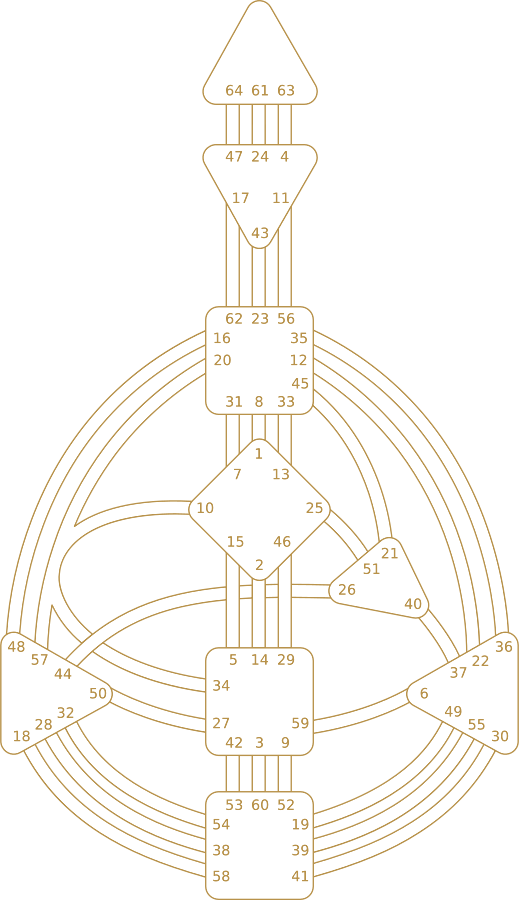

Dominance Connection in Human Design
A dominance connection in Human Design forms when one person has a Channel defined and the other has no Gate of it at all. The person with the Channel conditions the other in a steady, one-way way that neither can change. It is usually irritating rather than serious.
Simple way to think about it: A radio playing in the next room. One person has it on, and the other hears it through the wall. You cannot turn it off from your side, and after a while you either stop noticing or learn to work around it.
Find your dominance connections
Enter both birth details to see every Channel the two of you make together.
Put both charts into the Compatibility Calculator and look for Channels that are colored in on one chart where the other chart has neither Gate. Each of those is a dominance connection, and the person whose chart is colored in is the one doing the conditioning. A pair can have several, running in either direction.
How a dominance connection forms
A Channel joins two Gates. A dominance connection is the case where one person has the Channel defined and the other has no Gate of it at all. If you have Channel 19-49 Synthesis defined, with Gate 19 in the Root and Gate 49 in the Solar Plexus, and the other person has neither Gate 19 nor Gate 49, that Channel is a dominance connection and you are the one who has it.
Dominance is checked third of the four. The reading first rules out companionship, where you both have the Channel, and compromise, where the second person has one of its Gates. If one person has the whole Channel and the other has no part of it, what is left is dominance. This is why the connection can feel one-sided without anyone doing anything wrong. The Channel is simply on one side of the relationship, and it is felt on the other.
There is no meeting point in that Channel. One chart has it and the other does not touch it. The result is a steady influence that runs in one direction only, and it does not change because either of you wants it to. It works the same way between friends, family and colleagues. The mechanics only look at the two sets of Gates, so the kind of relationship does not change what the connection is.
How the conditioning works
The person who has the Channel defined is consistent in that area. The other person has nothing of it in their own chart, so they are open to it and take it in. Over time the open person tends to feel the first person's way of doing that Channel as a steady presence, not as something chosen on a given day. Think of the Centers the Channel joins. For the person who has it, those two Centers are defined and move together in a reliable way. For the person who has neither Gate, the same Centers may be open or may be defined by other Channels, and this Channel adds nothing of its own.
The person with the Channel is simply living their own design. They are simply being themselves. The second person may notice a lot, which is why the canon describes this connection as usually irritating rather than serious. People often find it helps to look at what the Channel is actually about. Each Channel has a name, such as Synthesis or Openness, and the name points to the kind of energy the other person carries in that area.
Going along with it or fighting it
The Jovian Archive dictionary puts the choice simply. Going along with the conditioning teaches both people about their differences, and fighting it keeps the friction alive. Neither person can change the Channel, so the useful move is to understand it instead of trying to remove it. That is the difference between this and a pull. Nothing in the second chart calls to the Channel, so there is no charge. There is only the steady presence of one person's way of working.
Going along does not mean giving in on everything. It means seeing the Channel as a fact about the other person, the way you would see their height or their accent. Once it is named, it often loses the feeling of being personal. Paying attention to when the irritation shows up can help you match it to a Channel.
The four connections compared
Partnership Analysis reads every Channel between two charts in the same order: companionship first, then compromise, then dominance, then electromagnetic. Each Channel falls into at most one of the four.
| Connection | How it forms in a Channel |
|---|---|
| Companionship | Both people have the same Channel defined. |
| Compromise | One person has the Channel defined and the other has only one of its Gates. |
| Dominance | One person has the Channel defined and the other has no Gate of it at all. |
| Electromagnetic | Each person has one Gate of the Channel and neither has the whole Channel; together they complete it. |
Living a dominance connection
With a partner
With a partner, a dominance Channel is often a small recurring annoyance: the way one person always handles one particular thing. Naming the Channel helps you stop reading it as a message about you. The person who has it can help by knowing that their steady way is felt more strongly than they intend. It is also worth asking the person with the Channel what they notice. They may be surprised to hear that their steady habit is felt as pressure by the other.
In families and friendships
Between a parent and a child, or between siblings, a dominance Channel can mean one person's way of doing something becomes the default in the house. When it runs from parent to child, it is worth remembering that the child is open there and is taking in more than the parent may realize. Siblings can show the same pattern. One child's Channel may set the tone for another who is open there, which is not a problem to solve but a pattern to understand.
At work
At work, a dominance Channel often looks like one person setting the tone in an area while the other adapts. It can be useful when the tone is welcome. When it is not, naming the Channel gives both people a neutral way to talk about it. A manager and a team member can form this connection too. Knowing it is a Channel and not a character trait keeps the conversation practical.
Decide with your own Type and inner Authority, not by trying to match the other person's Channel. Your Strategy and Authority still make your decisions; the connection describes the field you make them in.
When dominance connections are misread
"Dominance means one person is in charge"
"Dominance is a serious problem"
"The conditioned person has to change"
The other connections
FAQ: Dominance Connection in Human Design
What is a dominance connection in Human Design?
It forms when one person has a Channel defined and the other has no Gate of it at all. The first person conditions the second in a steady, one-way way that neither can change.
How do I find my dominance connections?
Put both charts into the Compatibility Calculator. Any Channel defined on one chart where the other chart has neither of its Gates is a dominance connection, and the person with the Channel is the one who conditions.
Is a dominance connection a bad sign?
No. The Jovian Archive dictionary describes it as usually irritating rather than serious. It is a one-way influence you can learn from, and naming the Channel can make it easier to live with. Seeing it as a fact about a Channel, not about you, is usually where the relief begins.
Can dominance happen in Channel 12-22?
Yes. Any Channel can. If one person has Channel 12-22 Openness defined, with Gate 12 in the Throat and Gate 22 in the Solar Plexus, and the other has neither Gate, it is a dominance connection. Gate 12 is Caution and Gate 22 is Openness in the canon.
What is the difference between dominance and compromise?
In both, one person has the whole Channel. In dominance the other person has no Gate of it. In compromise the other person has one of its Gates, which is why compromise is the harder of the two.
Can the conditioning run both ways?
Not in the same Channel. In a dominance Channel only one person has it. But a pair can have several dominance Channels, and in one the first person may be the one conditioning while in another it is the other person.