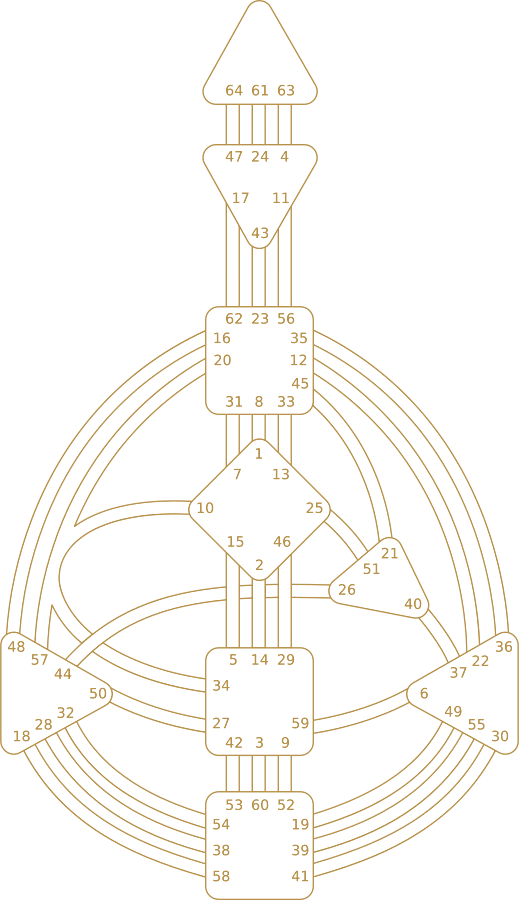

Companionship Connection in Human Design
A companionship connection in Human Design forms when both people have the same Channel defined. Each of you already carries the whole Channel, so the two of you share the same ground. It tends to feel easy and safe, and it is uncommon, because people tend to be drawn to what they do not carry themselves.
Simple way to think about it: Two people who grew up in the same town. You do not have to explain the corner store or the old bridge, because you both already know them. Nothing is hidden, and nothing is new either.
Find your companionship connections
Enter both birth details to see every Channel the two of you make together.
Put both charts into the Compatibility Calculator and look for Channels that are colored in on each chart before the two are combined. A Channel that both of you have defined is a companionship connection. Because it is uncommon, a pair may have only one, or none at all.
How a companionship connection forms
A Channel joins two Gates. A companionship connection is the case where both people have the same Channel defined. If you have Channel 12-22 Openness defined, with Gate 12 in the Throat and Gate 22 in the Solar Plexus, and the other person has that same Channel defined too, it is a companionship connection.
Companionship is checked first of the four. Before the reading asks whether one person has only part of a Channel, or none of it, it asks a simpler question: do you both already have the whole thing? If the answer is yes, that Channel is companionship and nothing else. Think of it as the simplest of the four. There is no gap to close, no half to match and no one-way influence. Both charts show the same colored line between the same two Centers, and that is all the reading needs to see.
Nothing is completed between you, because nothing is missing. Both of you run the same Channel in the same way, so the field you make together is one you each already know from the inside. You can have this with a friend, a parent, a child or a colleague as well as with a partner. The mechanics only look at the Gates, so the type of relationship does not change what the connection is.
Why it feels easy and safe
When you both carry a Channel, neither of you has to adjust to a stranger's way of working in that area. You each move through it in a similar way, so there is little to translate. The Jovian Archive dictionary describes this as shared ground, and that is how it tends to feel: familiar, steady and low in surprise. This is also why the Channel can feel like home ground when the rest of the relationship is new. The Gates it joins, and the two Centers they sit in, are defined for both of you, so the energy between those Centers moves in a way you each recognize.
That ease can show up as comfort in small things. You may finish each other's thoughts about a topic, or sit through a long silence without it meaning anything. The Channel is a place where the two of you do not have to prove or explain yourselves. If every Channel you share were companionship, the relationship could feel flat. The canon calls it uncommon, so where it appears it is one thread among the others, and it does not carry the story alone.
What shared ground does not give you
Because both of you have the same Channel, neither of you brings the other something new in that area. Nobody is pulled toward what the other carries, since you carry it together. It can feel quiet next to the other three, and the canon's reason it is uncommon fits: people tend to be drawn to what they do not carry. It is worth pausing on what that gives you. In an area where you are alike, you can rely on each other to understand the pace, the mood and the way of getting things done without having to ask.
Quiet is not a flaw. It simply means the growth in the relationship comes from other places: the Channels where you differ, the Centers one of you leaves open, and your own Strategy and Authority. Companionship is the steady floor under those, not the whole house. A useful way to hold it is this: companionship tells you where you are the same, and the other three connections tell you where you differ. You need both pictures to understand how the two of you actually fit.
The four connections compared
Partnership Analysis reads every Channel between two charts in the same order: companionship first, then compromise, then dominance, then electromagnetic. Each Channel falls into at most one of the four.
| Connection | How it forms in a Channel |
|---|---|
| Companionship | Both people have the same Channel defined. |
| Compromise | One person has the Channel defined and the other has only one of its Gates. |
| Dominance | One person has the Channel defined and the other has no Gate of it at all. |
| Electromagnetic | Each person has one Gate of the Channel and neither has the whole Channel; together they complete it. |
Living a companionship connection
With a partner
With a partner, a companionship Channel is a place to rest. When the rest of the relationship is full of difference, this is the area where you simply understand each other. It is worth noticing which Channel it is, so you can go there on purpose when things feel hard. Use it as a shared language. When a conversation gets difficult in some other area, coming back to the Channel you both have can remind you that you are on the same side.
In families and friendships
Between a parent and a child, or between siblings, a companionship Channel can be the thing that makes one particular area feel natural. The risk is to assume the child shares your way of seeing everything, when the sameness only covers the Channel you both have. Siblings with a shared Channel can have a private understanding in that area. Parents and children can enjoy it, as long as the child's differences in other Channels are given the same attention.
At work
At work, two people who share a Channel can understand each other in that area without a long briefing. The same sameness means neither of you covers what the other lacks, so it helps to bring in someone whose chart differs where the work needs it. A shared Channel can make a team feel united around one kind of task, so it is worth asking who else is needed for the parts the two of you do not cover.
Decide with your own Type and inner Authority, not because a shared Channel feels comfortable. Your Strategy and Authority still make your decisions; the connection describes the field you make them in.
When companionship connections are misread
"Companionship means we are soulmates"
"Companionship means we will never clash"
"No companionship means the relationship is weak"
The other connections
FAQ: Companionship Connection in Human Design
What is a companionship connection in Human Design?
It forms when both people have the same Channel defined. Each person already carries the whole Channel, so the two share the same ground. It tends to feel easy and safe, and it is uncommon.
How do I find my companionship connections?
Put both charts into the Compatibility Calculator. Any Channel that is defined on both charts is a companionship connection between you. If no Channel is defined on both, you have none.
Why is a companionship connection uncommon?
The canon gives the reason: people tend to be drawn to what they do not carry themselves. Sharing a whole Channel is the exception, and the ground it makes is shared ground. Uncommon does not mean better or worse.
Can companionship happen in Channel 37-40?
Yes. Any Channel can. If both people have Channel 37-40 Community defined, with Gate 37 in the Solar Plexus and Gate 40 in the Heart, it is a companionship connection between them.
What is the difference between companionship and dominance?
In companionship both people have the whole Channel defined. In dominance only one person has it and the other has no Gate of that Channel at all, so the first person's Channel conditions the second.
Does a companionship connection mean two people are compatible?
Not by itself. It tells you one Channel is shared and feels easy. Compatibility also depends on the other three connections, the Center count and each person's Strategy and Authority. Read all four together before deciding what the pair means.