
Compromise Connection in Human Design
A compromise connection in Human Design forms when one person has a Channel defined and the other has only one of its Gates. It is the hardest of the four connections, and it is fixed by the mechanics: in that Channel the person with one Gate either follows the other's lead or the two keep clashing.
Simple way to think about it: Two people carrying a couch up a staircase. One knows the route and is already moving. The other has only half the picture. Either the second person follows the first, or both stop and argue at every turn.
Find your compromise connections
Enter both birth details to see every Channel the two of you make together.
Put both charts into the Compatibility Calculator and look for Channels that are colored in on one chart where the other chart has exactly one of its two Gates. Each of those is a compromise connection. The person with the whole Channel is the one whose lead is in question.
How a compromise connection forms
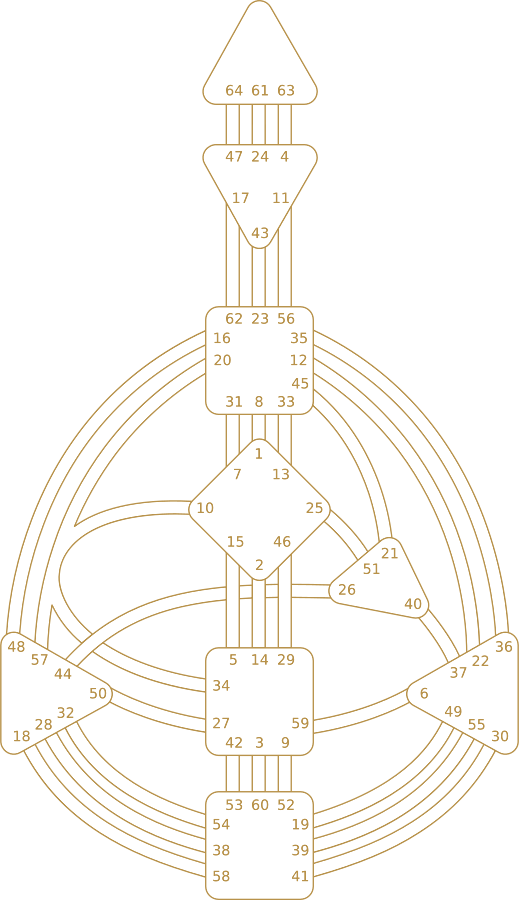
A Channel joins two Gates. A compromise connection is the case where one person has the Channel defined and the other has only one of its Gates. If you have Channel 16-48 The Wavelength defined, with Gate 16 in the Throat and Gate 48 in the Spleen, and the other person has only Gate 48 in the Spleen, that Channel is a compromise connection.
Compromise is checked second of the four, right after companionship. If both people have the whole Channel, that is companionship. If only one does and the other has a single Gate of it, the Channel is a compromise connection. This is why it is placed between companionship and dominance. It is not the full sharing of companionship, and it is not the complete absence of dominance. It sits in a middle spot that has its own tension.
What makes it different is that the second person is partly inside the Channel. They already carry one Gate, so they have a stake in it, but not the whole thing. The first person's complete Channel and the second person's single Gate are working on the same ground in two different ways. Like the other three, it can appear in any kind of relationship. The mechanics look only at the Gates, so a friend, a parent or a colleague can form a compromise Channel just as a partner can.
Why it is the hardest of the four
In a dominance connection the second person has nothing in the Channel, so there is nothing to argue with. In a compromise connection they have half of it. That half wants to act, and the other person's whole Channel is already acting. The result is a built-in tug in one area of life. To make it concrete, picture the two Centers the Channel joins. The first person has both Gates, so the Channel is defined and runs between those Centers. The second person has one Gate, a hanging Gate that on its own does not define the Channel.
The canon calls compromise the hardest of the four and fixed by the mechanics. It is a fact about how the two charts fit in that Channel, and that is why a good will on both sides does not make it disappear. Neither outcome is wrong. Following can be a relief, since the tug is gone. Clashing, once it is named, can show both people where the Channel sits in their life. The trouble comes when the pattern repeats without anyone naming it.
Following the lead or clashing
The mechanics give two outcomes. The person with one Gate can follow the other's lead in that Channel, which settles the tug but asks them to set their own Gate aside there. Or the two keep clashing, because each of them is acting from a different part of the same Channel. That partial activation matters. It means the second person feels a pull toward the Channel's full expression, but cannot complete it alone. The first person already has it complete, and that completeness meets the second person's half.
It helps to decide ahead of time which area the Channel covers and who will lead in it. A short, plain agreement made when things are calm is often easier than a debate made in the middle of the clash. The Channel will still be there, but the two of you will have named it. A helpful question to ask is: whose area is this? If you can answer it together, the Channel becomes a shared agreement instead of a recurring fight.
The four connections compared
Partnership Analysis reads every Channel between two charts in the same order: companionship first, then compromise, then dominance, then electromagnetic. Each Channel falls into at most one of the four.
| Connection | How it forms in a Channel |
|---|---|
| Companionship | Both people have the same Channel defined. |
| Compromise | One person has the Channel defined and the other has only one of its Gates. |
| Dominance | One person has the Channel defined and the other has no Gate of it at all. |
| Electromagnetic | Each person has one Gate of the Channel and neither has the whole Channel; together they complete it. |
Living a compromise connection
With a partner
With a partner, a compromise Channel can show up as the same argument in different clothes. The topic changes but the shape stays the same. Once you see which Channel is behind it, you can stop treating each round as a new problem and start treating it as one known pattern. One honest conversation about who leads in that area can do more than months of small corrections.
In families and friendships
Between a parent and a child, or between siblings, a compromise Channel can look like a power struggle over one particular area. When the parent has the whole Channel, the child's single Gate may feel pushed aside, and it helps to leave that child real room in the area. Siblings can show the same pattern over a shared room, toy or routine, and the same advice applies: name who leads in that area.
At work
At work, a compromise Channel can show up as two people who both care about the same part of the job and keep colliding over how to do it. Agreeing who leads in that area, and when it will change, saves a lot of friction. Written roles, or a plain agreement about who decides in that part of the work, tend to be the simplest way to hold it.
Decide with your own Type and inner Authority, not by giving way or pushing back out of habit. Your Strategy and Authority still make your decisions; the connection describes the field you make them in.
When compromise connections are misread
"Compromise means we have to give things up"
"Compromise means the relationship will fail"
"We can fix it by trying harder"
The other connections
FAQ: Compromise Connection in Human Design
What is a compromise connection in Human Design?
It forms when one person has a Channel defined and the other has only one of its Gates. It is the hardest of the four connections and is fixed by the mechanics of how the two charts fit.
How do I find my compromise connections?
Put both charts into the Compatibility Calculator. Any Channel defined on one chart where the other chart has exactly one of its two Gates is a compromise connection between you.
Why is compromise the hardest connection?
The canon describes it as fixed by the mechanics. In that Channel they either follow the other person's lead or the two keep clashing. The first person has the full Channel while the second has half, which is a different fit from having none.
Can compromise happen in Channel 20-34?
Yes. Any Channel can. If one person has Channel 20-34 Charisma defined, with Gate 20 in the Throat and Gate 34 in the Sacral, and the other has only Gate 34, it is a compromise connection.
What is the difference between compromise and companionship?
In companionship both people have the whole Channel defined. In compromise only one does, and the other has just one of its Gates. Companionship is checked first and compromise second.
Can a compromise connection be resolved?
The mechanics stay the same, so the Channel itself does not change. What changes is how you handle it: naming the pattern, deciding who leads in that area, and leaving the other person room. The tug itself is built into how the two charts meet in that Channel.