
What Happens Energetically When Two Charts Meet
Your open centers meet their defined ones. What chemistry actually is in Human Design, the four ways charts connect, and why breakups land hard.
On this page
There are people you are funnier around. People who make you decisive. People who leave you talking too much and slightly embarrassed about it afterwards.
Most explanations put that down to comfort, or history, or how much you like them.
Human Design has a more mechanical answer, and it is one of the more testable parts of the system.
Your chart does not change. What you experience does.
Start with the basic move.
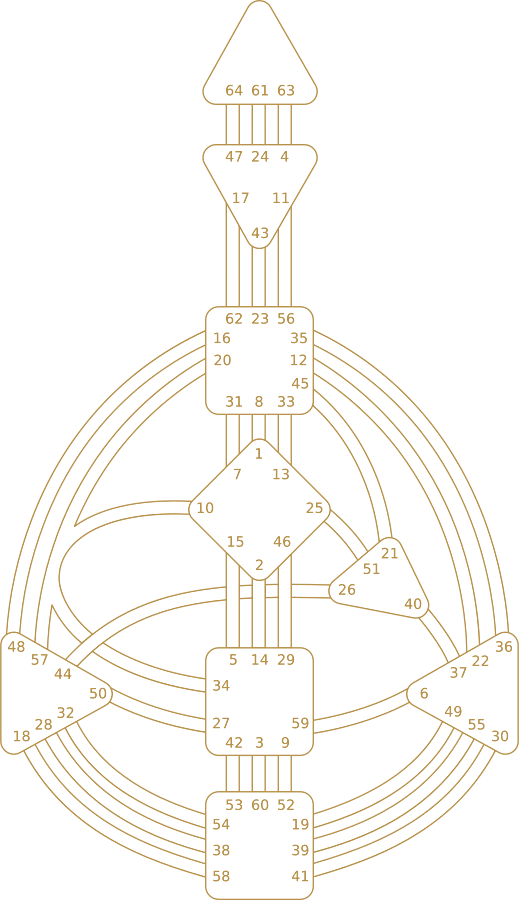
Your centers are either defined, running on their own consistent energy, or open, taking in whatever is nearby.
Stand next to someone and their defined centers reach your open ones. For as long as you are together, you have access to something you do not normally carry.
That is not a metaphor about vibes. It is the same mechanism that makes a room full of anxious people feel anxious, scaled down to two.
You are not imagining that you are different around certain people. You are running on partly borrowed energy.
The bit that produces chemistry
Now the more specific one.
A channel is made of two gates. You might carry one of them and not the other, which means the channel sits unfinished in your chart. A hanging gate.
Meet someone carrying the gate you are missing, and the channel completes. Between the two of you, something exists that neither of you has alone.
People describe that as clicking. As feeling like you have known them for years. As not being able to explain why this particular person.
It is called an electromagnetic connection, and it is the closest thing the system has to an explanation for instant attraction.
Worth knowing: it says nothing about whether the relationship will be good. Only that something switches on.
Four ways two charts meet
For any given channel, there are only a few possibilities, and each one feels different from the inside.
Electromagnetic. You have one gate, they have the other. Strong pull, and a sense of completion. Also the one most likely to be missed when they leave, because the channel goes back to being unfinished.
Companionship. You both have the same full channel. Easy, familiar, low friction. Sometimes so low that neither of you grows much.
Dominance. One of you has the whole channel, the other has neither gate. The one with it sets the tone in that area and often does not notice.
Compromise. One has the full channel, the other has one gate. Usually the friction point, because the person with the single gate keeps almost getting there and cannot quite.
Most relationships contain several of these at once, in different areas. That is why a person can be effortless about one thing and maddening about another.
Why this explains the crash after a breakup
Something people report and rarely have language for.
If a partner has been defining several of your open centers for two years, then leaves, you do not just lose them. You lose consistent access to energy you had started treating as your own.
The flatness afterwards is not only grief. Part of it is a genuine change in what you have available on a Tuesday.
That is worth knowing in advance, because people take it as proof the relationship was uniquely irreplaceable when some of it is mechanical and will settle.
Some of what you miss is them. Some of it is a center that has gone quiet again.
What this is not
Two cautions, because this is the part of Human Design most likely to get misused.
There is no compatibility score. The system describes how two charts interact. It does not rank pairings, and no combination predicts whether two people can build something. Plenty of low-friction pairings are dull and plenty of high-friction ones last decades.
And it is not a reason to leave anyone. "Our charts have a lot of compromise" describes a dynamic to understand, not a verdict. Using a chart to justify a decision you had already made is a misuse of it.
Something you can actually test
This is the part that makes the idea worth having rather than just interesting.
Think of three people you spend real time with. For each one, write down what you are like around them. Not how you feel about them. What you are like.
More decisive or less. More talkative or quieter. More certain or more scattered.
Then check your chart. The differences tend to line up with which of your centers are open, and once you have seen that once it is difficult to unsee.
Where to go from here
- Generate your free chart
- Read about hanging gates, which is where electromagnetic connections come from
- Compare two charts
- Why you keep attracting the same kind of person
- Living with someone whose chart is nothing like yours
Frequently asked questions
What happens to your chart when you are with another person?
Their defined centers and channels temporarily affect your open ones. You do not change chart, but you experience energy you do not normally have, which is why people often feel noticeably different around certain individuals.
What is an electromagnetic connection in Human Design?
It describes what happens when one person has one gate of a channel and the other person has its pair. Together they complete a channel neither has alone, which usually produces strong attraction and a sense of something switching on.
Why do I feel like a different person around some people?
Open centers take in and amplify the energy around them. Someone who has those centers defined supplies that energy consistently, so the version of you that shows up genuinely is different while you are together.
Want to go deeper?
A free chart shows your own centers and channels. What happens between two specific charts takes both, side by side.
Get your personalized Human Design reading: 60+ sections written from your exact chart, all 27 workbooks, 40 meditations, a 24-lesson course, two recordings, a Self-Discovery Notebook, and Jessica, an AI guide who knows your design. Yours for life.
